
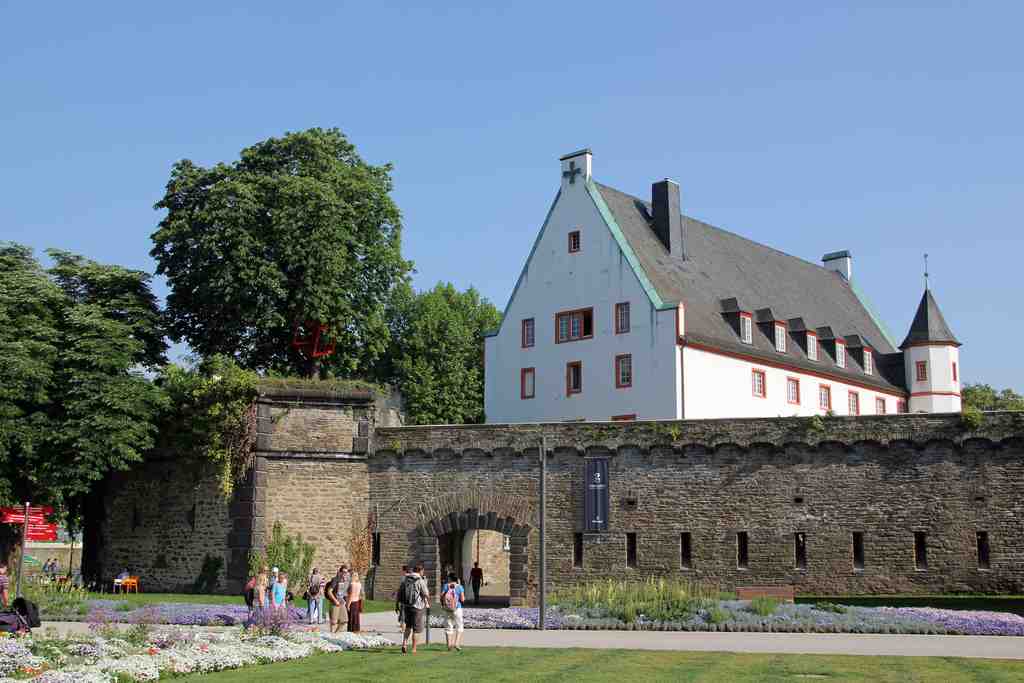
To spot the Teutonic Order Commandery, look straight ahead for a striking white building with steep gabled roofs and red-trimmed windows behind an old stone wall-right beside lush gardens and a flower-lined path.
Now, take in the view-here stands the Teutonic Order Commandery of Koblenz, where knights once traded silver spurs for garden shears… well, almost! Imagine it’s the year 1216. Knights in white cloaks with bold black crosses stride through this very ground, the air thick with excitement and a hint of mystery. The mighty Moselle and Rhine rivers crash together nearby, and on this prized spot, the very first Teutonic stronghold in the Rhineland rises from the muddy earth.
Called here by Archbishop Theoderich of Wied, the knights quickly became local legends-not for their swordplay, but for their care of the sick at St. Nicholas Hospital, which they moved close to the old Kastor Church. The city’s leaders liked the idea; after all, it turned out knights who can also fix a fever were pretty valuable during the Middle Ages.
Before long, the Teutonic Commandery was Koblenz’s power player. Fancy this: by the mid-1200s, the knights had expanded so much, they were getting deeds for villages and land all the way out in Frücht. Their headquarters, often called “Deutscher Ordt” or “Deutsches Eck,” became so famous that when the Kaiser Wilhelm I statue was built in 1897, the very name “Deutsches Eck” moved with it. It’s like the area had a case of identity crisis!
By the 15th century, the Koblenz Commandery was a big deal, being one of just four “chambers” directly under the Teutonic Grand Master himself. Some say the Koblenz commander had so much land-in far-off places like Elsen and Waldbreitbach-that he even got a say in the Holy Roman Empire. It must have been nice to attend all those imperial meetings-imagine the size of the scrolls and the complaints about the catering!
Of course, history is never simple. Fast forward to 1794: French troops marched into Koblenz, and the old order was toppled. By 1809, the knights were out, the property landed in private hands, and almost overnight these storied halls became a grain magazine. Walls were knocked down, new timber creaked under sacks of wheat, and parts of the church even vanished-except for a single wall, still clinging to its fancy stone vaults.
As the world spun into the 20th century, the building served as the Prussian State Archive-imagine rows of dusty documents and librarians who probably dreamed of armor and sword fights instead of paper cuts. Then, in World War II, bombs fell on Koblenz. The flames consumed almost everything, leaving shattered stone and charred beams. But from the ashes, the “Rheinbau,” the building before you, was rebuilt with care in the 1950s, preserving its steep roof, shield gables, and quirky turret for a new chapter.
Today, this place isn’t home to knights, scribes, or secret meetings, but the Ludwig Museum-a treasure trove of French modern art. Step inside and you might find yourself face to face (or thumb to thumb) with the giant “Thumb” sculpture by César or lost in a piece about memory and forgetting. Outside in the Blumenhof-the same garden where knights grew herbs-you’ll find modern artworks instead of medieval carrots.
And one last bit of magic: the Commandery is part of the UNESCO World Heritage Site of the Upper Middle Rhine Valley. Underneath this calm garden, builders have stumbled on knightly ruins even in the 21st century. Who knows? Maybe a lost sword or secret document still waits beneath the flowers, keeping the old mysteries alive, right at the confluence of the Rhine and Moselle.
If you're keen on discovering more about the buildings, coming of the kammerballei koblenz or the commander of the kammerballei koblenz, head down to the chat section and engage with me.




