
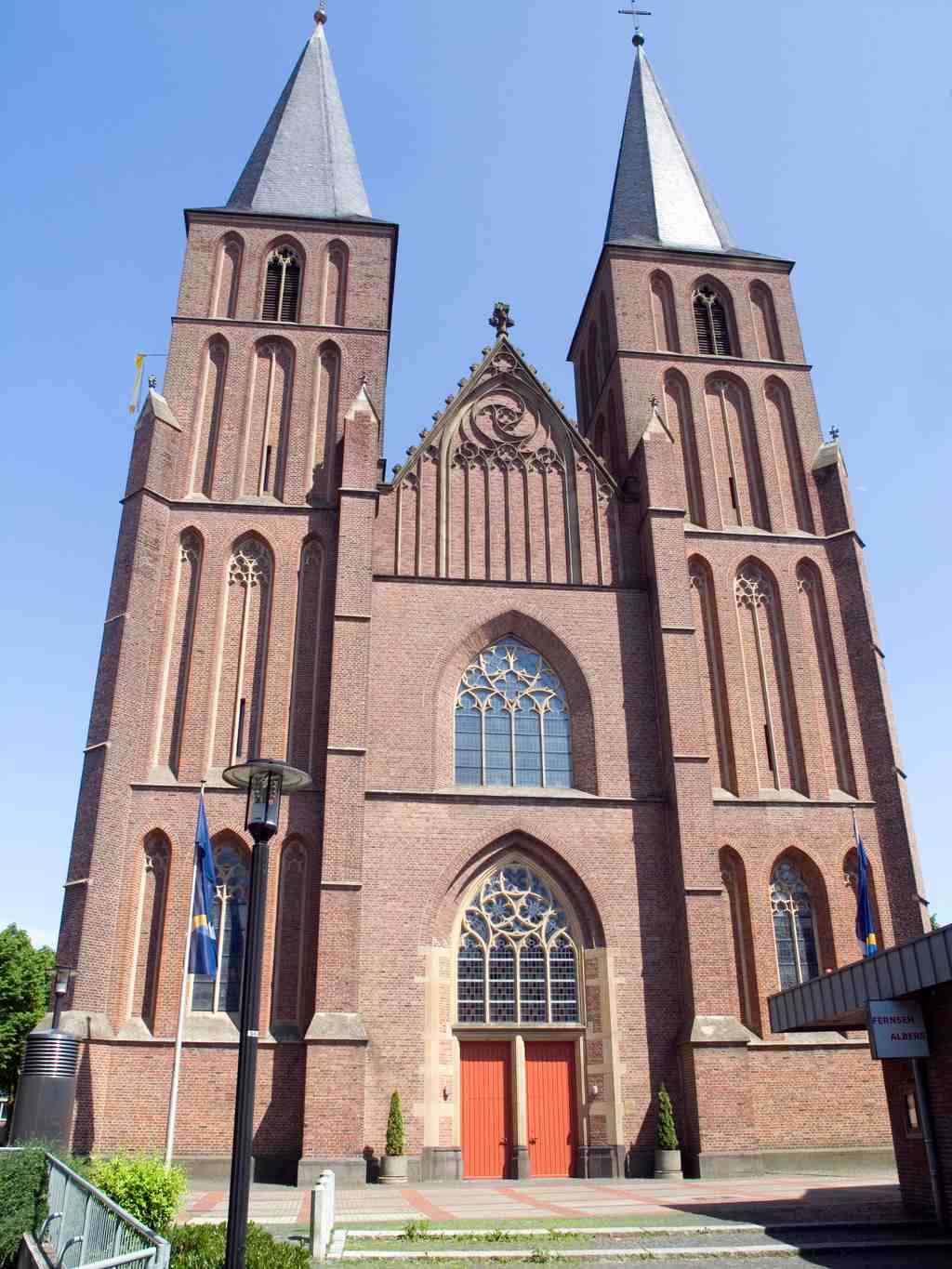
To spot the Collegiate Church of Kleve, look ahead for an enormous red-brick Gothic church with two tall, pointed towers like rocket ships aiming for the clouds-the big red doors and intricate arched windows make it stand out like a castle from a fairy tale.
Now, take a breath and picture yourself back in the Middle Ages, the air buzzing with the sound of hammers and chisels, and the smell of fresh-cut stone. You’re standing before the St. Mariä Himmelfahrt Collegiate Church, a place where history, faith, and a little architectural stubbornness have collided for over 850 years. The first church in these parts was mentioned way back in 1170, sitting outside the medieval defenses of Kleve’s castle. Imagine: in 1242, as Kleve became an official city, a new “branch” church popped up inside the walls, soon sharing space with a minorite convent-a sort of holy roommate situation.
The real drama kicked off in 1341, when Count Dietrich IX decided it was time for a major upgrade. He’d already founded a Marienstift on his Monterberg castle, but why stop there? He moved his entire canon foundation right here to Kleve, laying the first stone of this very Gothic church. Construction moved so quickly (for medieval times, anyway) that by 1347, the count himself was buried in the choir, with monks and masons still clinking away overhead. By 1394, the nave was finished, and in 1426, the twin towers you see today stretched skyward-so if you’re feeling tiny, that’s by design.
But Kleve’s church wasn’t just a house of worship; it was the heart of a powerful canon foundation, supporting princely officials, ringing out with a mighty collection of bells. The church grew in importance, becoming a Catholic stronghold, a provost’s seat in 1967, and later, the main parish for a united Kleve in 2005. Of course, history with its quirks-Napoleon’s secularization in 1802 shut the original canon community down. And between you, me, and the church mouse, this place has seen more than its share of drama. During World War II, almost everything was reduced to rubble except a bit of luck and stubborn ambition-by 1956, the church’s main body was restored, and by 1969, the historic towers were back too, like nothing ever happened.
Step closer, and you’ll spot the windows-these are masterpieces created over fifty years, with famous artists like Dieter Hartmann and Ursula Lünenborg leaving their mark, casting radiant colors on the church floors whenever the sun is bold enough to sneak through. But the real magic? Listen. Inside, there’s a mighty organ built by Rieger, with enough pipes and special registers (Celesta! Glockenspiel! Cymbelstern!) to sound like a little orchestra wrestling with angels. Sometimes, you’ll even hear a soaring carillon of 23 bells-added over the years thanks to some very generous townsfolk-ringing out from the north tower, especially at 11:46, 15:46, and 18:31.
Did I mention two ancient bells from 1404 still ring out daily, their tone calling to generations past and present alike? It’s a living, chiming, singing heart of Kleve. So as you stand here, take a moment and feel the centuries humming through the brick, glass, and song. By the way, if you hear music swell or bells play a tune-don’t worry, it’s just the church showing off!


