

Look to your right, and you will spot a strict, geometric complex featuring a U-shaped main building, a striking semi-circular rotunda, and a towering five-meter-high concrete security wall. Your app features a photo of how this imposing modern fortress looks lit up at night.
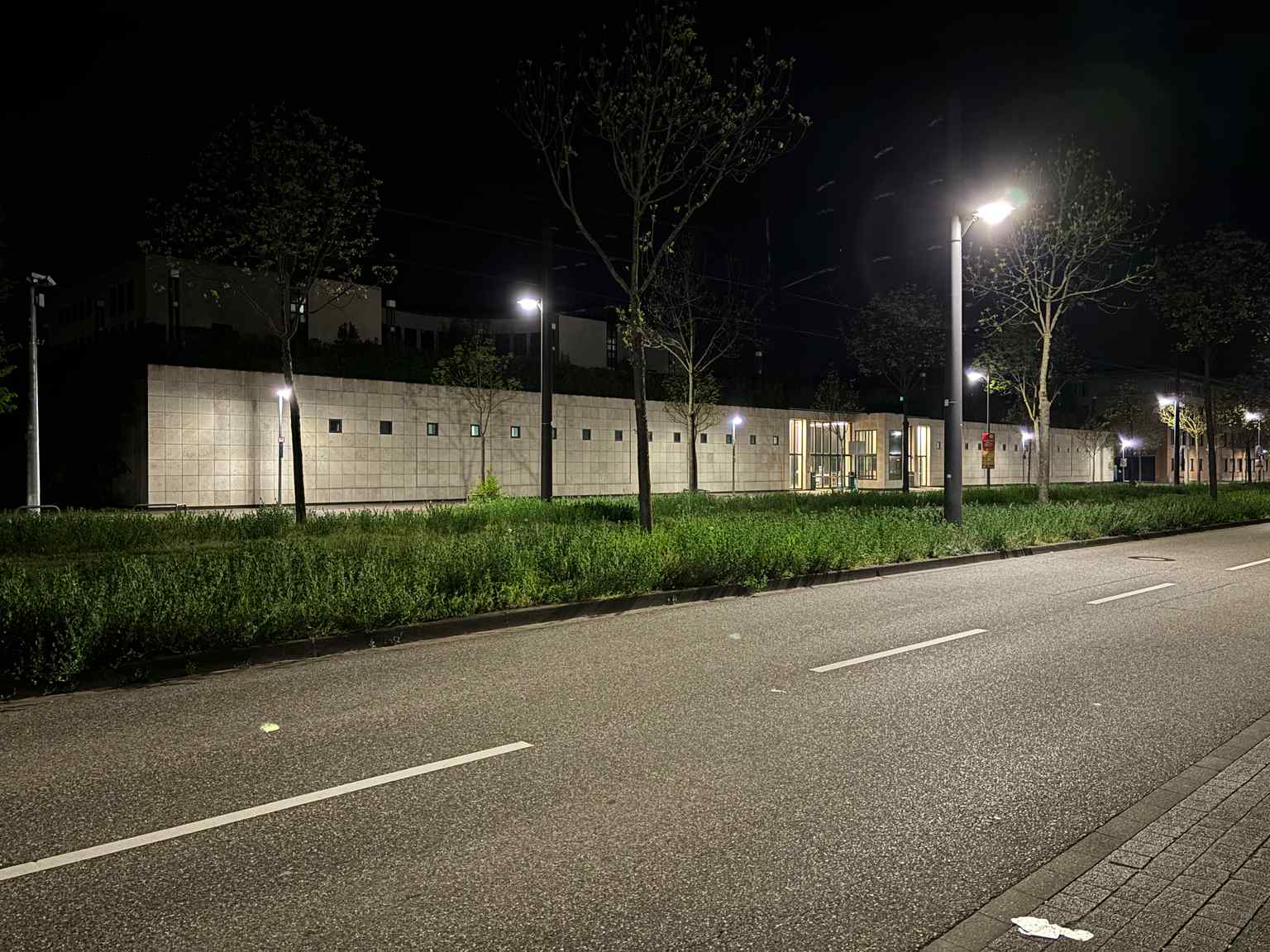
This is the Federal Prosecutor General at the Federal Court of Justice. Put simply, this is Germany's state security hub. It serves as the absolute nerve center for federal justice, handling the nation's most critical cases of terrorism, espionage, and crimes against international law.
The building itself was designed by architect Oswald Mathias Ungers as a modern urban palace, finished in 1998. But a palace ringed by a massive security wall hints at the heavy burden carried inside. The chief prosecutor here is what Germans call a political official. That means they do not just enforce the law in a vacuum... they belong to the executive branch and must share the security and criminal policy goals of the current government. They take direct instructions from the Federal Minister of Justice.
As you might guess, blending the pure pursuit of justice with the demands of politics can get a little rocky. Take 2015, for example. The prosecutor at the time, Harald Range, opened a treason investigation against journalists who had published confidential intelligence documents. The Justice Minister hit the brakes and tried to stop a key report in the case. Range publicly accused the ministry of meddling with the independence of the judiciary. The minister's response? He immediately fired Range and sent him into early retirement.
But there is a much heavier shadow hanging over the early days of this institution. When West Germany was building its democratic legal system after World War Two, the high-minded goals of a fresh start collided head-on with a severe lack of untainted lawyers. A recent study revealed that in the 1950s, about 75 percent of the senior staff here were former Nazi party members. By 1966, ten of the eleven main federal prosecutors had Nazi pasts.
The most glaring example was Wolfgang Fränkel. In March 1962, he was appointed to the absolute top job as Federal Prosecutor General. Just months later, it was revealed that during the Nazi era, he had personally pushed for death sentences for minor, petty offenses. He was quickly ousted... but a later disciplinary hearing somehow concluded he had secretly opposed the Nazis. Unbelievably, that ruling allowed him to collect a generous state pension until his death in 2010.
The risks tied to this office are terribly real. In 1977, the reigning Federal Prosecutor, Siegfried Buback, was assassinated by the Red Army Faction terrorist group while simply being driven to work here in Karlsruhe. That shocking murder kicked off the German Autumn, a severe national crisis that tested the very foundations of the republic.
We are going to leave the intense world of federal law and national security behind us now. It is time to look at a very different kind of influence born here in Karlsruhe. Let us head toward our next stop, about a three-minute walk away, where we will dive into the wild early days of digital pioneering and the birth of a major internet giant called Web.de.





