
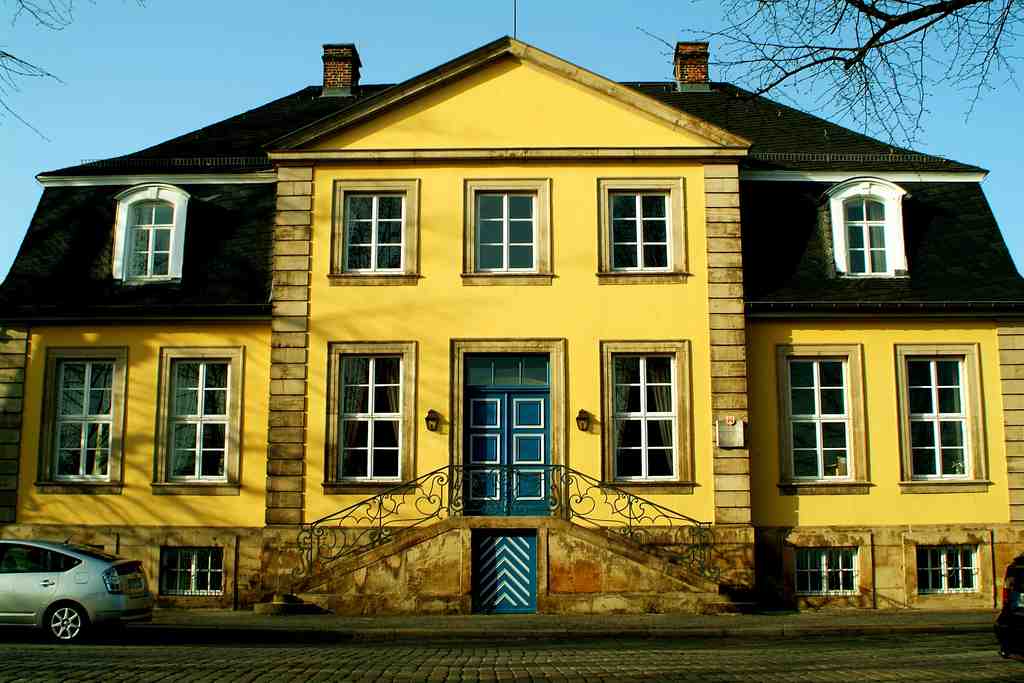
To spot Hardenberg’s House, look for a stately yellow villa with tall windows and a distinctive blue door, right ahead of you, set back a little from the street with an elegant twin staircase leading up to the entrance.
Welcome to Hardenberg’s House, where almost every stone seems to whisper with stories from centuries past! Imagine standing here in the mid-1700s, when this spot wasn’t yet graced by today’s grand villa but instead held the humbler home of a royal gardener. Then-sweep in the sound of chisels and hammers-between 1749 and 1751, the air filled with the rattle of construction as master architect Johann Paul Heumann transformed the site into an official residence fit for Friedrich Karl von Hardenberg, the man in charge of royal gardens and building projects. But Hardenberg wasn’t just seeking a fancy address; tucked inside were special winter rooms for plants too delicate for Hanover’s chilly winters-talk about living in a house where your neighbors are orange trees!
Over time, this stately home became a kind of VIP guesthouse for a wild variety of history’s headliners. Fast-forward to 1803: the crack of marching boots echoes down the street as French troops invade Hanover. Their leader, General Mortier, glances around and spots the perfect headquarters-this very house! One can only imagine him trying to decide: which room would he claim for war meetings, and where to put his boots without upsetting the tulips? Soon after, another Frenchman moves in, a certain Jean Baptiste Jules Bernadotte. He must have liked the digs-a year here, and he went on to become King of Sweden and Norway! Clearly, good things happen to those who hang around Hardenberg’s House.
Jump ahead half a century, past royal intrigue and big historical upsets-by 1866, after the Battle of Langensalza erased the Kingdom of Hanover, the proud Welf family needed a new home for their private museum. What better place than here, among the grand hallways and echoing staircases?
But Hardenberg’s House wasn’t done changing hats. During the Nazi era, the city took it over and arranged for the registry office to move in, meaning people said “I do” within these grand rooms-a far cry from secret intrigues and generals’ plans! The gardens got trimmed a bit to widen the street outside, and they even changed the street name, perhaps just to confuse the mailman. After the war, it became a home for exiles from Hannover’s partner city, Glogau, and was lived in by various noted personalities-at one point the artist Kurt Lehmann called these walls home, hosting legendary guests such as Martin Buber and Alexander Calder.
After a massive renovation at the dawn of the new millennium, Hardenberg’s House opened its doors for celebrations, conferences, and-now-curious wanderers like you. There’s even a library on garden art, so the plants finally got their revenge and took center stage. Step back, and imagine all the laughter, the urgent footsteps, the whispered conversations. And remember: if these yellow walls could talk, they’d probably ask for a cup of tea-and a bit of peace after centuries of excitement! Ready for the next adventure?


