
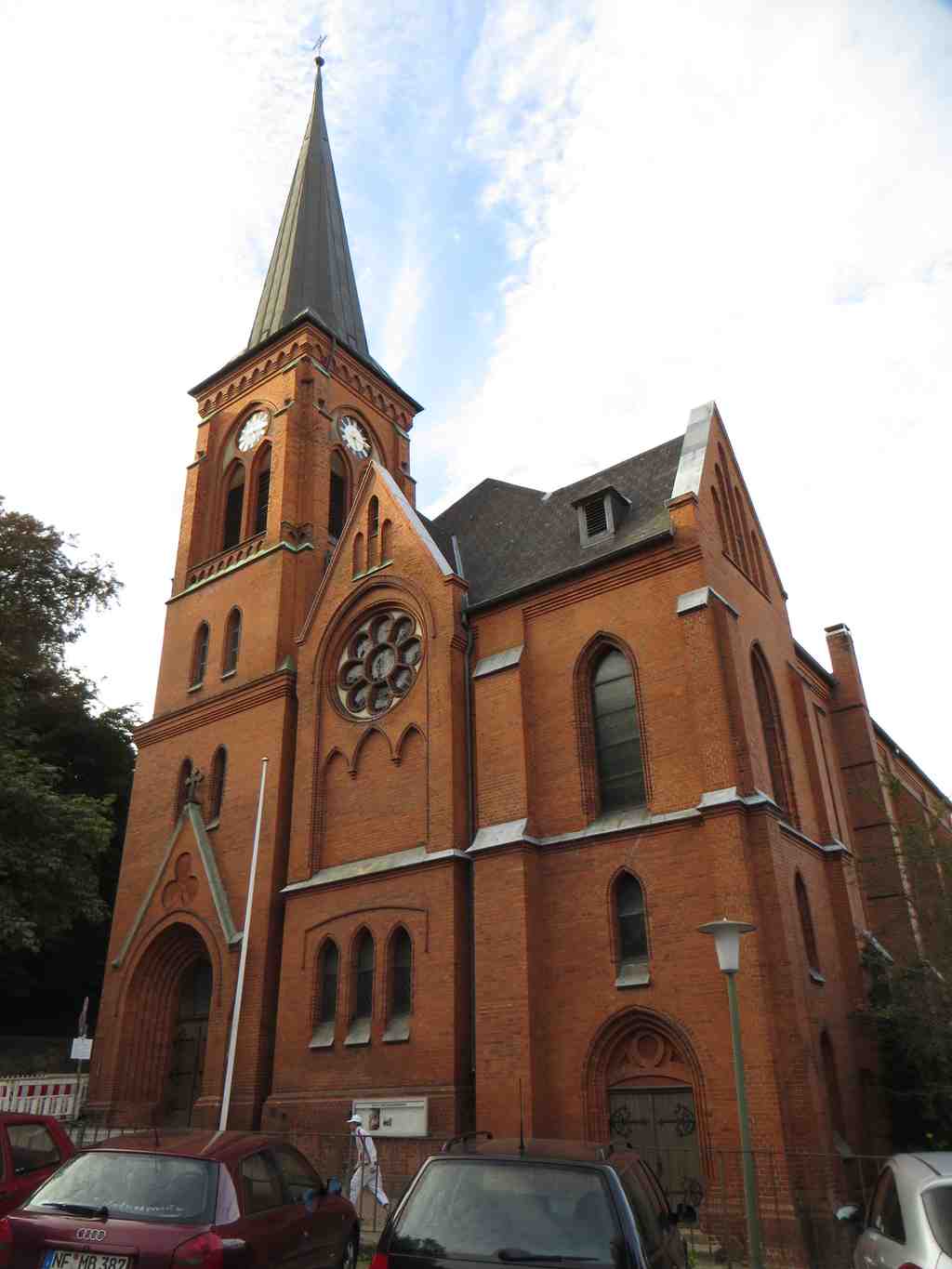
To spot St. Mary's Sorrowful Mother Church, look for the tall, pointed spire and bright red brick facade with arched windows and a round rose window on the front, just up on your left above the street.
Now, let’s imagine it’s a chilly evening around the turn of the 20th century, and the city is buzzing with anticipation-there’s a sense of hope in the air, mixed with the stubborn scent of clay and fresh-cut timber. Right in front of you stands the St. Mary's Sorrowful Mother, but getting from dream to reality wasn’t easy! You see, after the Reformation, Flensburg was staunchly Protestant and the Catholic community, for centuries, lived almost in the shadows. When Catholics finally began to gather here after the German-Danish War, imagine them squeezing into a tiny house on this very spot just to pray together. Picture it: There were so many of them by Christmas 1897 that half of the congregation had to shiver outside in the winter cold just to catch a few words of the service. I bet there were more cold feet than in a penguin parade that night!
But the community was determined. Letters were written-thousands of them, pleading for support. Coins were collected, and finally, in 1898, construction began. Here comes the plot twist: when they started digging, they discovered the city moat right beneath the ground-it was more mud and mush than anything else! Not exactly the best foundation for a church, but somehow, with grit and perhaps some divine luck, they managed. And so, in 1899, the cornerstone was laid, and by early 1900, the church was finally consecrated. But for a while there, instead of a grand spire, the tower only sported a rather unimpressive flat roof-talk about a church with a bad hair day! It wasn’t until 1909 that the impressive spire you see now pierced the Flensburg sky.
A walk around reveals even more fascinating details: the church’s sweeping red-brick walls and Neo-Gothic arches, its stained glass, and a spectacular rose window on the south side that glows with the morning sun. Step closer and imagine the inside: an airy hall with cross-ribbed vaults overhead, old wooden pews, and carvings of saints standing watch. The air smells faintly of polished wood and candle wax.
During World War II, life here was far from peaceful. Right next door was a school turned into an air defense training center, blocking the main entrance. In the postwar years, that building was demolished, bringing sunlight and space back to the churchyard-now replaced by a parking lot. The church didn’t just survive the tough times; it grew stronger, with renovations and celebrations marking each new chapter.
Today, this church anchors a thriving parish that stretches from Flensburg all the way to Kappeln, with lively services and a community that spans generations. The organ, by the way, is modern and mighty, built in 2001-so even if you’re musically inclined, you’d need two keyboards, lots of skill, and maybe ten fingers on each hand just to play it!
So, as you stand here outside, listen for a breeze, perhaps the faint echo of past hymns, and know you’re looking at a living chapter of Flensburg’s spirited story.




