
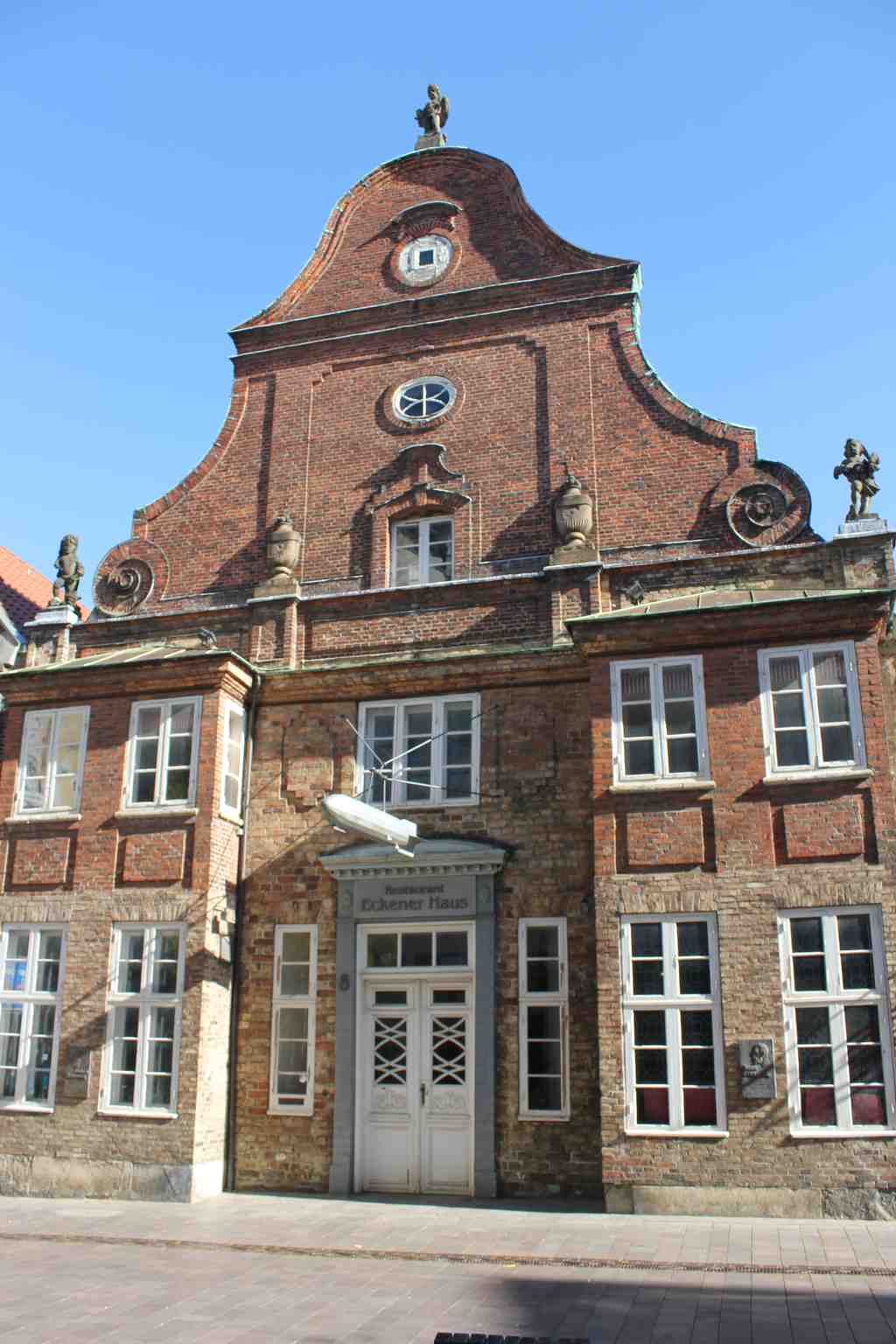
To spot the Eckener House, look for a striking, red-brick building with an ornate stepped gable and three small statues sitting on the roof-each one representing a different season-with decorative white-framed windows and a zeppelin-shaped sign above the door on Norderstraße.
You’re now standing before the grand old Eckener House, a place where Flensburg’s centuries swirl together like the perfect cup of spiced tea-you just might catch a whiff of history blending in with the salty Baltic air. Imagine this spot in the 16th century, when workers stacked brick upon brick, building these thick walls during misty autumn mornings. The house’s distinctive late Gothic gable stands proudly, but if you look closely at the two-storey façade, you’ll see it got an elegant Baroque makeover in the middle of the 1700s. On either side of the doorway are cozy little window alcoves-a sure sign of a local hotspot, even back then.
Now tilt your head skyward and spot the trio of funny little stone putti perched on the rooftop-the Winter, looking rather bundled up on your left, Autumn showing off in the center, and Summer basking on the right. Their journey is just as interesting as the house’s own. In the mid-1800s, they came waddling-okay, probably “carted”-over from a garden at Gottorf Castle. Every season has made itself at home on top of this house.
In 1867, while Prussia was forging new provinces and the streets of Flensburg buzzed with the sounds of industry and expansion, a Bremen merchant named Johann Christoph Eckener arrived here. He married the local cobbler’s daughter and opened up shop in this very building, selling cigars and spices-imagine the warm, peppery aroma swirling through the hallways. His children, Hugo and Alexander, were born upstairs; Hugo would one day soar to fame as a pioneer of airships. The house became known as the “birthplace” of greatness-and I’m not only talking about Hugo’s explosive first diaper.
Jump ahead to 1914, and the building gets a stylish renovation, transformed into a cultural monument and restaurant called “Old Flensburg House.” Local history buffs dined with antiques from nearby museums, surrounded by bits and pieces salvaged from other historical buildings of Flensburg. For decades, it was the city’s living room-a place for stories and a symbol on the local tourism logo.
Yet, fame couldn’t fix the leaky pipes or pay the rising heating bills, and by 2008, the restaurant had closed, leaving the building silent. Lately, people have talked about reviving the house as a museum that captures Flensburg’s more recent history, but plans keep changing-just like the weather. Even now, as it waits for a new purpose, the Eckener House stands stubbornly proud, its quirky statues watching over the street. With every brick and creak, it dares you to imagine what’s next.




