
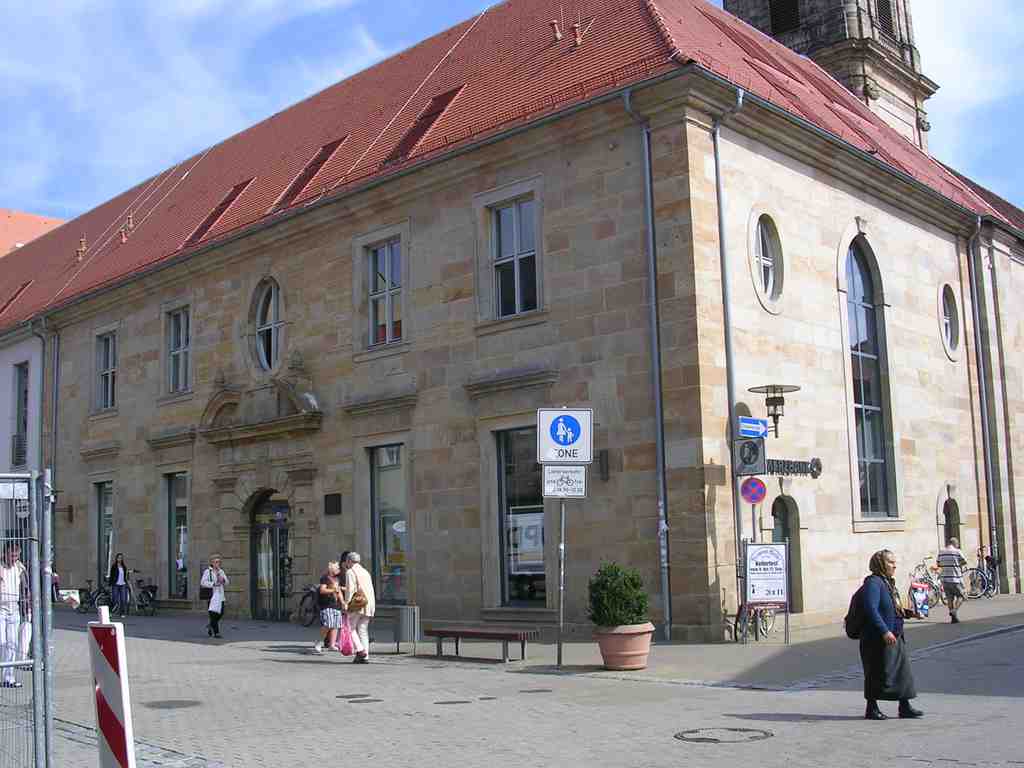
To spot St. Sophia’s Church, just look for the grand sandstone building with a red-tiled roof, oval and arched windows, and an ornate entrance right on the corner-its pale stone facade stands out against the nearby shops!
Now, let’s step into the world of St. Sophia’s Church-a place whose walls have probably heard more secrets than your favorite coffee shop! Standing here, close your eyes for a second and imagine the year is 1701. This spot is buzzing with excitement as Baron Christoph Adam Groß von Trockau lays the foundation for a special academy for young nobles, hoping to fill Erlangen’s streets with future knights rather than just, well, students late for class. At the southern tip of this grand academy, what you see before you rises: a church named in honor of Sophie Luise of Württemberg, wife of the powerful Margrave Christian Ernst.
Back in those days, the church’s Baroque facade was brand-new, gleaming with intricate details and a lofty, oval window above a majestic arched door-reminding everyone that, yes, holiness has style. But here’s the twist: what began as a private college chapel soon became a bustling parish church in 1703, filled with the hopes and hymns of a new Lutheran community. You can practically hear the echo of their first Sunday as the organ, installed in 1702, bursts into life.
The Sophienkirche had a knack for transformation. When the original knightly academy faded away-after its founder’s death and a bit of financial drama-the university took over and used these halls not just for worship, but for academic celebrations and even burials. Imagine professors in capes and robed students gathered for ceremonies where now the echoes have died away. Baron Groß von Trockau himself was laid to rest here, his legacy literally built into the foundations.
But wait, there’s more! The building didn’t just stop at religions and graduations. After some courtroom drama-yes, really-it became a courthouse and even a city jail complete with a “drunk tank.” That’s right-what had once rung with church bells sometimes held the slightly less angelic snores of those who’d had one too many.
In the end, even after most of the building was torn down for a department store, the city couldn’t forget the Sophienkirche’s story. Parts of its facade were carefully preserved and blended into modern shops and offices. So look around-it may appear more business than Baroque now, but take a closer glance and you’ll time-travel through centuries of church bells, school bells, and maybe even jailhouse rock!


