
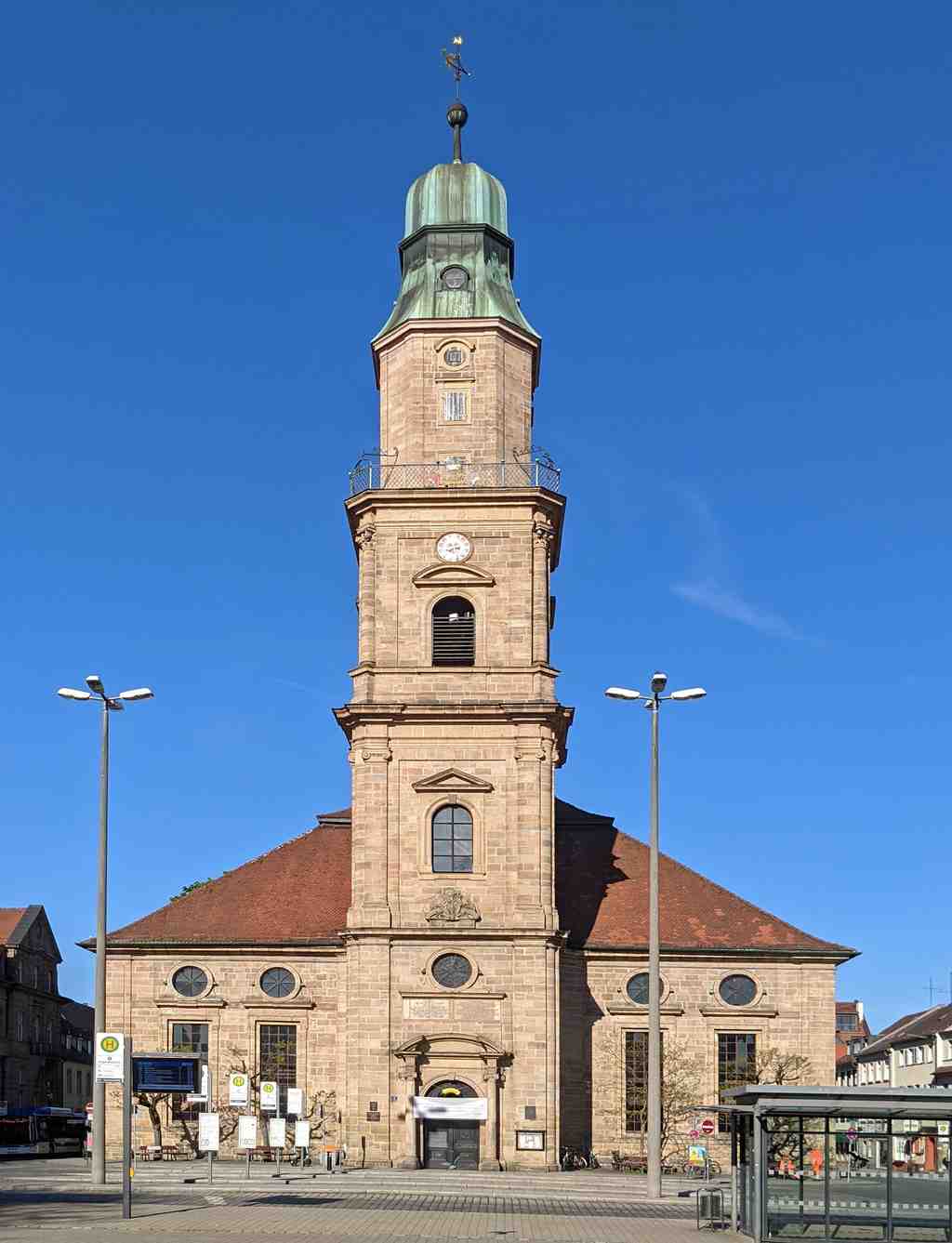
To spot the Huguenot Church, look for a grand rectangular building of sandy stone with a steep red-tiled roof and a tall, four-story tower topped by a greenish dome and a golden weather vane-it sits squarely at the heart of Hugenottenplatz, almost impossible to miss.
Welcome to the Huguenot Church, my friend! Imagine the year is 1686. The square where you’re standing is busy with the scraping of wagon wheels and the chatter of newcomers. But these aren’t just any newcomers-they’re Huguenots, Protestant refugees fleeing France with little but their faith and perhaps, if they were lucky, a well-traveled baguette. After King Louis XIV banned their religion in France, they poured across borders, and nearly 1,500 of them suddenly arrived right here, doubling Erlangen’s tiny population overnight. The locals, let’s say, weren’t thrilled at first-crowded houses, new flavors in the market, and an unexpected boost in fashion sense. But thanks to the local ruler, Markgraf Christian Ernst, these newcomers got more than a warm welcome. He built them an entirely new part of the city: the Erlanger Neustadt-and at its center, this impressive church.
Picture the area buzzing with construction. Soldiers lent their muscles, the Markgraf paid the bills, and just two months after the first refugees arrived, the foundation stone of this very church was set. The architect, Johann Moritz Richter, designed it as part of a gleaming baroque dream-a neat, gridded city with this simple yet imposing hall church at its core. The church’s layout is unique: longer from north to south than east to west. Its mighty hipped roof and large, light-catching windows marked it as a leading light, literally and figuratively, for Protestant faith in a new homeland.
But it wasn’t easy sailing. The congregation wondered if the church would be big enough, so the plans kept changing-expanding, stretching, trying to fit the hopes and numbers of its people. Finally, in 1693, the church was finished and dedicated. And what about that impressive tower in front of you? That came later, completed in 1736, funded in part by donations collected from far and wide. Ever adaptable, the congregation used all the resources they could-sometimes even using money meant for the poor to build higher! So, if the tower looks a little smug, that’s probably why.
Step closer, and you’ll notice inscriptions in Latin and those impressive smooth sandstone walls. The doors are on every side, with the grand entrance right under the tower. In those days, Huguenot services were held in French, keeping the old world alive until 1822, long after everyday life had switched to German. Even the church’s name has an identity crisis worthy of a soap opera! French-Reformed, then Huguenot, but only reluctantly-because the congregation has roots not just in France, but also Switzerland, the Netherlands, the Palatinate, and with the Waldensians.
Inside, things are refreshingly unadorned, as Calvinists frown on religious imagery-so no golden angels here, but twelve solid wooden columns holding up a simple vaulted ceiling, symbolizing the apostles. The celebrated organ, built by a student of the famous Silbermann, still thunders above the main entrance to this day. Three mighty bells chime from the tower-the oldest forged in 1702 and hauled from the foundry, spending World War II in a distant bell cemetery, only to return home victorious in 1947.
These days, the church is getting a top-to-bottom spruce-up, with modern amenities like a heat pump and rooms behind glass, but always with an eye on preserving the spirit of shelter, community, and faith that made it special hundreds of years ago. As you stand outside, imagine the first Huguenots glancing up at this very tower, hearts pounding with hope that maybe, just maybe, they had finally found a safe place to belong. Now, that’s a reason to ring a bell-or three!


