
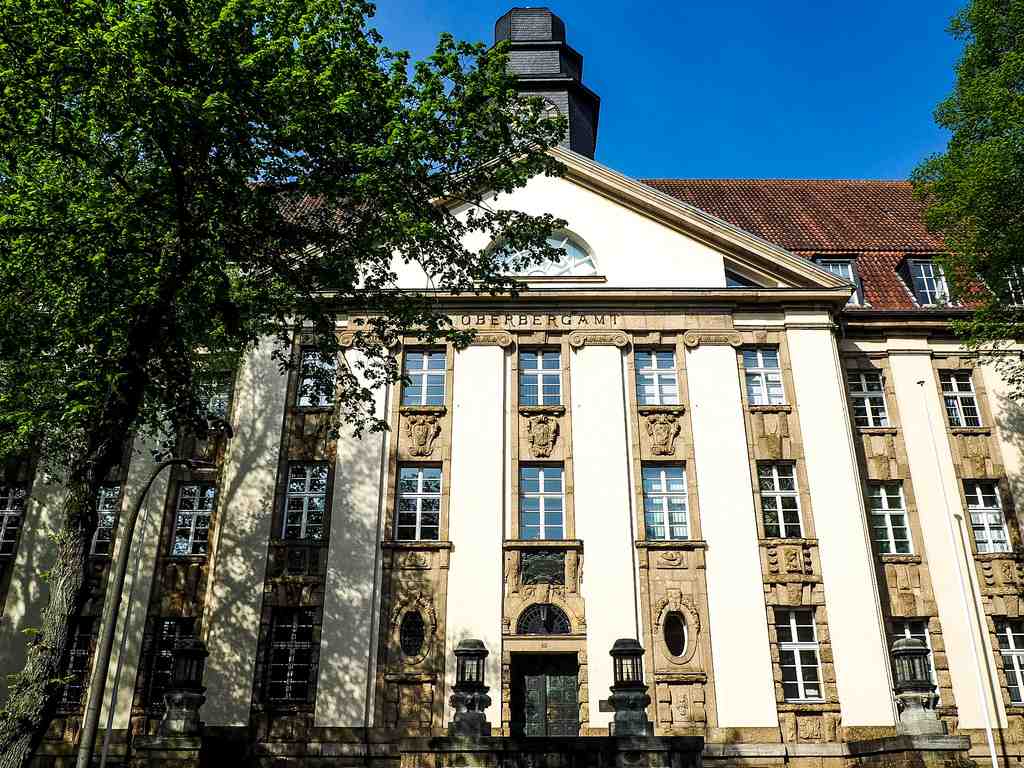
Take a look right in front of you: you’ll spot a grand, elegant three-story building with tall white columns, sandstone accents, and a slate-roofed clock tower peeking above the leafy trees-the words “Oberbergamt” proudly carved above its doors.
Now, let’s step back in time. Imagine the Ruhr area buzzing with the sound of steam engines, coal carts rattling down tracks, and a thick haze of smoke drifting above newly built factories-this was the Ruhrgebiet, booming with industrialization. But all these mines and machinery needed someone to keep order, and that’s where the State Mining Authority’s story kicks off.
Picture this: it’s the late 1700s. A clever, forward-thinking statesman named Freiherr vom Stein realizes the chaos of so many new mines could turn into a real disaster-like ordering a pizza with too many toppings, only with way more coal dust. He urges the Prussian government to put some officials in charge, and in 1792, the very first Oberbergamt opens in the little town of Wetter. Imagine miners, engineers, and mapmakers huddled around tables in an old castle-Burg Wetter-trying to make sense of maps and ledgers scribbled with the locations of every tunnel and shaft. These were the days of the legendary Niemeyer map-a kind of industrial treasure map created from 1787 to 1794, meant to capture the sprawling underground world.
But it didn’t take long for things to grow. The seat of the mining authority shifted-first to Essen, then to Bochum, and eventually, in 1815, to the lively heart of Dortmund. That first office, tucked in at the Alte Markt, quickly became too cramped as the industrial boom roared ahead and more mines popped up than mushrooms after a rainstorm.
So in 1875, a new home was built on Ostwall, designed by Gustav Knoblauch. But progress waits for no one! By 1910, another move was needed, and that brought us the majestic building in front of you. Picture government architect Fritz Behrendt and city official Rudolf Claren teaming up under the watchful eye of master planner Oskar Delius, sketching the plans for a building worthy of Dortmund’s mining empire. Look up at the elaborate stonework and the clock tower-imagine miners checking the time as they hurry to a meeting with a stern “Berghauptmann” (mining director) whose portrait might have glared at them from the walls inside.
This place has seen its share of drama. In World War II, it was badly battered, but unlike a stubborn old miner, the building simply dusted itself off and stood tall after the war, nearly unchanged. In its golden age, this authority didn’t just oversee mines in Dortmund-they watched over mining districts as far south as Oberhausen, Hattingen, Werden, and Witten. If these walls could talk, they’d tell tales of strict laws, heated debates, and maybe a few secret snacks tucked away during meetings.
And the parade of mighty “Berghauptleute”-with names like Toussaint von Charpentier and Guntram Polster-guided the region through wars, reforms, and wild times in the mines. By 1970, a merger with Bonn’s mining authority gave birth to the State Mining Authority of North Rhine-Westphalia, calling this building home.
Fast-forward to 2001, and the mining authority as it was officially closed. But the building didn’t lose its spirit. Today, it stands proudly preserved as a heritage site, part of the Industrial Heritage Trail-witness to Dortmund’s rise from muddy coalfields to industrial metropolis


