
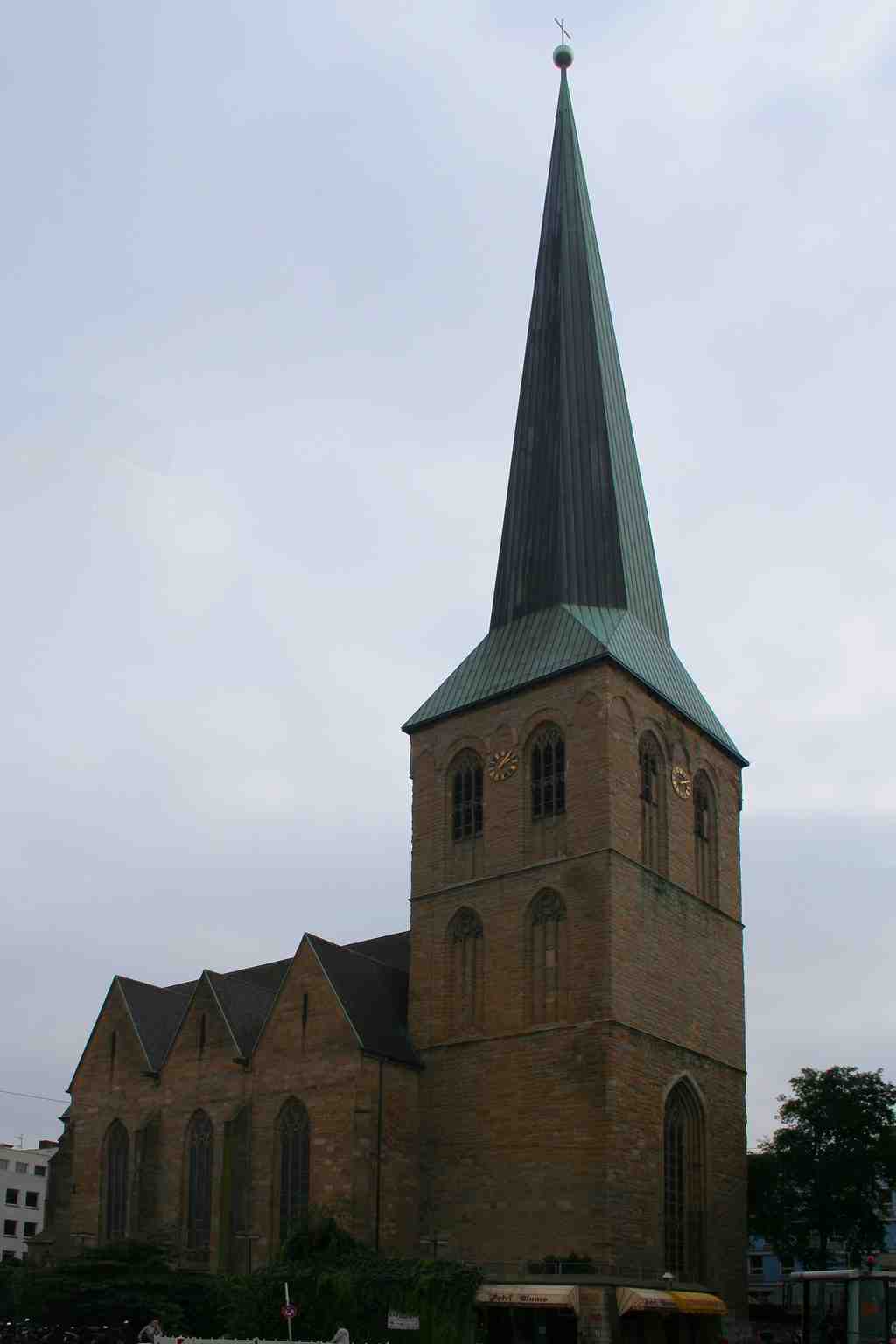
Right in front of you, you’ll see a striking sandstone church with a sharply pointed dark green spire that stretches dramatically skyward-just look for the tallest roof and a series of steep little gables running down both sides.
Welcome to the Petrikirche, where history stretches almost as high as its legendary spire. Picture yourself standing here in medieval Dortmund, with the sound of hammers and chisels echoing as builders lay the first stones in 1322. The church took shape over time, built from light Westphalian sandstone, and its tall central nave grew to match the lofty side aisles on either side-a true hall church, as open and airy inside as a cathedral, with sunlight slipping through stained glass and casting colored patches onto ancient floors.
But the real showstopper? Just tilt your head back-way back!-to admire that dizzyingly tall spire. It's not just impressive; it was born out of a medieval rivalry. Imagine the tension in the 15th and 16th centuries as the Petrikirche and nearby St. Reinold’s Church competed for the highest church tower in Dortmund. Was it a holy skyscraper race or just a bit of neighborly one-upmanship? Either way, the Petrikirche’s spire eventually soared to a historic 105 meters, almost as if reaching for the clouds themselves.
But even this mighty spire couldn’t avoid dramatic twists. In 1752, it collapsed-perhaps from age, perhaps from a stormy night that rattled its timbers. For more than two centuries, the church stood without its magnificent tip, the skyline forever changed. Only after World War II, in 1981, did craftsmen restore the spire to its full glory, shining once again over the city. Today, those 48 meters of slender pinnacle, topped with a world globe and cross, rival anything you’d find in a fantasy novel.
Now, step inside with your imagination and see what’s waiting beyond those thick walls-a treasure known as the “Golden Miracle of Westphalia.” It’s a late-Gothic altarpiece from Antwerp, crafted in 1521, that’s almost too dazzling to believe: closed, it shows serene scenes of worship, but open it up and you’ll find no fewer than 36 tiny, intricate paintings and 30 gold-leafed sculptures for festival days. The effect is like seeing a storybook burst open in a blaze of color and light.
Maybe you’re wondering about music, too. After the old organ was destroyed in the War, a beautiful replacement came in 2015: a reconstructed English romantic organ, built with more than 1,000 pipes standing tall inside a modern cube of pale birch wood. Listen closely! When it’s played, the whole space sings-a harmony of old and new.
Through centuries of storms and competition, destruction and renewal, Petrikirche has stood sentinel for Dortmund-stately, proud, and still full of secrets. So, next time you’re tempted by a little rivalry, just remember: in Dortmund, even the churches have played the game of “Who can reach the sky the fastest?”


