
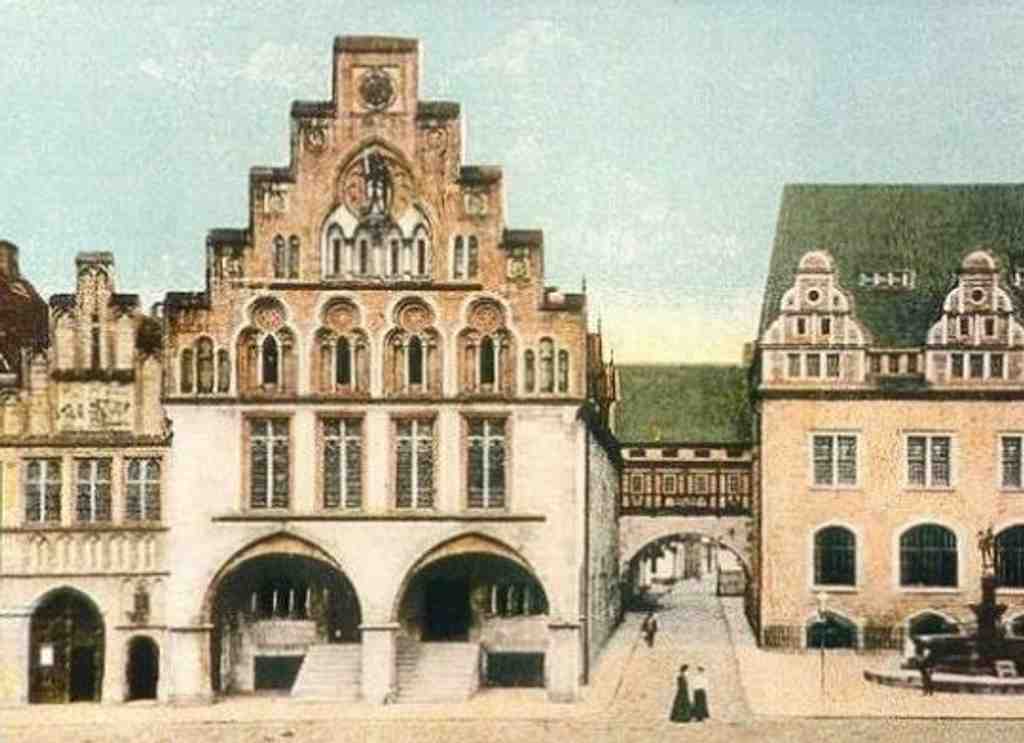
To spot the Old Town Hall of Dortmund, look for a tall, pale stone building just ahead of you, with a striking stepped gable and two large gothic arches at the bottom-almost like two eyes peering over the market square.
Alright, traveler, get ready to step through centuries-if you listen closely, the cobblestones practically whisper with secrets! Imagine it’s the year 1241. The Old Town Hall that once stood before you wasn’t just a building-oh no, it was the oldest stone town hall north of the Alps. City bigwigs in Dortmund must’ve strutted around like proud peacocks when they bought this Romanesque marvel, complete with upper and lower floors, right at the lively heart of the Old Market. The town scribe’s house-cheekily called the “Brothaus” though probably never full of bread-was snuggled right next door.
Picture the market buzzing with noisy merchants and the smell of fresh cloth and bread mixing with the din of voices, as the council held meetings upstairs and cloth traders bustled downstairs. The town judge pronounced verdicts from the tenth step of the stairs! Big decisions and small ones, from squabbles over wool to grand political verdicts, were dished out right here. And it wasn’t just business-a visit from Emperor Charles IV in 1378 turned the hall into a ballroom, where musicians played and Dortmund’s finest families danced, maybe even inventing the medieval version of the conga line.
And this wasn’t an ordinary house. The upper floor had a grand hall for city council meetings, while downstairs was alive with the color and bustle of wool traders. The halls echoed with deals, debates, and on occasion, a raucous celebration when a legal victory went someone’s way. Under its gothic arches was the Niedergericht, the lower court, where law and justice had such weight that any citizen from the whole region would respect the decision made on the tenth step. Imagine centuries of footsteps. The rulers shifted-from counts to city council-and even the old town judge doubled as a councillor!
As centuries rolled by, renovations shaped the Old Town Hall. In the 1300s, thick plumes of smoke would sometimes rise after great fires, leaving charred scars on the walls. Restoration after each blaze left new windows, strange nooks, and secret spaces for relics. By the 16th century, an archive tower grew on one side and a writing house on the other, all tied together like a medieval architectural sandwich.
Over time, the building saw more drama than a soap opera. Roofs caved in, gables were swapped-at one point featuring a grand baroque flourish. In old age, the place got a little shabby… A leaky roof, crumbling gables, and the slightly worrying tilt of a wall now and then. There were heated disputes about whether to save it, which nearly sparked a 19th-century “renovator’s rebellion!” One competition sought the best new design, another begged to save the old face of the hall.
Then, in the late 1800s, hope arrived: Friedrich Kullrich stepped in and lovingly restored the building to a vision inspired by its days of glory. With support from citizens and, yes, some very generous beer money from Joseph Cremer, the hall became a showpiece once again. The grand reopening in 1899 even brought Kaiser Wilhelm II to town. You could practically hear the fanfare!
But fate was not kind. World War II bombings smashed the hall terribly. After the war, despite its battered state, it was still faring better than some other buildings-yet city leaders decided to tear it down anyway. Its last walls were taken away under heavy police guard, as rumors swirled about treasure hiding in the archive tower (some people always believe there’s a secret hoard under old stones…). The rubble from this magnificent place-oh, the irony-helped rebuild St. Reinold’s Church.
And now, as you stand here, the only thing left is a humble brass plaque, quietly marking where centuries of city politics, dances, and decision-making once stood. If you listen hard, maybe you’ll catch the echo of a medieval judge calling out a verdict, or the mayor banging his fist on a very old desk. Imagine-right beneath your shoes, history is sleeping, waiting for someone (like you, perhaps) to tell its story all over again. And who knows? Local folks are still dreaming of seeing the Old Town Hall rise once more. Maybe, just maybe, you’ll one day visit its grand arches in real life, rather than in memory.
Now, are you ready to leave the echoes behind and head to our next stop?
Ready to delve deeper into the historical events, uses or the role model function? Join me in the chat section for an enriching discussion.




