
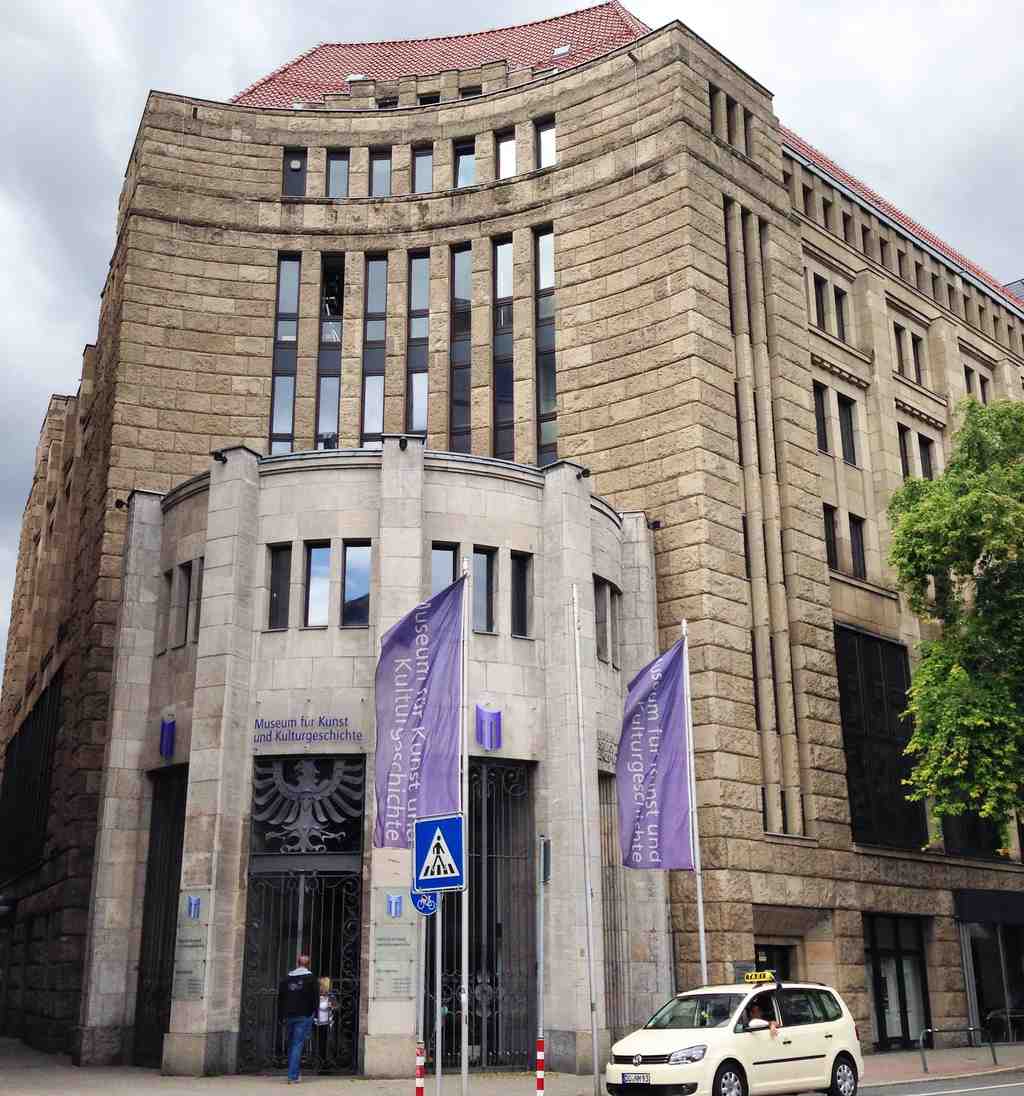
To spot the Museum of Art and Cultural History Dortmund, look for the massive, curved stone building with tall, narrow windows and a grand entryway marked by two purple flags-it stands prominently on the corner with a sturdy, fortress-like presence.
Alright, pause for a second and take in the sight before you: the Museum of Art and Cultural History Dortmund. It looks like a proud sentinel from another era, doesn’t it? Its bold stone walls and Art Deco curves once guarded money as the city’s Sparkasse, a bank built in 1924 by Hugo Steinbach. Now, instead of coins and cash, its vaults are bursting with treasures from Dortmund’s past-paintings, sculptures, peculiar old furniture, and objects that whisper stories from thousands of years ago.
Step inside in your mind for a moment. Imagine the echo of your footsteps bouncing off marble floors, mingling with the distant sound of laughter as school classes explore the wonders inside. This isn’t just a museum; it’s a time machine! Its oldest objects reach right back to the Stone Age. You’ll find yourself standing in front of ancient tools, each one chipped by hands long before Dortmund had a name. Then zoom forward-a cascade of centuries swept into one building-from shining medieval relics, once treasured in the city’s churches, to paintings thick with the drama of Romanticism, the faces and places of 19th-century Dortmund staring back at you.
But don’t be fooled into thinking history here is just about dusty old objects. Oh no! The museum itself has played a rollercoaster role in Dortmund’s life. Picture this: in 1883, the city’s leaders-nudged by a curious history buff named Eduard Roese-decided Dortmund needed a ‘collection point’ for whatever pieces of the past people could find. In true teacher fashion, the first director, Albert Baum (who also taught drawing on the side), filled the place with quirky finds, from archaeological oddities to household curiosities. Back then, the collection was a bit like a moving caravan-hopping from one building to another, including a spell in the freshly restored Old Town Hall. At times, it was so packed, the exhibits were squeezed into 70 separate rooms-imagine trying to find your way, like a treasure hunter through Dortmund’s attic!
As the decades rolled on, art got a starring role. Under the eye of art historian Rolf G. Fritz in the 1930s, gleaming paintings joined the ranks-especially those brooding, soul-stirring works from Germany’s Romantic period. But the museum’s ride wasn’t always smooth. In 1937, disaster struck like a clap of thunder: the Nazis swept through, seizing art they labeled ‘degenerate’, destroying countless masterpieces by brilliant artists-vanishing forever into the dark.
World War II brought more danger. The museum’s precious relics were hurried out of town, hidden away to escape the bombs raining down-saving Dortmund’s heritage by a hair’s breadth. When peace returned, the battered collections needed a new home. For a while, they hid within the grand rooms of Schloss Cappenberg near Lünen, sharing those echoing halls with rescued treasures from shattered Westphalian churches. Picture soft afternoon light falling on an altar from Marienkirche, carefully pieced together by museum hands.
Finally, in 1983, Dortmund’s cultural heart found its forever home in this former bank-an Art Deco beauty now protected as a monument. People cheered the way the museum mixed old and new: glittering works of fine art shown alongside humble crafts and historic oddities. And kids were invited, not just to watch, but to touch, learn, and imagine themselves as explorers.
What’s on display inside? Brace yourself. The ground floor whisks you back to Stone Age survival, while the first and second floors climb through medieval Dortmund and the elegance of the 1600s through the 1800s. You’ll stumble across a perfectly preserved 18th-century pharmacy (don’t taste the medicines!) and marvel at a Mercator globe from 1541-a relic from the days when the world itself was still being mapped.
And don’t forget: there’s even a permanent exhibition on geodetic tools-glimmering brass instruments that once measured and mapped out the world. If walls could talk, this old bank would tell you, “My vaults hold more riches now than ever-treasures for the mind and soul.”
You might catch a special exhibition, from magical Grimm’s fairy tales to the fiery beauty of centuries-old ceramic tiles. Or bump into a whole altar retable brought together after centuries apart, finally reunited for Dortmund to see. So, as you catch your breath, remember: this is more than a museum. It’s a living archive of epic tales, disasters averted, and hearts that never stopped seeking beauty-even when the world around was tumbling down.




