
To spot the Glockengasse Synagogue site, look for the Cologne Opera House ahead of you-this modern building stands where the grand Moorish Revival synagogue once welcomed visitors, and there’s a bronze plaque on its Offenbachplatz façade commemorating the lost landmark.
Now, imagine you’re stepping back in time-right where you’re standing was once one of the most remarkable buildings in all of Cologne. Picture a structure so dazzling, it almost made the Cologne Cathedral next door feel like it had to up its game! It all started in the mid-1800s, when this spot was anything but grand. Back then, it was the humble site of the Monastery of St. Clarissa. During the French occupation, people squeezed into a basic prayer hall here, so humble that by 1853 it had to close-apparently, wooden beams and a wobbly roof just can’t hold in big hopes and echoing prayers!
Enter Abraham Oppenheim, bursting with generosity, and frankly, a sense of architectural drama. In 1856, after much debate-where to build, what to build, how fabulous to build it-Oppenheim declared, “Let’s do it here, and let’s do it right!” He even footed the bill, determined to gift the Jewish community a synagogue that was as worthy as the spirits within it. The result? Ernst Friedrich Zwirner, a name you might recognize from the Cologne Cathedral, stepped up with a design straight out of an Arabian Nights storybook.
When construction began, the usual clatter of hammers and shouts of builders filled the air. By 1861, a breathtaking vision stood before the city: A vast building shaped like a Greek cross, crowned by a sparkling dome that soared 40 meters above the street. The outside was an enchanting mix of styles-four minaret-like towers, each topped with delicate onion domes, framed the tall façade. The entry was grand, and above the entrance blazed a rose window, a pop of Gothic flavor set against the building’s Moorish swirls. Just imagine how the copper domes would capture the afternoon sun, glowing with a soft green sheen after weathering and age had worked their magic.
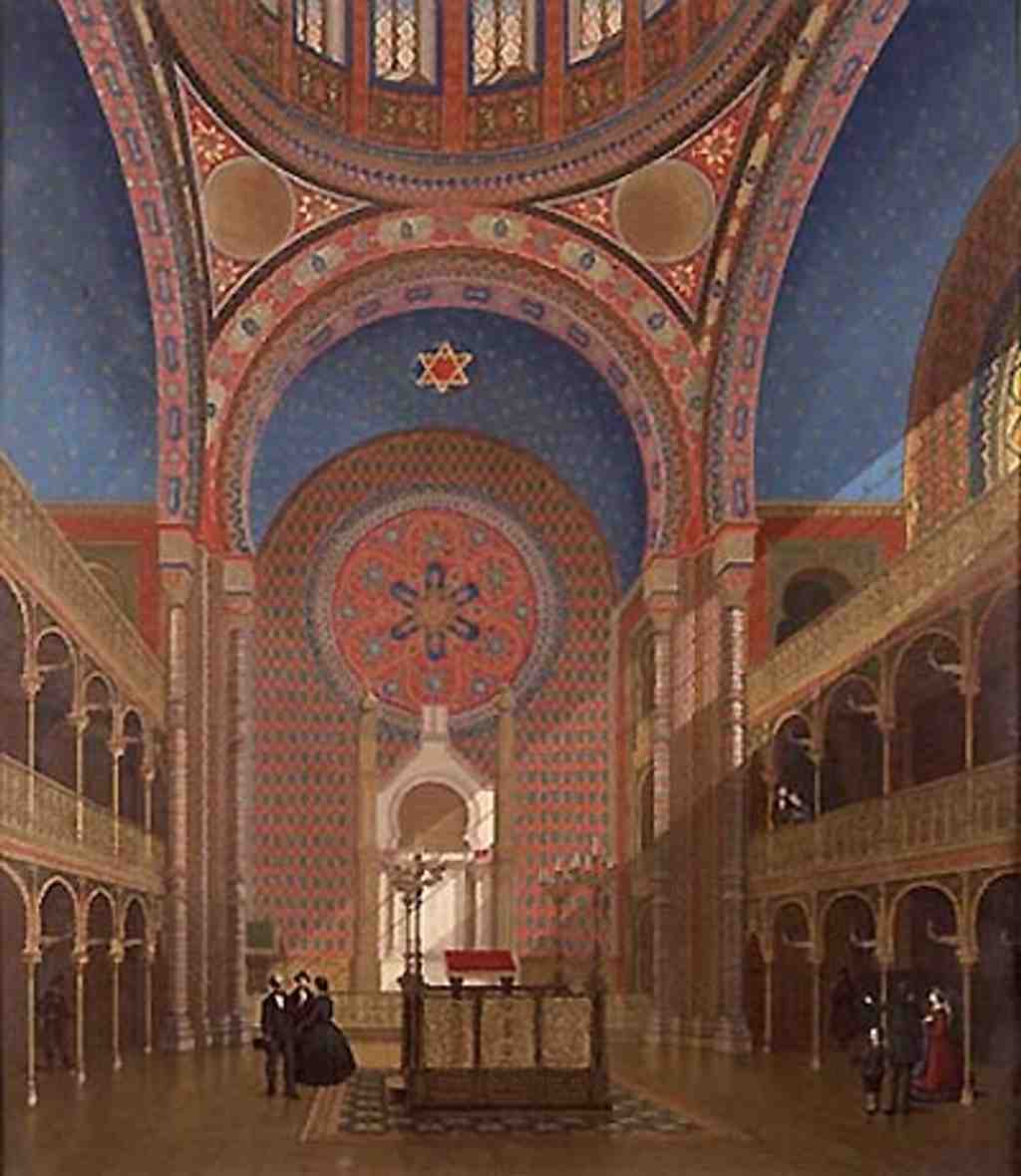
Step inside, and your jaw might just drop. A gigantic, brightly-painted dome rose above your head, glittering with golden stars against a deep blue sky. The air was thick with the warm smell of wood, wax, and-yes-nervous excitement. The ladies watched from graceful galleries supported by slender iron columns, their golden-painted balustrades shimmering in the subdued, colored light that shone through round, jewel-like windows. The walls and ceilings swirled with elaborate patterns-reds, blues, golds, and intricate, geometric stucco designs inspired by the palaces of Alhambra in Spain. It felt almost like standing in a kaleidoscope, or, as some said, “an Eastern palace-though you could still hear a hearty Cologne laugh echoing off the lovely iron arches!”
In the very center, beneath the dome and the gaze of hundreds, stood the bimah-elevated, carved from rich wood, and ready for the most important moments of worship. If you took a closer look at the Torah ark on the eastern wall, you’d spot marble horseshoe arches, nods to Moorish artistry, and minaret forms matching the outer towers. Even the mikveh-used for ritual bathing-was crafted from the finest Carrara marble. I’m telling you, the interior made even the staunchest architecture critic want to dance a little hora.
But grandeur doesn’t keep out trouble. The synagogue faced hardship: a fire in 1867, the stripping of the beautiful copper cupolas during World War I because of metal shortages, even partial dismantling of its towers. But each time hardship arrived, the community rallied, and portions were restored-if not immediately, then as soon as times allowed.
For decades, this was a hub of spirited prayer, laughter, and community. Celebrations echoed through its cavernous halls, like the grand fiftieth anniversary in 1911. Yet, a shadow was looming. On the night of November 9, 1938, Kristallnacht unleashed horrors all over Germany. Flames and smashing glass filled the night as the Glockengasse Synagogue-alongside all of Cologne’s other synagogues-was destroyed by the Nazis. A masterpiece was lost, and much more with it.
Now, the modern Cologne Opera House stands where joyful processions and sacred songs once filled the air. But the spirit of the Glockengasse Synagogue endures. A bronze plaque keeps memory alive, and if you close your eyes, you might still hear the soft footsteps on iron staircases, the quiet prayers, and the laughter of a community determined to build beauty, even in the face of hardship. So, take a moment here-let history whisper through the city's stones, and know you are standing where dreams once touched the sky.




