
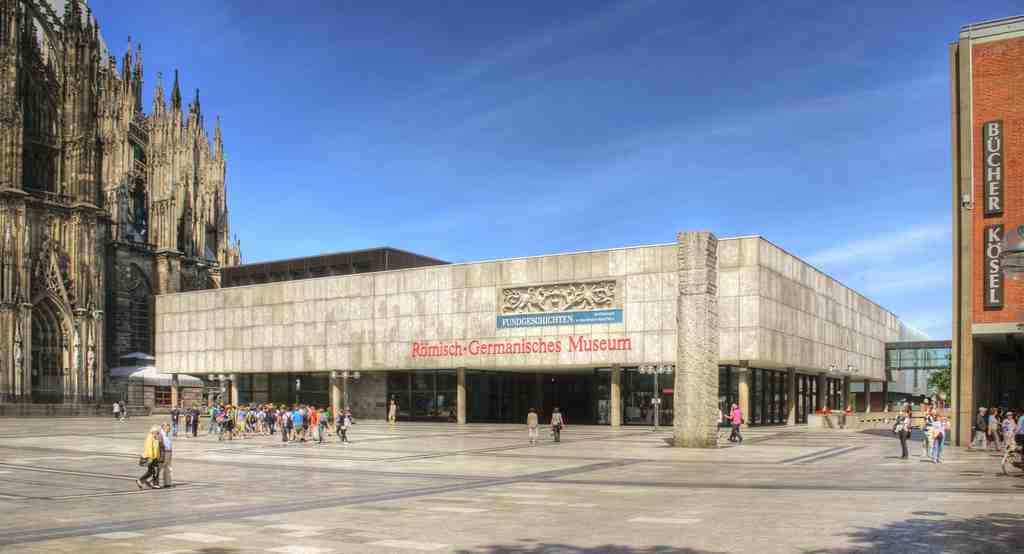
The Romano-Germanic Museum is a square, modern concrete building with a flat roof and large glass doors, featuring the name “Römisch-Germanisches Museum” in bold red letters above the entrance-look just to the right of the cathedral’s dark spires, and you’ll spot this low, light-gray cube on the plaza.
Alright, time to dust off your imagination and travel back-way back-to the days when Cologne was actually a bustling Roman city called Colonia Claudia Ara Agrippinensium. Right now, beneath your feet, lies an ancient Roman villa, and this very spot is like a doorway to nearly two thousand years of history. But don’t worry, no sandaled Romans are going to pop out and ask you for your passport!
Back in 1941, as bombs were dropping during World War II and crews were desperately digging an air-raid shelter, workers struck something a lot more beautiful than an underground bunker: the floor of an ancient Roman house, sparkling with a mosaic so grand you’d think Dionysus himself might dance right out and offer you a goblet of wine. Architects were faced with a truly Roman-sized dilemma-how to build a museum around a treasure that simply couldn’t be moved. The solution? Keep the mosaic right where it was and wrap the entire museum around it, like a priceless gift swaddled in concrete.
Stepping up to those glass doors, you’re about to find a collection that would make any ancient emperor jealous: Roman glass that glimmers like frozen rainbows, delicate jewelry fit for a toga party, and even everyday objects-think bone combs and bronze coins-that somehow survived almost two thousand years of lunch breaks and lost change. If you listen closely, maybe you’ll hear the faint clink of Roman glasses or the whispers of ancient shoppers bustling down the very Roman road just outside these walls.
One of the museum’s star attractions sits quietly below: that legendary Dionysus mosaic from around the year 220. Imagine Roman party guests reclining on cushions, music in the air, the sound of laughter echoing off marble-a scene preserved here for all time. And for a little dramatic flair, did you know that in 2007 a wild storm called Cyclone Kyrill blew a plank straight through the museum’s glass front, aiming right for the mosaic? But don’t worry, the Romans survived, and so did the mosaic. It was all patched up in less than a week-quicker than a chariot lap around the old city gates!
So as you stand before this museum, you’re not just at a building-you’re lingering between worlds: from Roman emperors to medieval magicians to modern museum lovers. If these ancient walls could talk, imagine the tales they’d tell you next. Ready to step into Cologne’s Roman past?




