
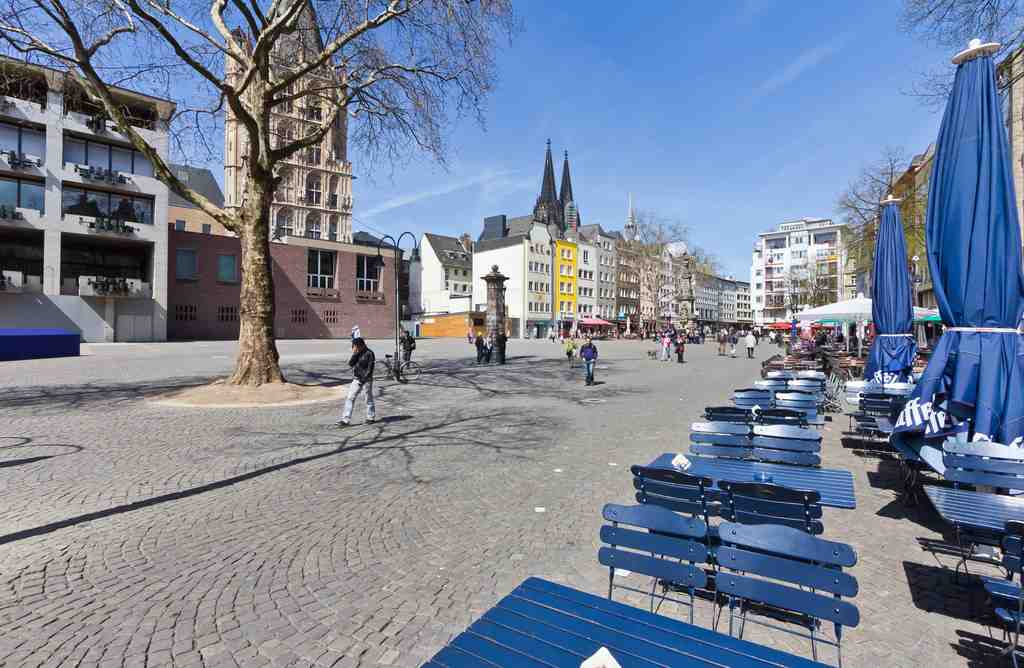
In front of you, the Alter Markt opens wide-a grand, cobbled square framed by pretty, colorful houses, leafy trees, and the stately, ornate facade of the Old Town Hall to your left; just look ahead to spot the tallest tower and the lively bustle of cafés with blue chairs, and you’ll know you’re in the right place.
Now, take a moment and imagine yourself standing in the heart of centuries-old Cologne, a place where, believe it or not, Romans once tied up their boats. Yes, way before this square became the beating heart of the city, beneath your feet lay a sandy stretch hugging an ancient arm of the Rhine. In Roman times, the bustling harbor here would’ve sounded with the slap of water and the heavy thud of stones unloaded for the city’s grandest buildings. When workers dug for the underground railway in 2007, they found a Roman barge-buried twelve meters down, locking away stories from nearly 2,000 years ago.
Yet this was always more than just a dock-it became the richest stage for Cologne’s dramas. Over your shoulder, you’d once spot the medieval city elite strutting about, their homes crowding the square, rising high and narrow because real estate here was as precious as Christmas cookies. By the 10th century, this was the marketplace, known first as “mercatus coloniae”-it was already ‘old’ before anyone even thought of a “new market.” Here, the archbishop put a mint right on the square, the clang of coins echoing as the “Kölner Pfennig” became a currency famous across the land, a bit like having the world’s first bitcoin launch right outside your front door.
Picture, if you can, a sea of stalls: apples and cheese on the east, vegetables piled high to the north, the air filled with the earthy smell of kraut and onions. Shouts crisscrossed the air, and butter, salt, and leather goods found eager hands. Somewhere near, a hospital and a brot-hall stood watch. But not all was straightforward trading. Sometimes, misbehaving customers or cheating merchants ended up at the pranger-a pillory right here, alongside a comically dreadful cage known as the “Käx,” where unlucky lawbreakers would, well, stew in their own embarrassment as the crowd jeered. There’s even a tale about a fraudster who pretended to be a dead emperor-and for that, the townsfolk crowned him... with rotten vegetables!
This isn’t just a place of business or justice, but of grand adventure and spectacle. Knights once charged and galloped across these stones during tournaments, the clatter of hooves and the clang of armor thrilling onlookers jammed into every window and doorway. In 1486, they even cushioned the tournament grounds with straw, but King Maximilian still managed to tumble right off his horse-so much for royal dignity!
Time barrelled on, and the square only grew in importance. During the French occupation in the 1800s, they even renamed it “Le grand marché à Cologne,” and, for a while, the dreaded guillotine made an appearance. Don’t worry, though-the strongest traditions here are lighter ones: the very first Christmas markets began during this period, and today’s festivities, with merry booths and, of course, sweet treats, still light up the winter air.
Perhaps the most heartfelt Cologne tradition bursts to life here every November 11th at 11:11 a.m.-yes, it’s that precise!-when the square erupts in song, laughter, and costumes to kick off Karneval. The story of Jan and Griet, the legendary love-struck country lad and the proud Griet, lives on in bronze at the Jan von Werth fountain, as the crowds below celebrate, debate, and do their best chicken dances.
Even after two world wars tried to flatten history, some buildings, like the lovely “Haus zum Bretzel” and the “Gaffel Haus,” were rebuilt, while others-such as the curious "Kallendresser" statue, celebrating Cologne’s cheeky sense of humor-keep stories alive in stone and bronze.
So look around at the sea of tables, the gleam of modern shops, and let your mind travel back to market days, medieval jousts, roaring Karnevals, and a kaleidoscope of city legends. Here, beneath the café umbrellas and the watchful eye of the old Rathaus, every step echoes with laughter, history, and maybe just a hint of mischief.




