
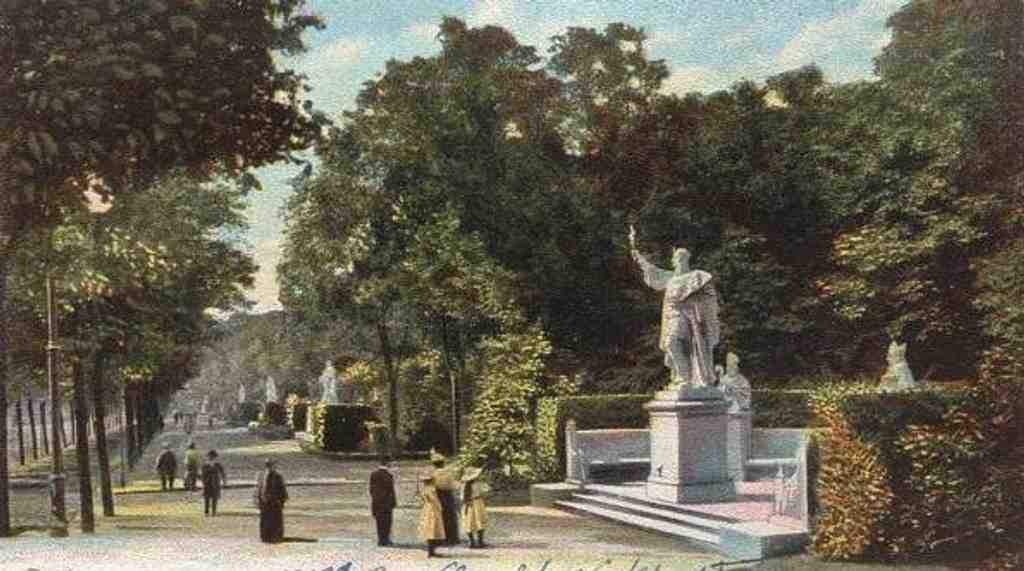
In front of you, you’ll spot a long, straight avenue lined with tall trees, and peeking through the greenery are white marble statues on pedestals, standing proudly along either side of the broad walkway-just look for the rows of sculptures under the leafy canopy.
So, you’ve made it to the spot where grandeur and a little bit of controversy once strolled hand in hand-welcome to the Siegesallee, or as Berliners joked, the “Avenue of the Dolls.” Imagine it’s the late 1800s, and Kaiser Wilhelm II is having a pretty good birthday-so good, in fact, that he decides to commission a staggering 96 white marble statues as a personal gift to Berlin. Not a box of chocolates or a nice card-no, he went with nearly one hundred sculptures! He was determined to make Berlin the envy of the world, so starting in 1895, the city’s sculptors-well, actually, mostly Italian sculptors working from German artists’ designs-set about bringing his vision to life. By 1901, the grand avenue had transformed into a marble parade, lined with 32 larger-than-life Prussian royals, each flanked by busts of their most loyal advisors. The boulevard stretched about 750 meters through the Tiergarten, running north from Kemperplatz and slicing across what is now the major Straße des 17. Juni.
Picture the scene-this leafy park avenue suddenly brimming with statues of kings, dukes, and one very pious queen on her knees. The Emperor hoped everyone would be impressed, but oh, did Berliners have opinions. Locals and critics alike ridiculed the new “neobaroque” display, calling it “Monument Billy” after Wilhelm himself, and even giving it nicknames like “Avenue of the Puppets” and “Plaster Avenue.” Apparently, all this marble was a bit much, even for a city used to grandeur. Even Augusta Viktoria, Wilhelm’s wife, wasn’t a fan-imagine trying to talk your spouse out of putting 96 statues in the middle of the park!
The critics didn’t hold back, comparing the whole thing to an out-of-tune brass band concert. But despite the mockery, many people couldn’t resist strolling here-maybe to admire the craftsmanship, maybe to giggle at “Plaster Avenue.” Teachers brought their students to the avenue, using the statues as a quirky (and very expensive) history lesson. Legend has it, the Kaiser himself even graded the students’ essays about the statues’ poses-now that's what I call “extra credit” from the top.
Yet, if you look around, you’ll notice that most of the original Siegesallee has vanished. When the monarchy fell in 1919, there were debates about smashing the statues, but most survived-until the 1930s, when Adolf Hitler and his chief architect, Albert Speer, had even bigger plans. They needed room for huge military parades and a new world capital called Germania, so they moved the Siegesallee and made space for even grander spectacles. The Victory Column, which had marked the north end of this boulevard, was uprooted and installed at the Großer Stern-don’t worry, it didn’t mind a little extra height while it was at it.
The Second World War battered the Tiergarten. Bombs shattered nearly every tree, and many marble royals lost noses, arms, or worse to flying shrapnel. When peace arrived, the victorious Allies saw these statues as reminders of Germany’s imperial past. In 1947, British forces decided the best solution was to erase the avenue entirely and replant the gardens. Most of the surviving statues were supposed to end up buried in the rubble hills around Berlin, but in a twist worthy of a detective novel, a city curator hid them underground near Schloss Bellevue. Years passed, memories faded, and then-surprise!-in 1979 workers digging in the park unearthed Wilhelm’s army of statues. Once again, Berliners marveled at the city’s ability to keep old secrets beneath their feet.
Today, some of those rediscovered royal heads and rulers are displayed in the Spandau Citadel, telling their own strange chapter of Berlin history. And the Siegesallee? It’s now a quiet footpath, lined with trees once more-but still a place where, if you listen for echoes and peek at the photos, you might just spot a lineup of marble ghosts keeping watch over Berlin’s historic heart. Talk about leaving a mark, even if nobody could ever agree on whether it was a masterpiece or a marble mess!




