
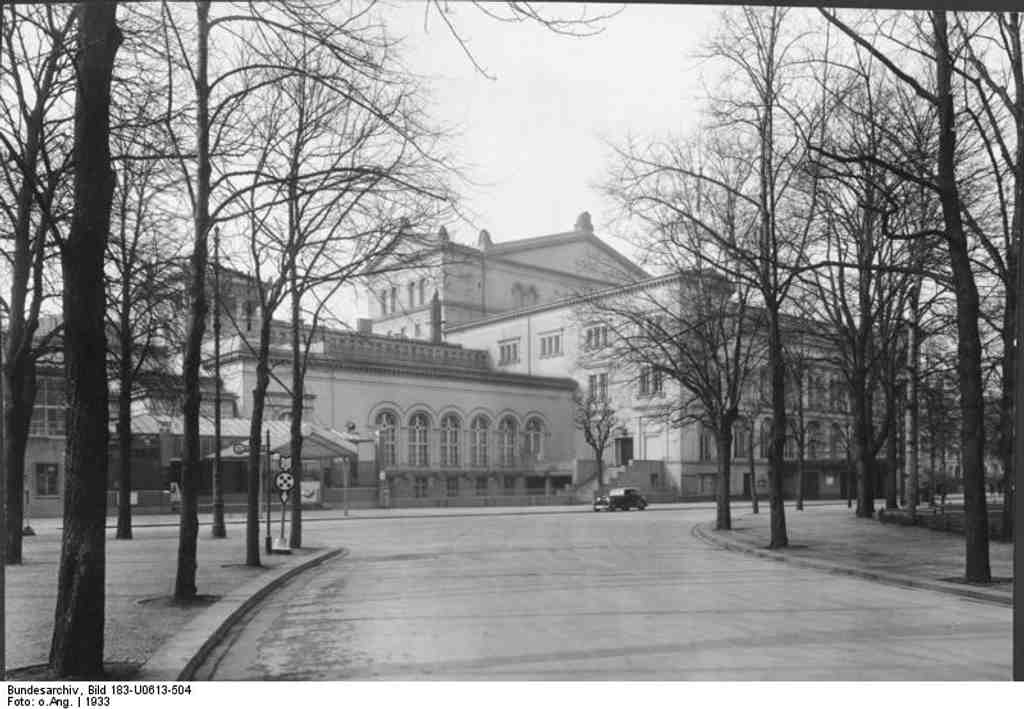
If you're trying to spot the Kroll Opera House from where you’re standing, look through the trees for a grand, pale building with rows of arched windows and a square, theatrical silhouette rising above the quiet street.
Welcome to the long-lost world of the Kroll Opera House, where echoes of applause and political drama once mingled in the Berlin air! Imagine yourself here in the mid-1800s, the ground beneath your feet once nicknamed the “Sahara” for its dusty, sandy stretches-hardly the romantic opera setting, unless you enjoy a little grit in your shoes. But Joseph Kroll, a determined restaurant owner from Breslau, had a vision: his grand entertainment palace would be a sparkling social hotspot for Berlin’s elite, complete with flower-decked halls, three massive chambers, and even a “Tunnel” where folks could smoke indoors. That was quite a novelty back then! Picture it: gas lamps flickering to life, forty waiters rushing trays of food, and sixty musicians tuning up for an evening that might even tempt a king.
Now, life in the Kroll Opera house wasn’t always a grand waltz. The early days were dazzling, with legendary acts like Johann Strauss Jr., the “Waltz King,” sweeping in to charm Berlin’s dancers. But just as Joseph’s dream was flourishing, disaster struck-in 1851, fire broke out as the lamps were lit, sending curtains up in smoke. Don’t worry, Joseph’s daughter Auguste wasn’t the type to go down without a fight. Before you could say “bravo!” she’d pocketed the insurance money and reopened with a brand new theatre just weeks later.
Yet the backstage drama never ended. Performing wild animal shows, summer operas beneath the stars, and even fireworks, Auguste and her conductor husband Jakob Engel kept pushing boundaries-sometimes too far, leaving their finances dancing on a tightrope. They even introduced Berlin’s very first electric “Edison system” lighting, setting the stage ablaze with innovation-but, unfortunately, not always with profits. The Kroll’s fortunes rose and fell with Berlin’s tastes, sometimes packed for Italian opera sung by stars like Marcelle Lembuch and at other times so stuffy and hot, as an American visitor once wrote, guests escaped outside into a refreshingly cool, lantern-lit garden during every intermission. What an atmosphere-a cocktail of culture, a whiff of smoke, and a garden glowing under electric and gas lighting!
In the early 20th century, the Kroll Opera House attempted a dazzling encore. It was rebuilt as the splendid Neues Königliches Operntheater, hosting everything from Stravinsky’s bold new sounds to the golden throats of Caruso and cutting-edge stage design by art legends like Moholy-Nagy and Schlemmer. For a while, it looked like the Kroll Opera House had finally struck a high note. But the financial strains of the time kept it wobbling-the Berliners, perhaps, had too many other amusements to choose from!
As the shadows of war crept closer, the drama turned political. After the Reichstag fire in 1933, with the Reichstag building damaged, politicians crossed the street and took their seats inside the Kroll Opera House. It became the unlikely, tragic stage for some of history’s darkest decisions: here Adolf Hitler secured massive new powers in the famous Enabling Act, giving him control over Germany and ultimately sealing the fate of millions. As the world teetered on the brink, the opera house saw not arias but angry speeches and declarations. Hitler gave chilling warnings to thunderous applause-a far cry from the sweet notes of “Romeo and Juliet.”
The opera house’s days were numbered. Warplanes howled overhead and bombs rained down, gutting the grand halls in 1943, leaving only blackened ruins. Then, in the chaos of Berlin’s final days, the Red Army swept past what little remained. By 1951, the Kroll Opera House was finally demolished, its ghostly presence lingering only as memories and a whisper of music over the lawns where voices once soared.
So next time you walk by this quiet patch of green, listen closely-you might just hear a snatch of Strauss’s waltz or the hammering of history’s gavel echoing through time. The stage lights are gone, but what a show it was!




