
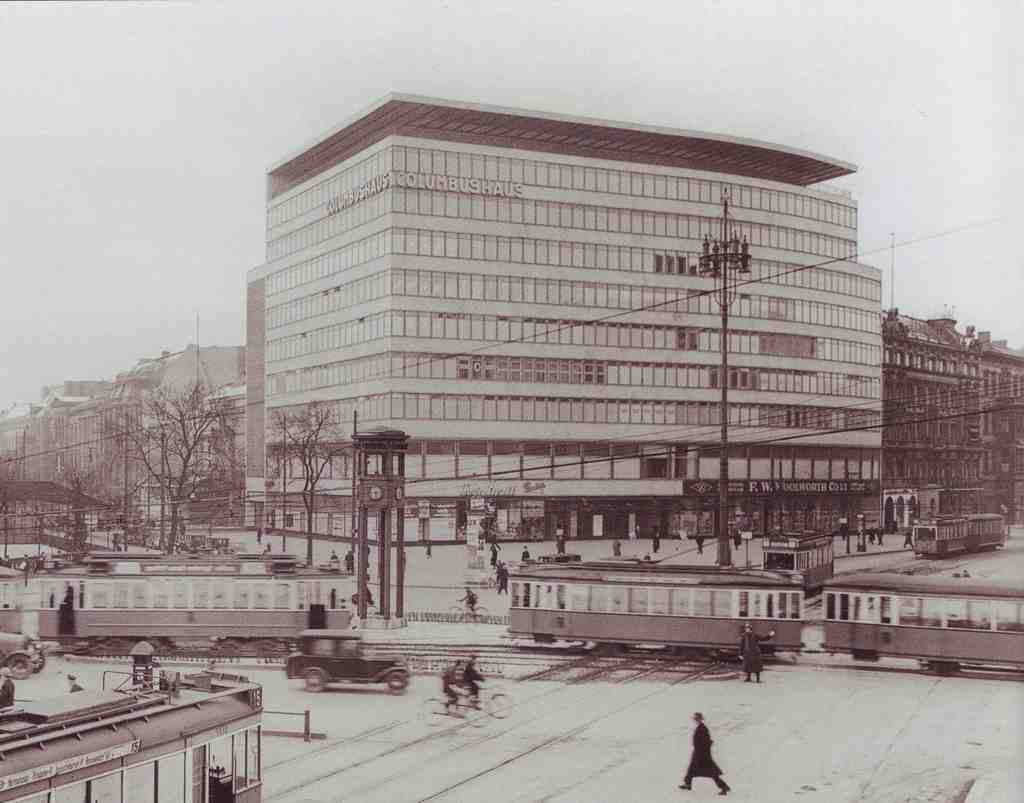
To spot the Columbushaus, look right ahead for a sleek, nine-story building with smooth, horizontal bands of glass, a curved corner following the street, and the name “COLUMBUSHAUS” proudly perched at the very top.
Welcome to where modern Berlin once reached for the sky! Picture it: the early 1930s, the city still buzzing with city trams, purring automobiles, and smartly dressed Berliners striding across Potsdamer Platz. And suddenly-rising like a lighthouse of glass and steel-is the Columbushaus. Imagine the house-sized neon sign on top flickering to life as the sun sets, while bustling shoppers duck into the Woolworth’s below, and the upper floors quietly hum with office workers, all packed into Berlin’s trendiest new address.
Erich Mendelsohn, the architect, was out to make a statement. The Columbushaus wasn’t just a building, it was a dare: a nine-story modernist marvel with horizontal stripes of windows and curving lines that seemed to slice through the drab, boxy buildings around it. Mendelsohn wanted flexible, airy spaces and as few interior supports as possible, so the whole building could adapt to any future, from department stores to office beehives. And let’s not forget those neon lights-so bright he said he had to add masonry just to support them! It was so forward-thinking that the Columbushaus became known as Berlin’s “little skyscraper” and, fun fact, boasted Germany’s very first office building ventilation system. So not only was it cool to look at, it was literally cooler on the inside-quite the selling point in those stuffy 1930s summers.
You might expect a place this modern to last forever, but fate had other plans. The Columbushaus wasn’t just about fashion and commerce; it was history’s guesthouse. In the 1930s, its halls bustled with travel agencies and steel companies, and from its roof, a massive neon ad blinked for the Nazi newspaper, Braune Post, while the Olympic Organising Committee ran their 1936 headquarters a floor below. In whispered corners, you could almost catch the secret steps of resistance: the Leninist Neu Beginnen group hid their archive in these rooms, plotting against the rising tide of dictatorship. And later, beneath innocent office signs, plans for the horrific Action T4 program took root-one of the darkest chapters in the building’s story.
When World War II raged, bombs fell and bullets flew, but the Columbushaus, built of modern steel, refused to collapse. Somehow, it survived, its skeleton standing among Berlin’s ruins like a lone, determined sentinel. When the city split, it fell into East Berlin’s hands: shops downstairs buzzed with customers, a police station opened above.
But June 1953 changed everything. As workers across East Germany rose up against oppression, chaos broke out outside. The mayor pleaded for peace, the police hurled out their uniforms and waved a surrender flag, but the crowd, electrified and furious, set the Columbushaus ablaze. Its steel frame stood but its heart was gutted by fire.
By 1957, the Columbushaus was just a ruin-soon demolished, its metal bones sold for scrap, its memory fading as the Berlin Wall slashed across the city. Instead of shoppers and office workers, its old square saw barbed wire, border guards, and daring graffiti artists like Wolfram Hasch dodging arrest to mark forbidden walls. In a bizarre twist, activists in the late 1980s turned its old patch of ground into ‘Norbert Kubat Corner’, declaring it a rebellious zone and building a radio station on-site. When the police came to clear them out, hundreds dashed over the Wall-not escaping from the East, but running from West Berlin into East Berlin, dogs, bicycles, and all! The border police on the other side just shrugged and served them breakfast-an event so strange you couldn’t make it up.
Today, Potsdamer Platz has outgrown its scars and old secrets, bustling again with glass towers and luxury hotels. The Marriott and the Ritz-Carlton now stand where the Columbushaus once flipped the skyline upside down. But if you listen carefully, you might still hear the echoes-a distant tram rumble, a faint flicker of neon, and the laughter of Berliners as they dared to build a brighter future, one floor at a time.




