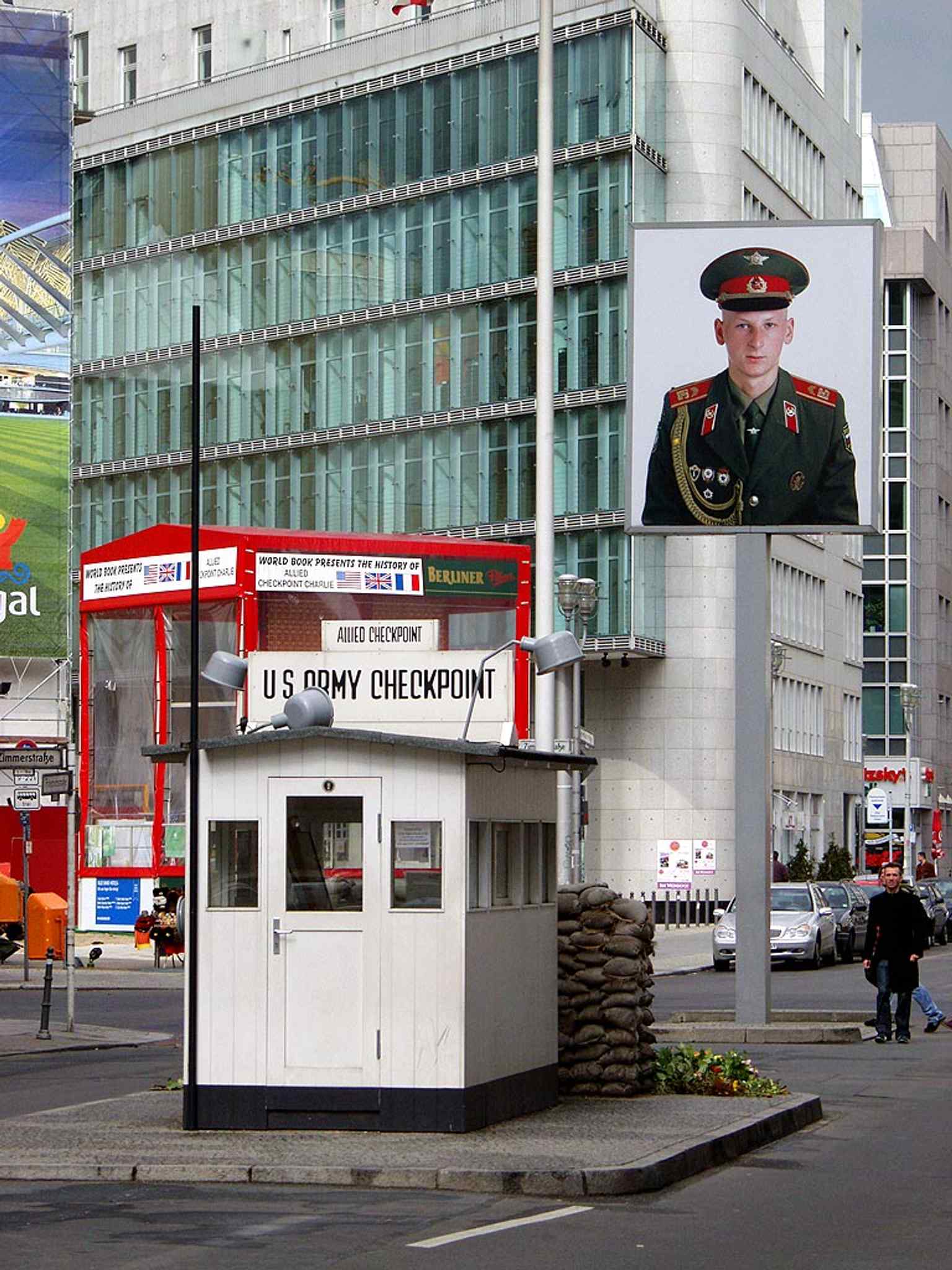
Look for the small white guardhouse, a plain boxy cabin in the street, paired with the tall border sign and the line of cobblestones that cuts across the pavement where the Wall once ran.
This was Checkpoint Charlie, the most famous crossing in the Berlin Wall, and for a while one of the most dangerous addresses on earth. The name sounds almost jaunty... which is rude, really. It came from “C” in the N-A-T-O phonetic alphabet: Alpha, Bravo, Charlie. Here, that neat military code met a city being split apart in real time.
This is where control announced itself with full confidence: papers, barriers, armed men, and rules about who could pass. But Berlin has always been annoying that way for systems of control; people kept testing the seams, slipping through, arguing over authority, inventing routes, and refusing to stay in the boxes drawn for them.
The pressure behind all this was massive. Between nineteen forty-nine and nineteen sixty-one, about three and a half million East Germans left for the West, roughly one fifth of the East German population. Many were young professionals, engineers, teachers, doctors, skilled workers. East German leader Walter Ulbricht pushed the Soviets to let him stop that drain, and on the thirteenth of August, nineteen sixty-one, East Germany threw up barbed wire across Berlin. Within days, engineers turned it into a concrete border meant to freeze movement, and maybe history with it.
If a border cut through your daily routine overnight, what would vanish first... your commute, a family visit, the habit of crossing town without thinking?
Checkpoint Charlie was the only designated crossing here for foreign tourists, diplomats, and Allied military personnel. That technical detail mattered, because Berlin’s status after the war made every passport check a legal argument with engines attached. In October nineteen sixty-one, East German guards tried to inspect the papers of an American diplomat, Allan Lightner, on his way to East Berlin for the opera. The Americans refused to accept East German authority over Allied movement. That absurdly bureaucratic dispute produced ten Soviet tanks and ten American tanks facing each other about one hundred yards apart, right here. If you want the visual, glance at the tank photo on your screen.
A few years later, on the twenty-sixth of June, nineteen sixty-three, John F. Kennedy stood here, looked across the Wall into East Berlin, and then gave his “Ich bin ein Berliner” speech. So yes, this corner functioned as both traffic control and global theater.
But the human cost was not abstract. In August nineteen sixty-two, eighteen-year-old Peter Fechter tried to escape, was shot by East German guards, and bled to death near the border in public view. That death fixed this place in the world’s memory more brutally than any speech could.
Most tourists miss one important wrinkle: the famous American guard house here is not the original. The real one was removed in nineteen ninety and now sits at the Allied Museum in Dahlem. What you’re looking at is a reconstruction, which is very Berlin... even the icon of authenticity needed a stand-in.
You can compare the old frontier with the staged memorial on your phone; the before-and-after image is worth a quick look.
Today the crossing draws millions, and the site is open all day, every day. As you head to Ideal Insurance, about three minutes from here, keep one question in mind: if control can look this obvious at Checkpoint Charlie, where else in Kreuzberg is it hiding in plain sight?