
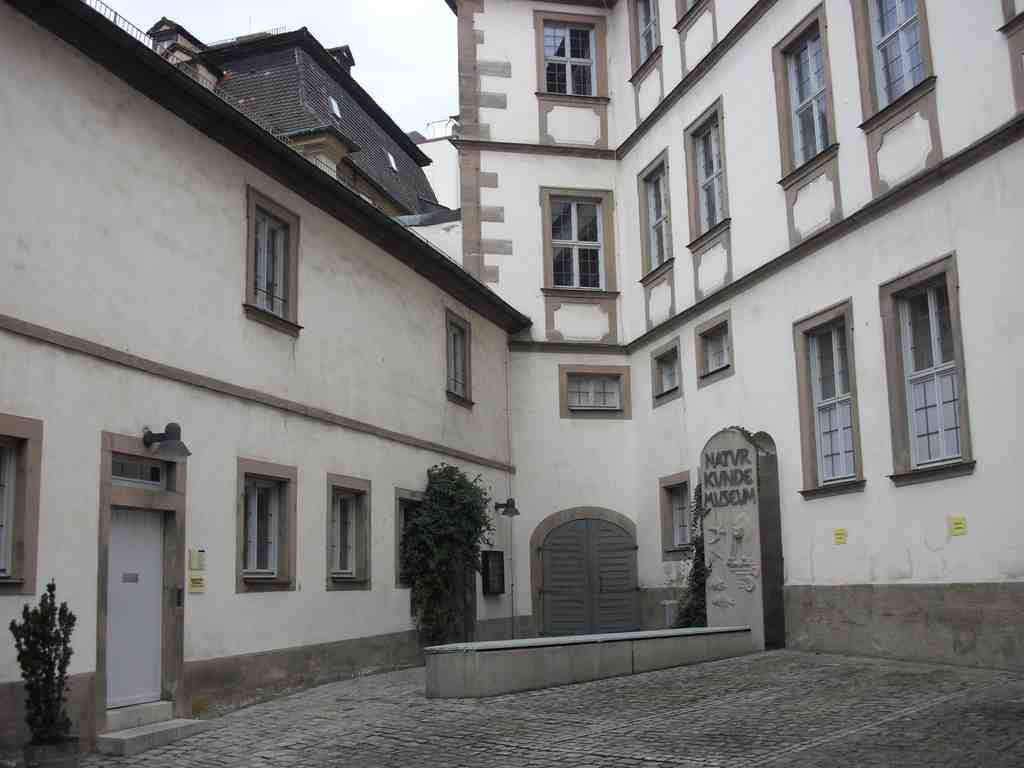
On your left, look for the pale, enclosed courtyard building with lots of simple windows and a stone slab sign that reads “NATUR KUNDE MUSEUM” beside a big arched doorway.
You’re standing at Bamberg’s Natural History Museum, tucked into the old university rooms of the former Jesuit college in the island district… which is a wonderfully Bamberg way of saying: “Yes, it’s important, and yes, it’s slightly hidden.” It began in 1791, when Prince-Bishop Franz Ludwig von Erthal set up a “cabinet of curiosities” with an Enlightenment-era mission: collect, catalog, and study the region’s biology and geology. Not really for casual browsing, either. This was designed for professors and students first… the public came later, once everyone loosened their collars.
Then the university was dissolved in 1803, and the collection had to reinvent itself. By 1822, under Dionysius Linder, it absorbed pomology materials from the Benedictine monastery at Banz… basically, serious fruit science. Somewhere, an apple felt very seen. The museum kept growing thanks to gifts and collectors, including Julius von Minutoli, who brought back objects from travels far outside Europe-turning this place into a global scrapbook of natural history.
Inside is the famous Vogelsaal-the “Bird Hall”-and it’s not just a room, it’s a time capsule. Finished in 1810, it’s the only original 19th-century museum display room still preserved like this. The lower level shows European and exotic birds; the gallery adds invertebrates, fish, amphibians, reptiles, mammals, botany… the whole crowded, wonderfully old-school parade of nature. Nobody’s totally sure why it was never modernized. The best theory? After 1803, teaching mattered less, the Bavarian crown wasn’t eager to spend, and Linder was busy obsessing over fruit models. Priorities.
And about those collections: roughly 200,000 objects-minerals from now-vanished sites, records of old ore deposits, about a thousand Jurassic ammonites, a complete preserved quagga (rare worldwide), 60,000 local insect records around 1930, and wax models of apples, pears, and cherries from around 1800-varieties that mostly don’t exist in orchards anymore. There’s even the “Bamberg Wonder Chain,” carved from more than 150 tiny fruit stones. Patience, weaponized.
When you’re set, University of Bamberg is a 4-minute walk heading northwest.


