
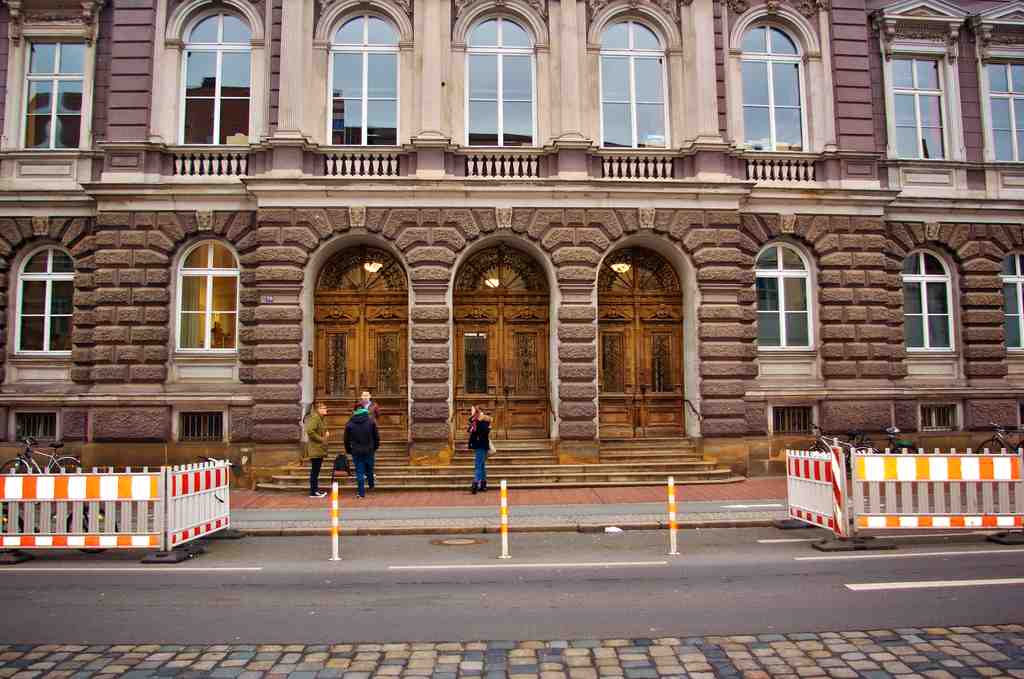
On your left, look for the wide, palace-like stone facade with three big arched wooden doorways and tall arched windows above them.
So yes… this is a high school, but it’s dressed like it has a meeting with a king. That “serious public building” look is no accident: Clavius-Gymnasium was built in 1879 to 1880 in a Neorenaissance style that was popular for civic pride projects after German unification-basically, architecture saying, “Education is important, and we have the stonework to prove it.”
The school’s roots go back further than the building, though. In 1794 it started life as an engineering and drawing academy-very practical, very hands-on-meant to feed Bamberg’s trades and crafts with real skills. By 1833 it earned official state recognition as a combined agricultural and trade school, which is why that year is treated as its formal “birth.” Then came additions like a commercial department in 1854, bringing in subjects like English and shorthand… the nineteenth-century version of “add business skills so the kids can get jobs.”
Space was a constant headache. Classes were squeezed into the old Wedding House downtown, and gym class wandered wherever it could fit-sometimes even into a secularized church in winter. Then in 1871, disaster struck: the roof of that old building burned. Suddenly, “we need more room” became “we need a new building yesterday.”
So Bamberg debated locations like a committee that couldn’t pick a restaurant. Eventually, they settled here, and one doctor argued the case beautifully: the street was broad, friendly, airy… lively, but not choked with traffic. Also-and this is very Bamberg-another proposed site was rejected because nearby hop-drying kilns might be unhealthy for students. Nothing says “educational planning” like being taken out by beer logistics.
The school was later named after Christophorus Clavius, the scholar who helped make the Gregorian calendar reform work-so when your phone calendar behaves, you can mutter a quiet thanks. The institution became a full Gymnasium in 1965, strengthened its science-and-technology focus, and later added an economics track too.
Its history isn’t only proud; it’s also sobering. During the Nazi era, Jewish teachers and students were pushed out, the building was seized as a hospital during the war, and then used for refugees and emergency care afterward. These walls have seen a lot more than exams. Today, the memorial plaques inside still hold that memory.
And speaking of “today,” the big modernization from 2011 to 2017 cost about 39 million euros at the time-roughly the same order as 45 million dollars in today’s money-and replaced decades of temporary container classrooms with new space, a new sports hall, elevators, and a restored historic feel.
When you’re set, Tent of Religions is a 2-minute walk heading north.


