
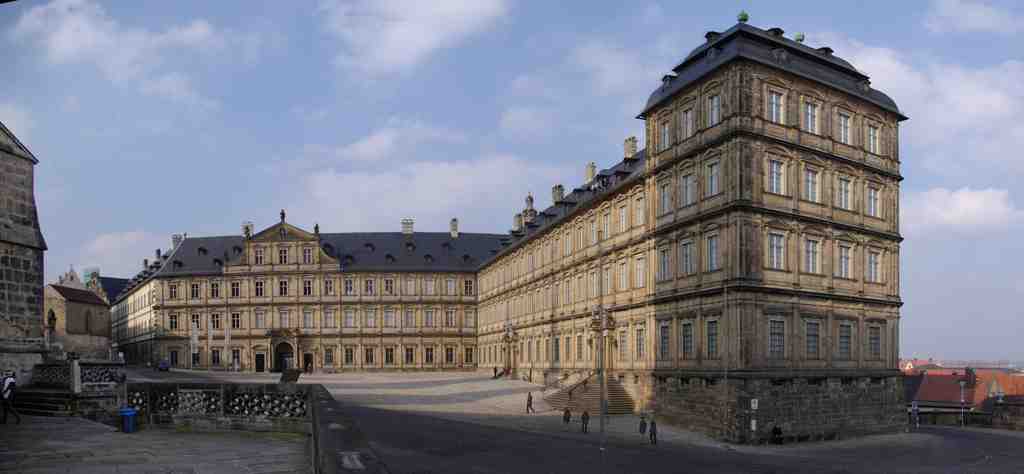
On your right, look for the long, honey-colored stone wing of the New Residence with rows of tall windows and a big, palace-style corner tower anchoring the whole façade.
So yes… this is a library, but it’s wearing the outfit of a prince-bishop’s headquarters. The Bamberg State Library lives inside the New Residence at Cathedral Square, and that setting is the first clue to its personality: serious scholarship, wrapped in Baroque confidence.
The library as an institution really took shape after a huge shake-up in 1802 and 1803, when church property was secularized and Bamberg’s monasteries and foundations were dissolved… and the old university was shut down. Imagine the chaos: carts, crates, and “temporary” stacks turning into permanent mountains of books. Out of that upheaval, the Elector’s Library was founded in 1803. Names changed with politics-Royal Library, then State Library-and in 1966 it became the Bamberg State Library.
Early on, the library’s problem wasn’t prestige. It was organization. Their first major builder of order was Heinrich Joachim Jaeck, a former Cistercian monk, who somehow turned a flood of inherited collections into a usable research library. That’s the kind of work nobody applauds… until it isn’t done. Then everyone suddenly becomes very passionate about “access.”
Today it’s open to everyone for serious study, professional work, or just self-improvement, and it’s focused on the humanities-history, art history, manuscripts, the book itself as an object, and especially Franconian regional culture. It also works closely with the University of Bamberg’s library, because in a town like this, the past has a way of showing up in the present and asking to be cataloged.
One of its key regional jobs is collecting anything published in Upper Franconia. Since 1987 it has been a legal deposit library for the region-meaning local publishers owe it copies for permanent preservation. The result is a kind of paper memory for Upper Franconia: not glamorous, but priceless when you’re tracking down who said what, when, and why.
Now for the headline treasures. This place has around 1,000 medieval manuscripts, and some are tied directly to Emperor Henry II, who founded the Diocese of Bamberg and gifted manuscripts to it between 1007 and 1024. Two spectacular manuscripts-the Bamberg Apocalypse and a major biblical commentary-were added to UNESCO’s Memory of the World register in 2003. And in 2013, the Lorsch Pharmacopoeia, written around the year 800, joined them. In other words: Bamberg isn’t just storing books… it’s storing civilization’s receipts.
The building itself keeps the drama going. The New Residence was built from 1697 to 1703 by Johann Leonhard Dientzenhofer for Prince-Bishop Lothar Franz von Schönborn. Inside, the reading room combines former ceremonial spaces remodeled by Balthasar Neumann in 1731, opening up with grand arches and a view toward the Rose Garden. Even the entrance hall shows off stained glass from the 1500s and 1600s-because apparently a normal lobby would be embarrassing.
When you’re ready, Heller-Bräu Trum is next-just walk southeast for about 3 minutes.


