
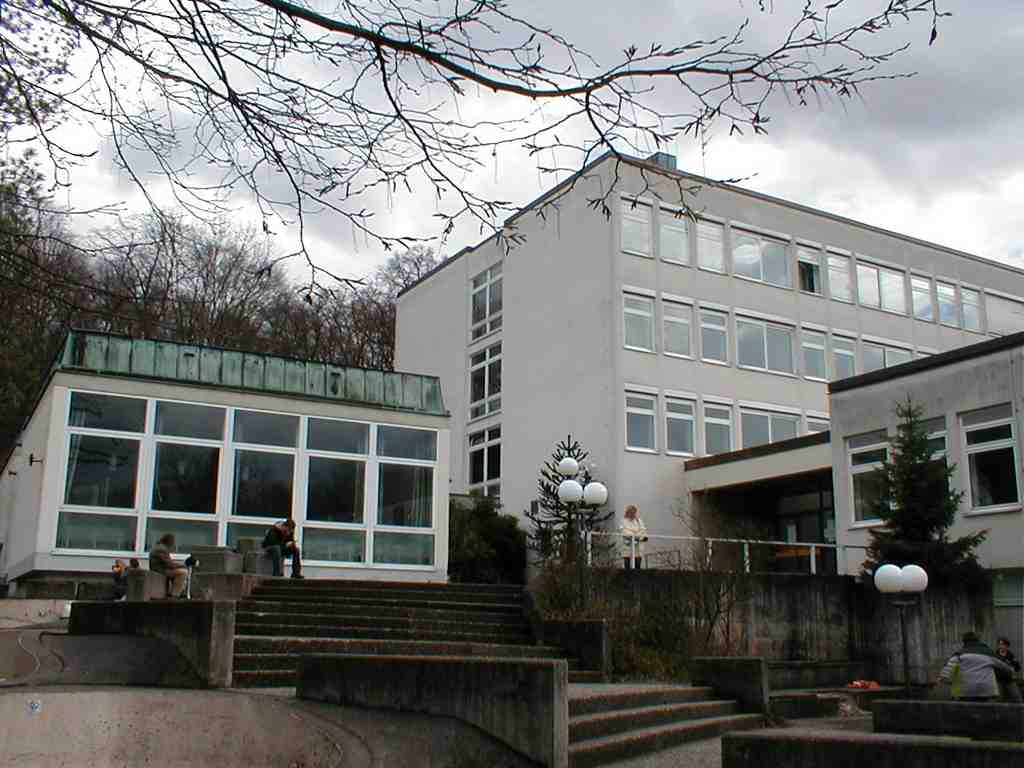
Look for a pale, modern concrete building with lots of square windows towering above you to spot Kronberg-Gymnasium Aschaffenburg-it’s up ahead, surrounded by terraced steps and trees.
So here you are, standing right in front of Kronberg-Gymnasium Aschaffenburg-not just any old school, but a survivor with a story bigger than its modern walls let on. Imagine the year is 1620, it’s the second year of the Thirty Years’ War, and Aschaffenburg is full of distant church bells and the clatter of wooden carts rolling past the Jesuit complex, nestled right near the castle. This school was the brainchild of Johann Schweikhard von Cronberg, the Archbishop of Mainz, who called the Jesuits to teach here. In June of that same year, he made it official-converting a humble Latin school into what would one day become this iconic institution.
Now, don’t let today’s plain architecture or the students checking their phones fool you: Kronberg-Gymnasium's journey has been full of drama. Back in the autumn of 1631, Aschaffenburg saw unexpected “school holidays”-not because of snow, but because Swedish troops invaded the town. The Jesuits? Gone in a flash! Their classrooms were suddenly commandeered, but rumored lessons somehow continued. When the Swedes left three years later, regular lessons returned-well, almost. The very next year, the plague swept through, and students found their fall holidays much less fun than expected, with several succumbing along with two teachers. Just when things seemed to calm, the Swedes stormed back, bringing chaos and, heartbreakingly, the death of the school’s rector.
Standing here, it’s hard to can picture the chaos, yet pieces of that early era echo on-especially in the name “Kronberg,” a nod to the school's Jesuit founder, and a distant reminder of those cloistered, Latin-murmuring halls. For two centuries, the Jesuits ran the show, but after 1773, a new cast of secular clerics took charge.
The building you see today, though, isn’t the original. The former school stood on Pfaffengasse until 1944, when bombs in World War II leveled Aschaffenburg’s heart. Only a carved stone portal and a coat of arms survived-like something out of a detective film! For years, students bounced from one temporary home to another: the Dalberg-Gymnasium, Maria-Ward-Schule, the Kolpingschule, and even a set of postwar huts on what locals called the Grandmother’s Meadow. Not quite the five-star campus experience.
Finally, in the 1960s, the city and the state of Bavaria had a tug-of-war-should the new building be by the Main River, or in Fasanerie Park? Munich won, and here the Kronberg-Gymnasium finally put down roots again. In 1965, they laid the cornerstone. By 1968, students were trekking up these very steps you’re standing on, excited for the grand opening, which even the Bavarian Minister President attended (his own son was a recent graduate).
But even modern walls can’t contain everything this school stands for. Kronberg-Gymnasium has a proud tradition of both humanities and languages-Latin and Greek for the old-school brains, natural sciences and tech for the modern tinkerers. It’s produced thinkers, scientists, and even a few pranksters, I’m sure! Did you know Alois Alzheimer, the doctor who first uncovered the disease that now bears his name, once strolled these halls? Or historian Franz Bopp, who pretty much turned the science of languages on its head? There have been politicians, bishops, philosophers, comedians-Urban Priol, for example, no one ever accused him of being boring-and so many more bright minds.
Imagine all the chatter, debates, and laughter layered across the decades. That’s Kronberg-Gymnasium for you-a place that’s rebuilt itself through wars, plagues, and politics, but never lost sight of lighting up a curious mind.




