
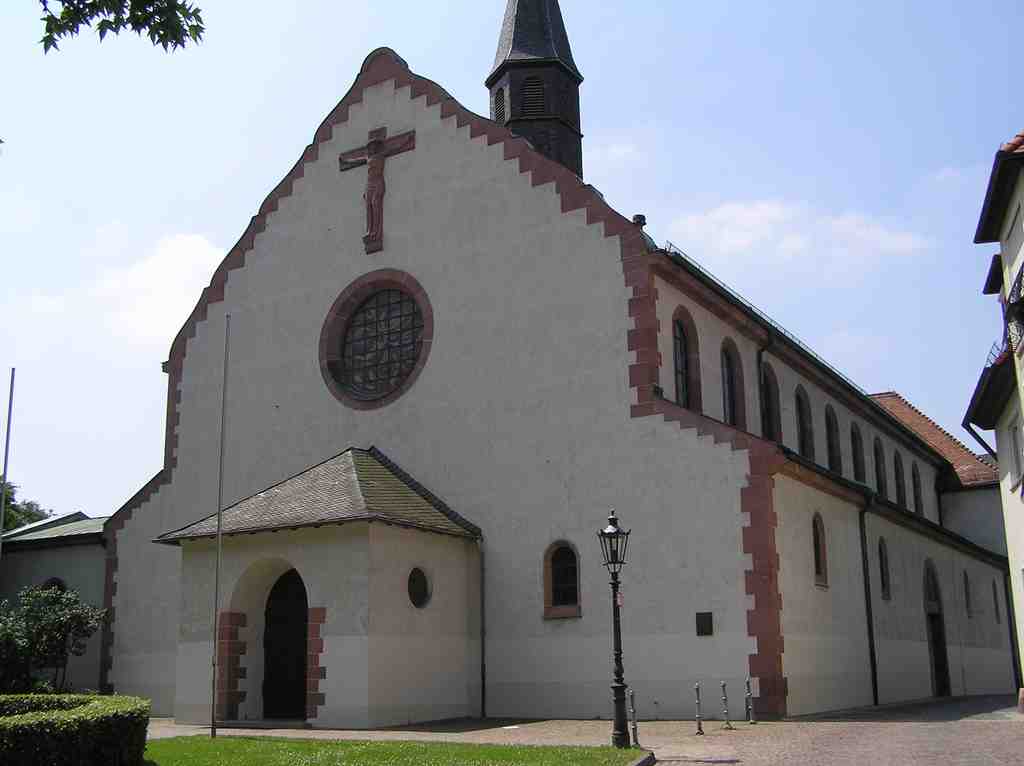
To spot the Capuchin Church of St. Elisabeth, look for a pale, simple church with reddish stone trim, a steeply-peaked roof, a small tower at the top, and a round stained-glass window above the main entrance, just to your left on the quiet street.
You’re now standing in front of a church that could tell enough stories to fill a century-long confession. Let’s take you back in time-picture the year 1626: horse hooves on cobblestones, the scent of wood smoke, and an eager group of Capuchin monks arriving at the invitation of Elector Archbishop Johann Schweikhard von Cronberg. He thought Aschaffenburg needed a boost of spiritual energy-maybe the monasteries had gone a bit “stale,” you know? So, with a stroke of generosity, he gave the monks this very ground, right “by the castle garden,” and soon, both monastery and church began to rise.
The original foundation was laid in 1626, and by the next year, a simple but meaningful church was standing. It quickly became not only a local anchor of faith but, as you’ll soon discover, a magnet for drama. Fast forward to October 1813: outside, the chaos of the Napoleonic Wars rages. Following the nearby Battle of Hanau, the monks’ peaceful realm suddenly becomes a bustling military hospital. Then-oh dear-some careless hospital workers, a little too fond of open flames, sparked a devastating fire in the dead of night. The entire monastery and church were left in ruins. Although every wounded soldier escaped, an incredible library of 4000 books was reduced to ash. Yet thanks to quick-thinking townsfolk, a city-wide fire was avoided by tearing down neighboring homes as a barrier.
But this building wasn’t going to let disaster win. The church and monastery were rebuilt in 1814, though it would be more than 30 years before proper consecration could be celebrated-it always takes longer when you’re aiming for perfection! The church did double duty as a hospital again in the 1866 war, suggesting this was the place everybody turned to in tough times.
In 1908 and 1909, architect Friedrich Ritter von Thiersch led the charge on a new design, cleverly building in parts of the old sanctuary, so that some walls here have watched centuries of stories unfold. Notice the structure’s mix: a blend of neo-Romanesque and neobaroque, with a splendid interior-imagine the grand altar built from solid stone and adorned with all the artsy flair Munich could muster! Glance up at the old north entrance, where a statue of St. Elisabeth, carved in the 1600s, gently offers a drink to a beggar.
And let’s not forget music-beneath that peaked roof, the organ was a masterpiece in itself: built over decades, it boasts pipes and controls worthy of a small spaceship (or at least a very ambitious monk).
World War II brought more hardship: in a 1944 air raid, the entrance and roof were blasted apart, and two patres lost their lives in bombing raids. But again, this church dusted itself off, patched up the damage, and looked to the future. Its barrel vault became a wooden ceiling, and over the entrance, a gorgeous round window was installed-a fiery “burning bush” in colored glass, glowing at sunset.
As you stand here, imagine the echoes of singing, prayers, and maybe a few grumbling builders, as well as the comforting clang of a bell-cast in Passau and inscribed, “Elisabeth the Good, hear us from heaven.” Even today, after a grand renovation that finished in 2015, a new generation of brothers and sisters fill the halls, now caring for the Italian community. So if the walls feel alive, it’s because they’ve survived fire, war, cracked jokes by mischievous monks, heavenly music, and nearly 400 years of bustling Aschaffenburg life!
Interested in a deeper dive into the reconstruction after 1945, renovation and modernization from 2011 to 2015 or the organ? Join me in the chat section for an insightful conversation.




