
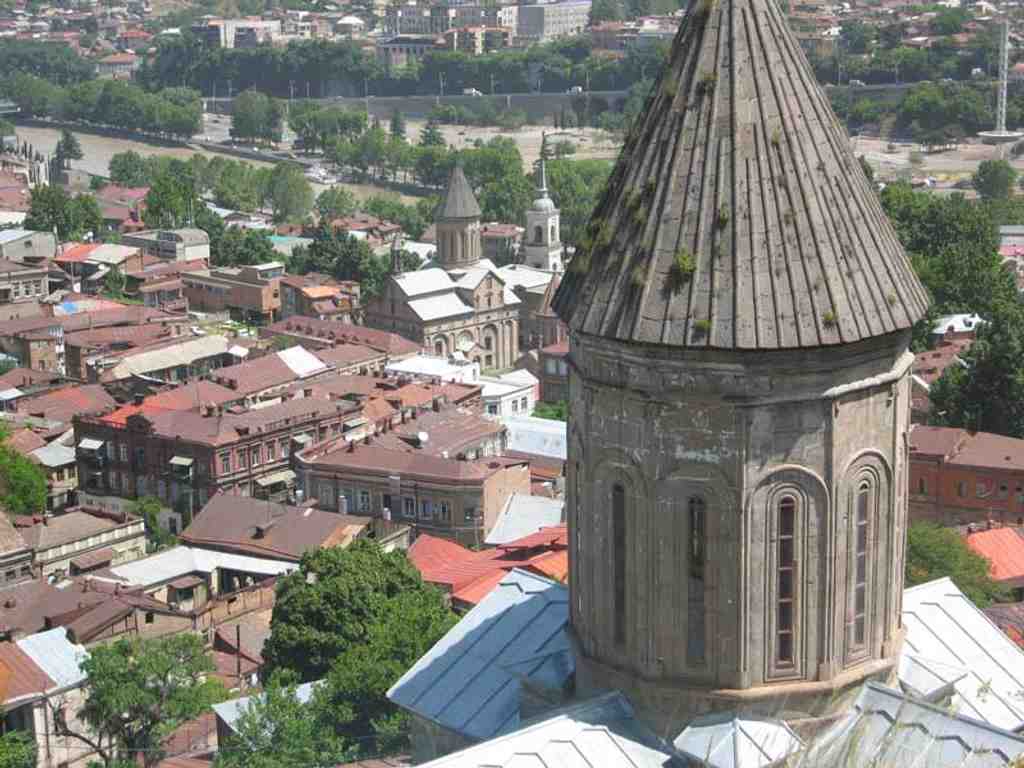
Alright, you're almost at stop number 10, the Holy Mother of God Church of Bethlehem! To help you spot it, look to your left-this church is known for its tall, cylindrical bell tower with slanted roof, which dominates the area. It's located at the foot of the Narikala Fortress, so you can use the fortress as an additional landmark to guide you.
Now, let's dive into the history of this beautiful structure:
The Holy Mother of God Church of Bethlehem, also known as the Upper Bethlehem Church, has an intriguing history that spans centuries and cultures. Originally built as an Armenian church in the 18th century on the site of an older chapel and finished by priest Gregory's descendants, it's now a Georgian Orthodox church! This transformation, however, makes it one of the storied edifices in Tbilisi.
The building history reads almost like an epic novel-complete with bravery, loss, and discovery. Construction was significantly driven by Agha-Meliq Bebutyan, a participant in the Indian crusade of Nadir Shah, who didn't get to see the final masterpiece as he was killed in battle against the Turks. His son, Meliq Avetis, built the surrounding fence, adding to the fortress-like structure.
Interestingly, during excavations in 1981, the basement of the original chapel was discovered inside the church, revealing more about its extensive past. It tells a tale of perseverance through times of conquest and conflict, including the brutal episode when the church treasures were hidden, leading to the murder of the Archpriest by Agha Mohammed Khan.
In the 1990s, transformations continued as the ownership transferred to the Georgian Orthodox Church. Unfortunately, some original Armenian elements were removed during this phase, including frescoes and altarpieces. Yet, it's these layers of history that give this church such rich character.
So, as you're standing here, think of it as a time machine in stone, its walls whispering tales from different eras and traditions. Isn't history cool?




