
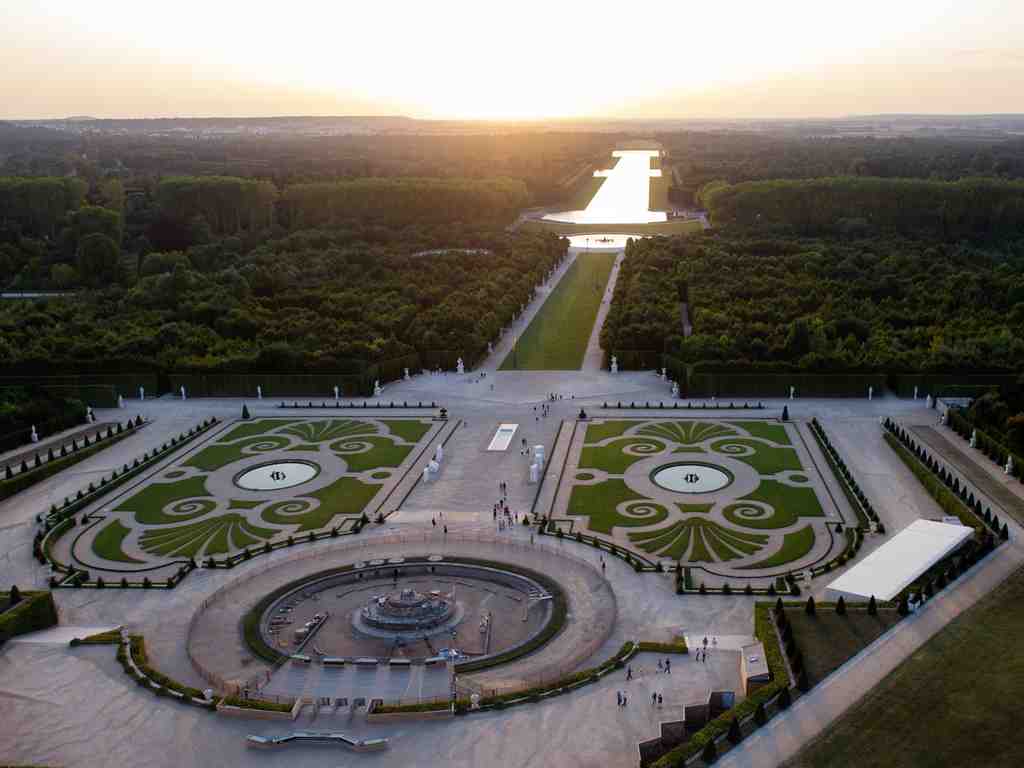
Directly in front of you is a grand oval basin surrounded by swirling green patterns in the grass, pathways that swoop out in spirals, and a cascade of terraces topped by a majestic sculpted group-this is the Latona Parterre, centered in the vast perspective of Versailles with the fountain and statue easily visible straight down the main avenue.
Welcome to the Latona Parterre! Now, take a look at that grand, multi-tiered fountain rising at the heart of this swirling green carpet, and picture this scene almost 400 years ago when Versailles was the playground for French royalty and their most creative artists. Designed by André Le Nôtre back in 1666, and later dramatically reworked by Jules Hardouin-Mansart, this parterre has always been a stage for theater, rivalry, and divine punishment-oh, and for frogs!
Here’s where myth meets marvel. High atop the fountain stands the marble goddess Latona with her two famous children, Apollo and Diana. But don’t be fooled: their serene faces have witnessed some seriously wild drama. According to the Roman poet Ovid, Latona-having caught the attention of Jupiter and the eternal jealousy of his wife Juno-was banished from every land. Pregnant and exhausted, she roamed the countryside, finally giving birth on the tiny island of Delos, only to find herself once again wandering through Lycia, desperate for water for her thirsty babies. When the local peasants, following Juno’s orders, cruelly forbade Latona and her children from drinking, the goddess had the last word: she transformed those unfriendly folks into frogs. Imagine the surprise on their faces-one second telling off a goddess, the next, croaking by the pond!
In the beginning, the fountain looked a bit different: animals and then humans surrounded the center, all poised in mid-metamorphosis. Imagine a circle of six unlucky peasants, their limbs shrinking, their mouths broadening, their eyes bulging-poor things!-and another ring of twenty-four croaking companions, forever frozen in frog form. Later, Hardouin-Mansart lifted Latona and her children up, placing them like royalty atop a dramatic cone of terraces, while peasants in mid-transformation populate the third terrace and alligator-turtles scuttle along the bottom, ensuring no one mistakes these gardens for just any old patch of green.
But wait, there’s more! Surrounding the water and the lush grass are grand statues of mythological heroes, philosophers, and legendary beauties-all sculpted by the finest French artists. If you see someone looking thoughtful, it might just be Diogenes or Plato, pondering the meaning of all these frogs. Along the ramps are elegant marble copies of antique statues, including gods, fauns, and heroes, each one echoing ancient glories. The parterre isn’t all marble and myth, though-in 1671 these statues were actually gilded, shining like sunbeams during the lavish festivities of Louis XIV!
And speaking of parties, the Latona Parterre once stole the show during royal celebrations: the fountains erupted with spray, the edges flickered with a thousand lights, and the garden seemed to shimmer under fireworks and the reflection of water-a show truly fit for the Sun King himself.
For Louis XIV, this wasn’t just a tale of cranky countryfolk and magical revenge. It was a message: defy the king and, well, you might just find yourself hopping around the lily pads. The imagery here quietly echoes the real-life drama of the Fronde, when rebellious nobles threatened young Louis, and reminds everyone-friends or frogs-who’s really in charge.
Centuries later, the Latona Parterre inspired gardens far beyond France, including the famous Buckingham Fountain in Chicago. After all, if frogs and gods can endure this long, why not a little slice of Versailles across the ocean?
So as you stand here, see Latona guarding her children, listen for a phantom frog or two, and imagine golden statues dazzling under royal fireworks-proof that even the greatest gardens can be filled with mischief, beauty, and just a little bit of royal warning.
Yearning to grasp further insights on the iconography, location and composition or the a manifesto of royal power? Dive into the chat section below and ask away.




