
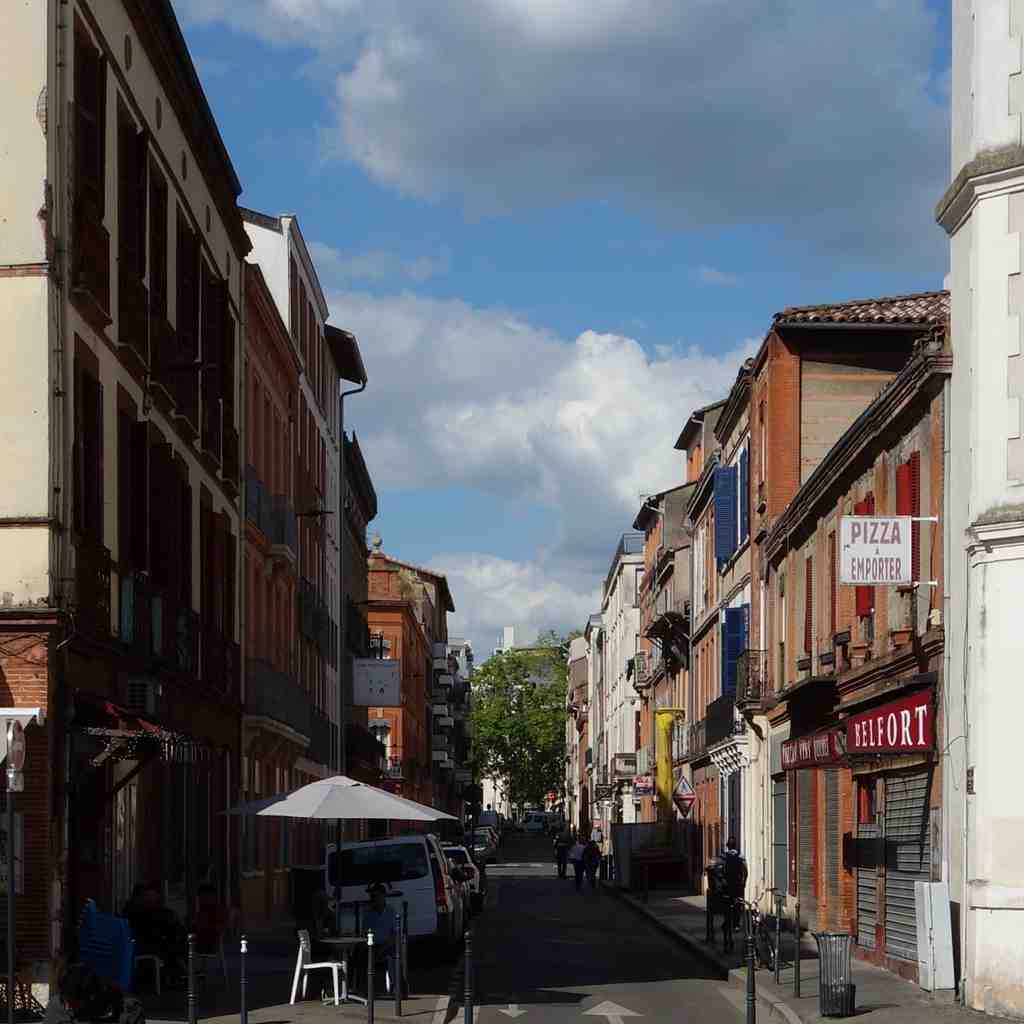
As you approach Bertrand-de-Born Street, look for a charming, narrow lane lined with red-brick and pastel buildings, lively shops and cafés, and balconies peeking out over the sidewalks-a true slice of Toulouse city life!
Welcome to Bertrand-de-Born Street, where the quiet hum of Toulouse’s past mixes with the buzz of today’s city! Take a deep breath-can you smell the hint of pizza from the nearby shop and the soft sweetness of brick dust in the air? No, that’s not the beginning of a new perfume, it’s just the authentic aroma of this Matabiau neighborhood. Picture yourself back in the late 1800s: the street is new, full of the energy of industrial growth. The canal du Midi to your right is bustling with barges hauling goods, and nearby stands the grand Matabiau train station, ringing with the shouts and whistles of travelers.
The street lies in the heart of a district that was designed for movement and industry. When this route was completed in 1868-a time when Toulouse was a hive of innovation-its buildings were a statement of confidence, business, and community. And if you feel the need for speed, don’t get your hopes up! The street’s a one-way and the speed limit is strictly 30 km/h. No wild chariot races here, I’m afraid.
But now, let me introduce you to the troubadour who gives this street its name. Bertrand de Born was anything but boring: a 12th-century poet and medieval rebel famous for his sharp tongue and satirical poems that could start barroom brawls-or maybe just awkward silences at royal banquets. The city council honored his legacy in 1941, but it’s a good thing they picked this name, because the street almost had an identity crisis! At first, it was named “Cambon,” for a Toulouse parliament president, but that didn’t last. Then it borrowed “Denfert-Rochereau” before finally settling on Bertrand de Born. Talk about a street with a complex!
Keep your eyes peeled for number 9-Immeuble Guitard-a classic neoclassical building reconstructed in 1881. See the light-colored bricks? The rows of windows on the first and second floors, dressed up with fancy molding and little cast-iron balconies? On the first floor, those windows are connected by a wide balcony edged with geometric, ironwork rails-a balcony perfect for spying on the neighbors or waving dramatically at passersby. Don’t forget to look up! The building is crowned with decorative cornices and quirky, round windows known as œils-de-bœuf, like watchful eyes peering down from the roof. At street level, you’ll find the lively chaos of shops, updated and changed through the years, but still bustling as ever.
Walking further, you’ll see more late-19th-century and early-20th-century façades, once home to busy manufacturers and warehouses, thanks to the street’s close connection to industry and trade. Imagine the clang-and-bang of workshops, the sweet-and-sour tangle of smells, the shouts as workers unloaded cargo from the canal.
From troubadours to factory hands to pizza-lovers, Bertrand-de-Born Street has hosted them all. And as you stroll along, remember: every doorway and step is layered with history, echoing with laughter, poetry, and the daily rhythms of Toulouse. So go ahead, walk in the footsteps of rebels, workers, and dreamers-the story of this lively street is just beginning with you!




