
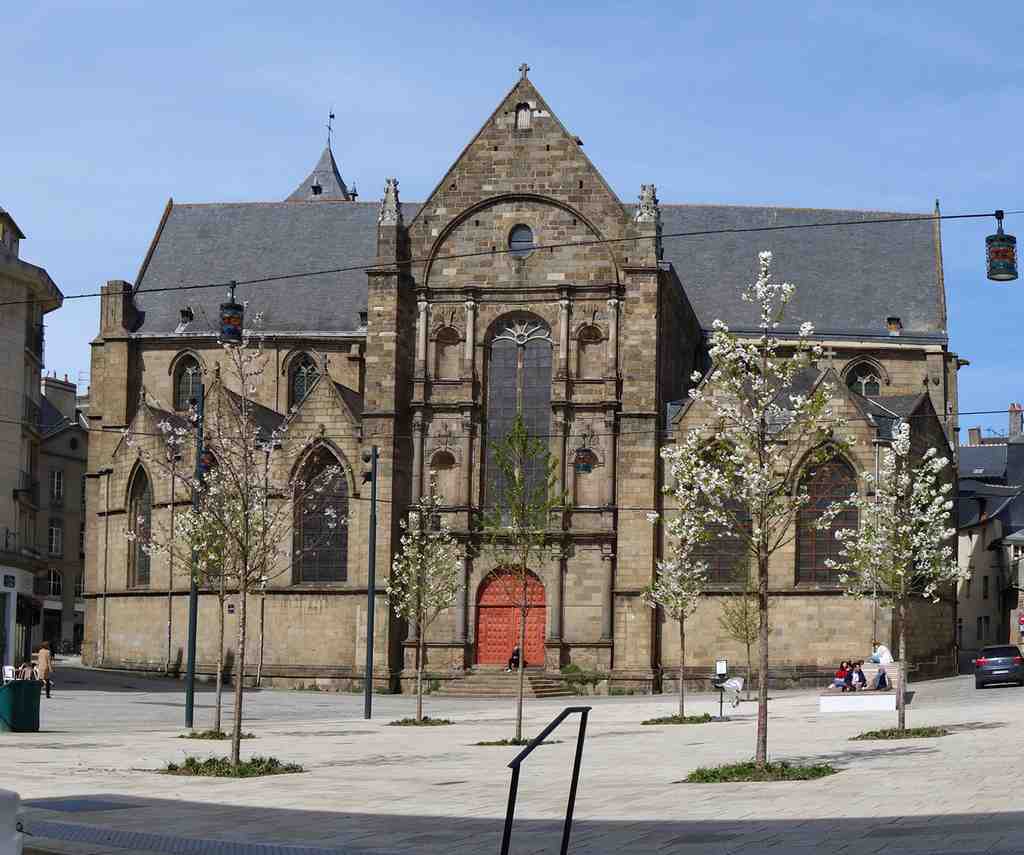
If you're looking for Saint-Germain Church, just glance across the sunny square for a large, rectangular Gothic stone building with a flat west wall and striking red double doors in the center, framed by tall pointed windows and a towering roof-it's hard to miss!
Welcome to Saint-Germain Church! Now, let’s step back in time for a moment-imagine the smell of stone and ancient timber and the faint echo of city life bustling outside as we stand before these tall, pointed arches. This church, right here in the heart of Rennes’ “new town,” has seen it all: from medieval merchants to high-powered parliamentarians. If these stones could talk, I bet they’d have some juicy stories-scandals, secrets, and maybe a little gossip about the neighbors on Place Saint-Germain!
Picture the year 1470. Builders are hard at work, but slowly-very slowly-a bit like your least favorite relative who never seems to leave. The church isn’t finished until 1690, over two centuries later! It starts off in the flamboyant Gothic style, a real local specialty, with intricate stonework and soaring arches, but it finishes in the Renaissance style. Talk about a fashion makeover. Even the church’s layout breaks the rules: it’s not your usual cross shape, but rectangular, with a quirky, angled corner on the southwest side, following the path of an old Roman road. And if you’re wondering about the bells-well, the proud tower rising above you wasn’t even a church tower at first but a beffroi-part of the city’s guardhouse. The church inherited it, probably after much negotiation and maybe some cookies exchanged with the city council.
But there was a church here even earlier-in the twelfth century! That one was surrounded by a graveyard. Today, only two pillars next to the sacristy remain from that primitive church. A little spooky, a little magical…
Look up at the west facade and imagine what was once a giant Gothic window-home to the legendary Apocalypse stained glass. Now it’s blocked by an impressive organ: say hello to the star of the church’s musical history! This instrument didn’t even originate here; the grand organ case once belonged to an abbey far from Rennes, and since the early 1800s, it has drawn music lovers from near and far. Over the centuries, different families and workshops have added their own notes-like a centuries-long game of musical telephone. The current organ has a grand total of three keyboards, a pedalboard, and thirty-six stops. That’s enough to shake the dust from even the oldest stonework!
Step inside, in your mind’s eye, and you’ll see the church is filled with soaring Breton Gothic arches, slender pillars, and wooden beams decorated with fantastical and comical faces: monsters, grotesques, and wild creatures straight from a medieval cartoonist’s imagination. The roof vault rose much higher than first planned-originally, it was meant to be wooden, but was switched to stone in the 1600s. Thanks to this change, the ceiling feels almost sky-high, echoing with every footstep and whispered prayer.
Turn your gaze to the windows. Saint-Germain is home to Rennes’ oldest surviving stained glass window-crafted in the 1500s and beautifully restored in the 1800s, it sits quietly on the south side, pieced together from bits and bobs rescued from barrels after the Revolution. No neat stories here-the fragments are shuffled like a stained glass jigsaw puzzle, creating a dreamy, abstract splatter of color and history. Elsewhere, the master glass artist Max Ingrand left his signature in the twentieth century, brightening up the rest with his luminous windows, turning the walls into a canvas of light.
Behind the main altar, you’ll spot a grand painting of the raising of Lazarus by Eloi Firmin Féron-a prize-winner from Rome who won the king’s favor in the 1800s. Before this, an earlier work on the same subject by Gaspard de Crayer held the spot; the Musée des Beaux-Arts swaps these masterpieces like fancy wallpaper.
And don’t miss the details: a finely carved eighteenth-century baptismal font railing shines in the light, and the pulpit, built in 1805, is decorated with vibrant reliefs of the four evangelists. Above, an angel blasts a trumpet, probably to make sure nobody falls asleep during a long sermon.
Oh, and the altar? It’s a cross-country traveler! Built for Saint-Malo’s cathedral in the late 1700s, it found its way here in 1805 after the Revolution left Saint-Germain rather empty-handed. Over time, artisans added columns of vivid marble, a gilded wooden canopy, and chubby cherub faces-by 1855, a radiant, triangle-shaped “glory” was added, surrounded by flying angels.
Today, Saint-Germain Church sits proudly as a classified historic monument, quietly collecting all the stories, hymns, and footsteps of Rennes’ lively past. So take a good look-you’re facing a place where history and legend are stitched together, brighter than any stained glass. And unlike the builders here, I promise not to take 200 years to finish the story!




