
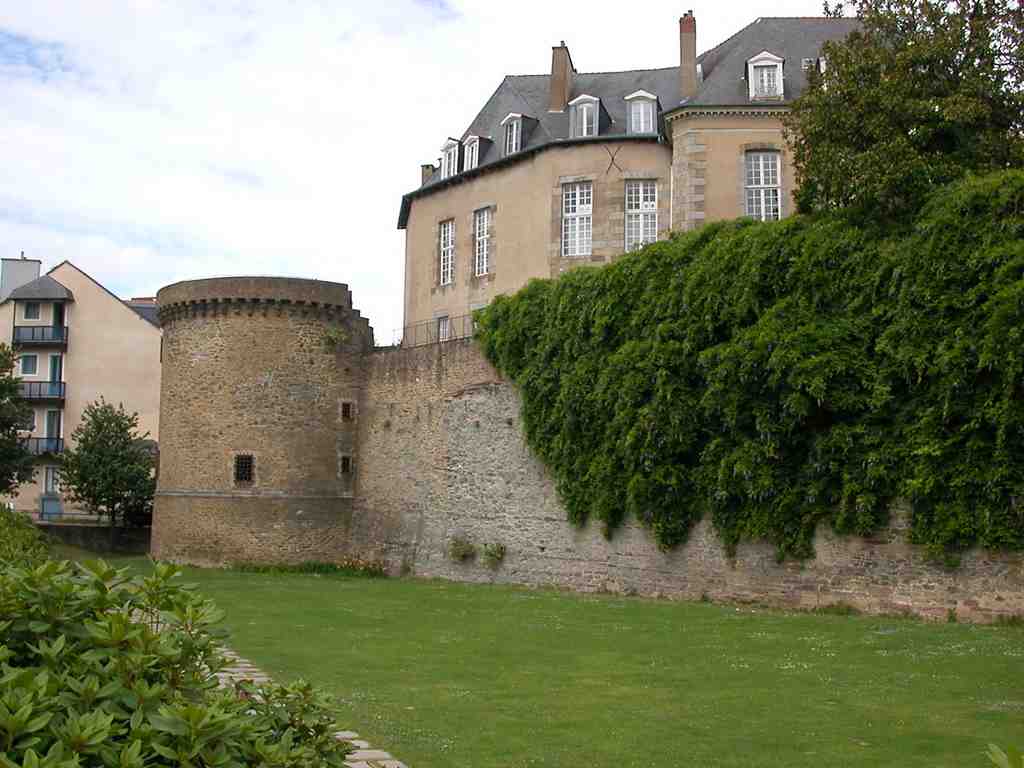
To spot the Ramparts of Rennes, look for a thick stone wall stretching in front of you, with a rounded turret on one end and vines cascading over part of the wall, set just below an old mansion-like building.
Now, take a deep breath and look up at these ancient stones-because you’re staring at some of the last standing sentinels of Rennes’ wild and battle-filled past. Imagine the year is somewhere around 275 AD, and the town-then called Condate-has no walls and is free to spread out as it likes. But suddenly, the peaceful days are shattered by the chaos rocking the Roman Empire. In desperation, after a nasty series of lootings, the townsfolk roll up their sleeves and start stacking giant blocks of granite, mixing them with red bricks, to form a wall so solid it was almost impossible to take down-so much so that when demolition crews tried centuries later, the sound of chisels and hammers must have echoed across Rennes for days on end.
This original wall was no ordinary fence. It stretched almost 1,200 meters and surrounded nine whole hectares-giving Rennes the nickname “the red city,” thanks to those distinctive Roman bricks. The architectural details weren’t just for show: along the outside, you would see diamonds and triangles made from white stones, and some bricks laid in stylish herringbone patterns. “Look at us!” these walls seemed to brag, “Nobody’s taking this city easily!” And if you were a rogue Viking or a sneaky bandit, well, good luck. There were rows of wooden stakes along the River Vilaine to keep you at bay, and every so often another fearsome tower would loom from the wall, keeping a sharp eye on the horizon.
Rennes itself was a bit of a medieval fortress theme park: there were four main gates, guarded with towers so sturdy that they needed continual repair, especially after sieges like the one led by Nominoë in the ninth century. Over the years, the wall was constantly strengthened and updated-new ditches were dug, older bits patched up, and even whole new layers added. Sometimes, right after a siege or major scare, you’d find masons scrambling to make sure every tower and gate was in top shape. They took this wall seriously!
By the 1400s, things got even more... crowded. Rennes was booming, and the city’s suburbs had grown like eager fans sneaking into a stadium. The powers that be-led by Duke Jean V-realized the old monster wasn’t big enough, so they built two new defensive layers. The first, enclosing the bustling “New Town,” was packed with traders, artisans, and, just to even things out, a few monks. Here, a 22-meter-tall stone tower, grandly called Le Bart, sprang up-and eventually ended up as a prison (talk about job changes!). The second layer, pushed out even farther, wasn’t quite as refined: built quickly and cheaply as the population spread, sections of it fell apart fast, crumbling under the stress of new-fangled cannons-or maybe just some overly enthusiastic goats. Some towers were already showing cracks less than ten years after they were built! You had to feel sorry for the quality control team.
As gunpowder became the new boss in town, the defenders added “boulevards”-oval-shaped bastions bristling with cannons ready to bark at any nearby enemy. By now, any would-be attacker must have felt a bit like they were trying to break into a fortress built by over-caffeinated, slightly paranoid beavers.
And then, in a twist worthy of a sitcom, along came the union of Brittany with France, pushing the front lines so far away that the walls weren’t much needed anymore. Bit by bit, whole chunks of the ramparts were sold off and knocked down as Rennes grew. Today, only fragments like this one remain-hidden, protected, even tucked into people’s basements. The sections you see in front of you, between Place du Maréchal-Foch and Rue de Juillet, have survived centuries of change, their stones still whispering the stories of “the red city.”
You’re not just looking at an old wall: you’re standing where Romans, dukes, crafty masons, scared peasants, and a few underpaid laborers left their mark. And thanks to archaeological projects and restoration efforts, these last proud remnants are now being honored and revealed along this green, peaceful stretch, where once you’d have heard swords clashing and the clang of armored boots.
So, as you walk here, just imagine the ramparts stretched all around-alive with guards, flickering torches, and the ever-present rumble of history, peeking out like roots beneath your feet and all around this remarkable city.
Fascinated by the situation, roman enclosure or the extensions in the fifteenth century? Let's chat about it




