
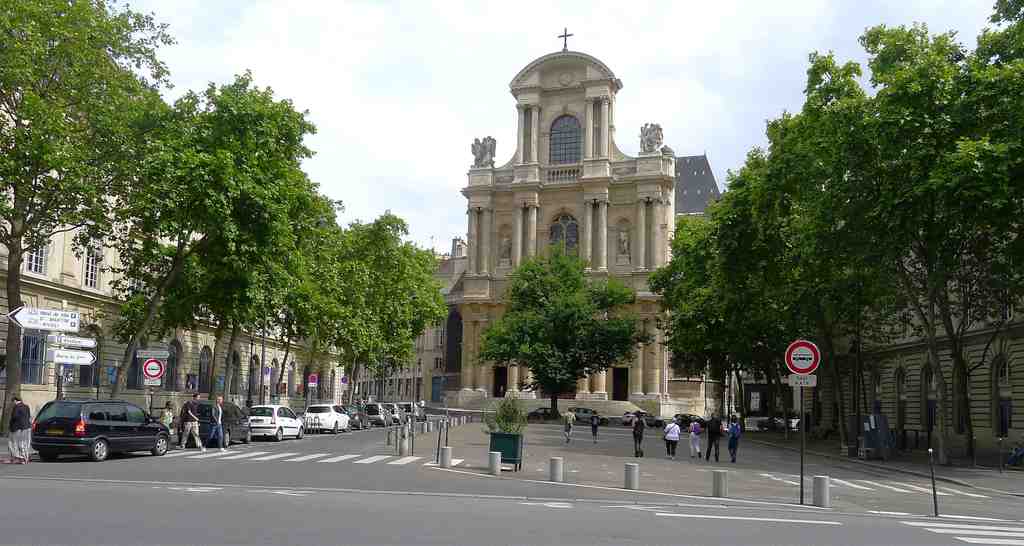
To spot Place Saint-Gervais, just look for the open trapezoid-shaped square framed by leafy trees and ringed by handsome old stone buildings, with the towering, ornate façade of the Saint-Gervais-Saint-Protais church rising dramatically at the far end.
Welcome to Place Saint-Gervais! As you stand here, take a deep breath and imagine the centuries pressing in all around you-because if these cobblestones could talk, they might never stop chattering!
This square is one of the oldest crossroads in Paris, right in the very heart of the Saint-Gervais neighborhood-a place that’s seen more pageantry and peculiar happenings than a royal court on parade day. Let your eyes follow the trapezoidal shape of this open space, edged by the shadows of grand old buildings and the whispering leaves above. But, if you really want to tune into the spirit of Place Saint-Gervais, you’d better look for the legendary “Orme Saint-Gervais.” Don’t worry, you can’t miss it! It’s the proud elm tree standing before the church. Fun fact: this isn’t just any tree-it’s the latest in a long line of elms that have graced this spot since the Middle Ages!
Back in those days, this place was called the “carrefour de l’Orme”-or Elm Crossroads. Why? Because, believe it or not, it was common to plant an elm before the main churches. And what an elm! Protected by a big chain, it was an all-star of Parisian community life. After mass, villagers would gather under its branches, finding shelter from the rain AND the sun-which, in Paris, sometimes happens in the same hour. Here, local judges settled disputes, landlords collected their rents, and townsfolk swapped stories, gossip, and probably a few questionable jokes. Artists loved this tree too! The “Orme Saint-Gervais” has been immortalized in paintings, carvings, and even on the church’s own choir stalls.
But don’t think it was all neighborly chats and shade. If you lived here in the 1400s, you might have owed rent to the Duke of Guyenne, and you’d pay it right here at the foot of the elm. Imagine the tension-coins nervously clinking, eyes scanning the square, hoping your purse was heavy enough to appease the landlord. And let’s not forget, this lively hub was immortalized in poems as “l’Ourmetiau,” or “little elm,” when the tree was still a youthful sapling-just a sprout with a big future.
Flash forward to the time of grand revolutions and sudden change: around 1790, the elm was chopped down to make room for an expanding, modern Paris. Its wood, legend says, went to the cannons-so from giving shade to giving firepower, the Place Saint-Gervais elm was truly a tree of many talents.
Like any good Parisian square, Place Saint-Gervais evolved. In the 19th century, it was expanded and boxed in by elegant stone buildings, including military barracks-one for the Garde, another for municipal workers, all bustling with the city’s comings and goings. Nowadays, if you see people hurrying off to the Hôtel de Ville, they might just be passing the same space where, not so long ago, hopeful job-seekers gathered under the tree to “strike a deal”-quite literally!
The current elm was planted in 1935, renewing a tradition that’s as rooted in Parisian life as the tree itself. And since 2025, the square also shelters the touching Jardin du 13 Novembre 2015, a living memorial to resilience in the face of tragedy.
So, as you stand here, let your imagination reach back seven centuries. Feel the voices gathered, the judgments rendered, the laughter and the worries shared beneath spreading branches. In Place Saint-Gervais, history isn’t just beneath your feet-it’s in the air, in the shadows, and, of course, in the leaves overhead. Welcome to the crossroads of time in the heart of Paris! Ready to find out what’s around the next corner? Let’s go!




