
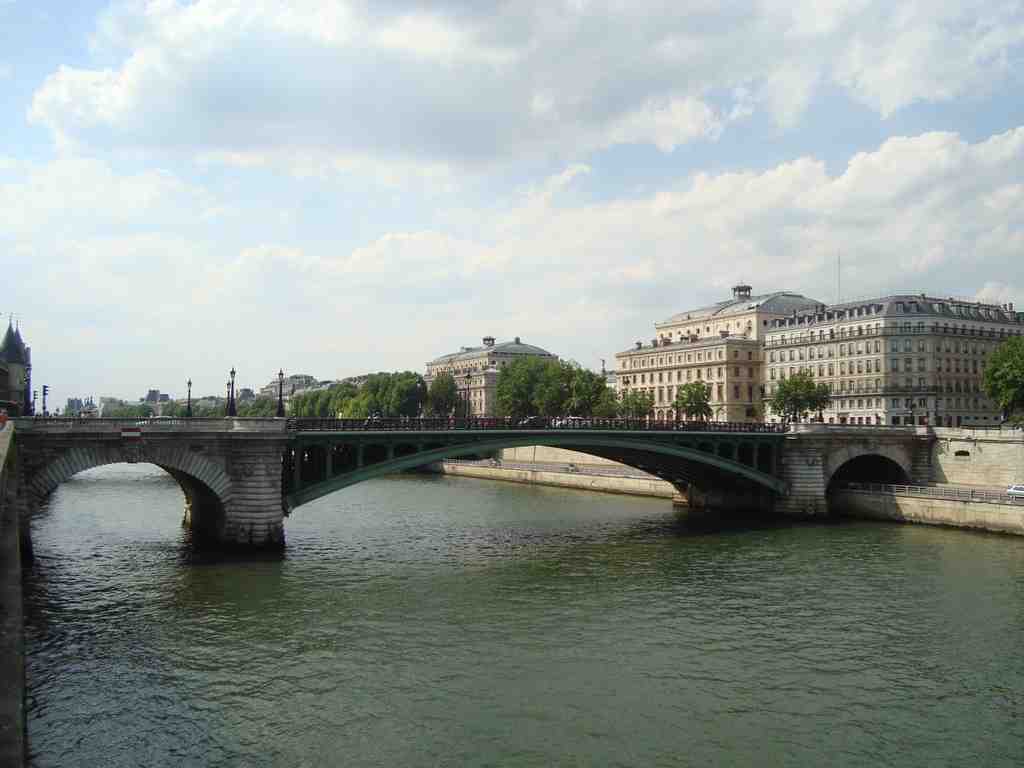
Just ahead of you is the Our Lady Bridge, or Pont Notre-Dame. To spot it, look straight over the Seine. You’ll see a graceful green metal bridge arching across the river, connecting two beautiful old stone embankments. Its elegant shape and low arches are perfectly framed by the grand buildings on either bank, and if you glance along the top, you’ll spot rows of traditional Parisian streetlights.
Now, let’s travel back in time together. Imagine it’s a chilly morning in the Middle Ages. Instead of this strong metal bridge, you’d find a rickety walkway of planks, called the “planches de Mibray.” Picture the thumping of wooden wheels, shopkeepers shouting, and the sound of the river rushing underneath.
This spot has always been the gateway to the very heart of Paris, connecting the right bank to the island of the city-Île de la Cité. It was here, in 1413, that King Charles VI himself hammered in a post and named the bridge Pont Notre-Dame. Back then, houses actually lined each side, with colorful markets and bookshops perched above the water. Imagine the smell of fresh bread, the clang of an armorer’s hammer, and the soft flutter of book pages. But, as you might guess: houses and water don’t always get along.
In 1499, after years of warnings, disaster struck. On a stormy night, the city woke to a thunderous crash as the bridge suddenly broke apart, and all those houses tumbled with a splash into the Seine.
The people responsible were so blamed that they landed in prison-it’s safe to say, nobody wanted that job after! Today, the bridge is calmer, built strong in the 1800s, and if you listen closely, maybe you’ll hear the whispers of old booksellers and the distant clatter of medieval Paris echoing across the water. Keep walking-Paris has many more secrets for us to discover!




