
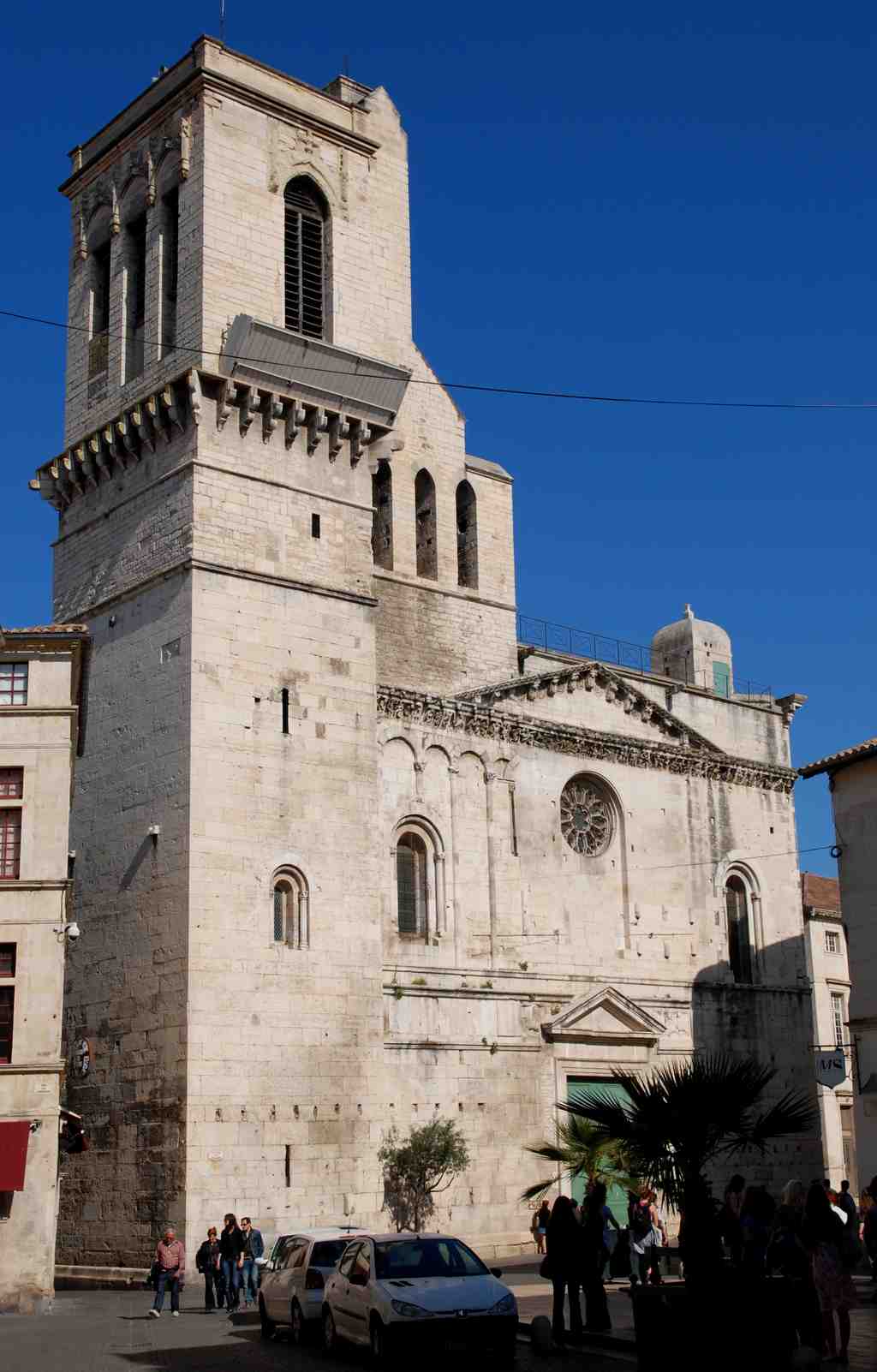
To spot the Notre-Dame-et-Saint-Castor Cathedral, just look ahead for a tall, square, fortress-like stone tower with deep-set arched windows, Romanesque arches along the façade, and a big green door topped by a triangular pediment-standing proudly on the bustling Place aux Herbes.
Alright, my friend-here you are, outside the Notre-Dame-et-Saint-Castor Cathedral, and if these ancient walls could talk, I bet they’d have an opinion about all the pigeons. But let’s step back in time together, and listen to the echoes of Nîmes’ past.
Centuries ago, this very spot looked a bit different-archaeologists have found traces of a church here from the 7th century, buried just beneath your feet. Imagine the gentle hum of medieval prayers and the steady pace of funeral processions, since this place served as a constant resting ground for Nîmes’ citizens for hundreds of years. Over those early centuries, churches were built, knocked down, then built again-each one bringing something new to the site, like a cake that just kept gaining layers.
Now, shift forward to 1096: the first big Romanesque cathedral rises on top of all that history, grand enough to persuade Pope Urban II to come and dedicate it himself. The thick stone you see still carries the rhythm of graceful carved arches-a style straight out of old Provence. On the left side of the front, look closely and you’ll spot a row of biblical scenes, like a stone comic strip for the ancient crowd.
But it wasn’t always peaceful here! During the religious wars of the 1500s and 1600s, the cathedral was battered and bruised by the Reformers-imagine windows shattering, flames licking the old stones, and desperate townsfolk running to protect their church. One tower, the “treasure tower,” was destroyed (and honestly, if you see a treasure tower get blown up, you know it’s been a wild week). The Protestant community even chipped in money to rebuild the nave-that’s some fierce local cooperation.
The cathedral we see today mostly comes from the 17th century, built under Bishop Cohon, who favored a sweeping, single nave lined with chapels and crowned with a beautiful baroque Rosary chapel at the far end. If you picture golden candlelight and echoes under those soaring arched ceilings, you’ve got the atmosphere spot on. In the 1800s, a duchess had the entrance rebuilt to a neoclassical style, so she could pass through with her grand canopy-sometimes royalty just needs a bigger front door.
But there’s a twist! Step inside, and you’ll find not just classical grandeur, but a burst of Romano-Byzantine decoration, added by an imaginative architect named Henri Antoine Révoil in the late 1800s. He wanted to remake the façade, but was stopped… otherwise, who knows what kind of exterior fashion statement this place would make!
Look up at the north tower, capped with a terrace reached by a winding spiral staircase-it climbs up 40 meters into the sky, so if you hear the ghostly ring of bells, you know they’re coming from one of the eight bells in the tower. The ninth old bell is out of service, sitting a bit forlorn above the choir.
And before you leave, imagine the deep, thunderous notes of the cathedral’s organ, which has been shaking the walls since 1643. Its great case is so famous, it's protected as a national treasure, and the sounds have grown richer with every restoration. The latest major touch-ups were finished in the 1980s, so if you hear a triumphant chord echoing through the streets, you know that centuries of music are still alive right here.
So, standing in the heart of Nîmes, you’re not just at a cathedral; you’re surrounded by centuries of hope, destruction, reinvention, and a parade of colorful characters who all left their mark-sometimes with a chisel, sometimes with a bell, and sometimes with a really grand entrance.
For a more comprehensive understanding of the historical, description or the the organ, engage with me in the chat section below.




