
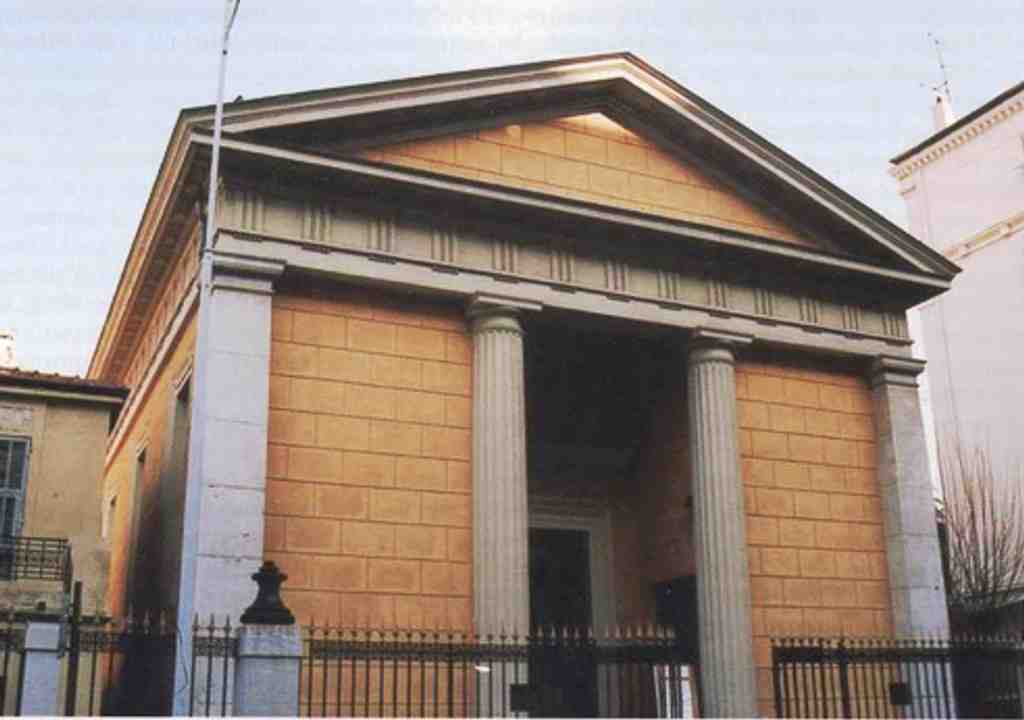
Right in front of you, you’ll see a simple yet striking building that stands out from its neighbors. Look for its soft yellow-orange façade and the tall, classic columns that hold up a clean triangular roof, a bit like an ancient temple from old Greece. The entrance is set back between the columns, and there’s an iron fence surrounding the front. The structure seems a little out of place here, and that’s your clue-you’re looking at the Waldensian Temple of Nice.
Imagine standing here in the mid-1800s. This street was busier than you’d expect, filled with the sounds of people speaking not just French, but Italian-and many other languages, too. The building before you was once alive with the hopes of a community that had faced years of struggle just to practice their beliefs. The Waldensians, as they were known, weren’t the powerful kind of people you’d expect to build such a proud temple. They were ordinary folks-hotel workers, gardeners, even seamstresses-most from the high valleys of Piedmont, over the mountains, who found their way to Nice for work and safety.
Now, close your eyes for a moment and picture this: before this temple, all they had was a cramped apartment above a shop, then a slightly bigger space on a lively street. Finally, after years and years, and with a lot of excitement and maybe a touch of fear, they managed to buy this patch of land right here and start building something of their own, something lasting.
It’s not just a place for prayers. Behind these walls, there were classes for children, noisy sewing gatherings, and even a free library. Yet, the air around this place wasn’t always so free. For a long time, Protestant worship was forbidden here, and just a few decades earlier, you wouldn't have seen this temple at all.
There’s a little twist to the story-now look along the side, where a narrow passage runs beside the temple. That lane is named after this very place, the Passage du Temple Vaudois-a reminder of what once happened here.
Even after France took control of Nice in 1860, the Waldensian community had to negotiate-literally-how they could keep worshipping inside this temple. They struck a deal, with annual payments as small as a symbolic hundred francs, just to prove they still had a right to be here.
So next time you see the doors shut or hear the silence inside, remember: this building was once full of life, languages, arguments, and laughter. And even now, its columns and quiet strength stand as a sign that, sometimes, the most ordinary people can build extraordinary things in the face of uncertainty.




