
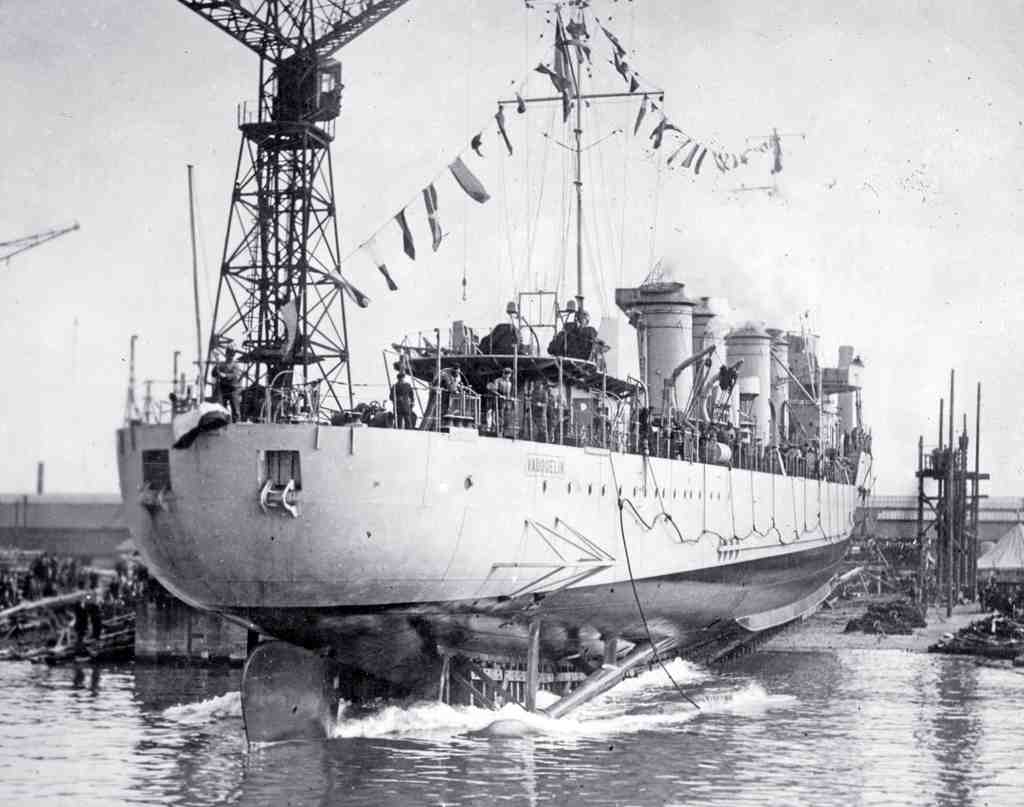
On your right, look for a long brick-and-metal industrial building with a broad rectangular form and a distinctive sawtooth roofline, the kind of profile that gives away a working shipyard at a glance.
This place tells one of Dunkirk’s biggest working stories. In eighteen ninety-nine, Léon Herbart, the president of the chamber of commerce, created the Ateliers et chantiers de France here beside the port. That may sound like a boardroom footnote, but the idea was bold and very practical: French yards were busy building warships, merchant shipbuilders needed space, and French shipowners kept taking their orders to England, where prices were lower and delivery moved faster. Dunkirk wanted that business back.
The early years were not exactly fireworks. The yard first turned out only four barques for the Bordes company, all four-masted sailing ships. Then it tried trawlers, but there was a catch... without a boiler workshop, the hulls had to be towed all the way to Le Havre just to get their machinery fitted. That is a little like baking a cake in one town and driving it somewhere else for the oven.
Then came the order that changed everything: cargo ships for the Société navale de l’Ouest. To fill it, the yard expanded its boiler shop. Under chief engineer Henry Boyd, an Irishman with a sharp eye for modern industry, Dunkirk began launching ships fully equipped and ready to sail. For the time, that was a serious achievement.
Soon this yard became the city’s industrial heavyweight, employing between two thousand and two thousand five hundred workers, plus a swarm of subcontractors. During the First World War, enemy fire, labor shortages, and scarce materials hit hard, yet the yard kept going, building not only ships but also munitions and vehicle armor.
By the nineteen twenties crisis, the company leaned on military orders and built destroyers, patrol vessels, oil carriers, and more. When Operation Dynamo unfolded, the shipyard stood right inside that storm of war we spoke about earlier. In nineteen forty, it had four building slips, each one hundred eighty meters long.
Its later chapters were just as dramatic. In nineteen thirty-seven, the yard launched L’Émile Miguet, then the largest tanker in the world. It built the ocean liner Flandre, launched in nineteen fifty-one, and then the M-S Pasteur, launched in nineteen sixty-six, the last passenger liner built in Dunkirk. After mergers and name changes in nineteen sixty and nineteen sixty-seven, the yard kept producing dredgers, tankers, bulk carriers, and methane carriers, until the Train-Ferry Nord Pas-de-Calais sailed out in nineteen eighty-eight as the last vessel to leave.
If you need the practical bit, the office keeps weekday hours from nine to twelve-thirty and from two to six, and it is closed on Saturdays and Sundays.




