
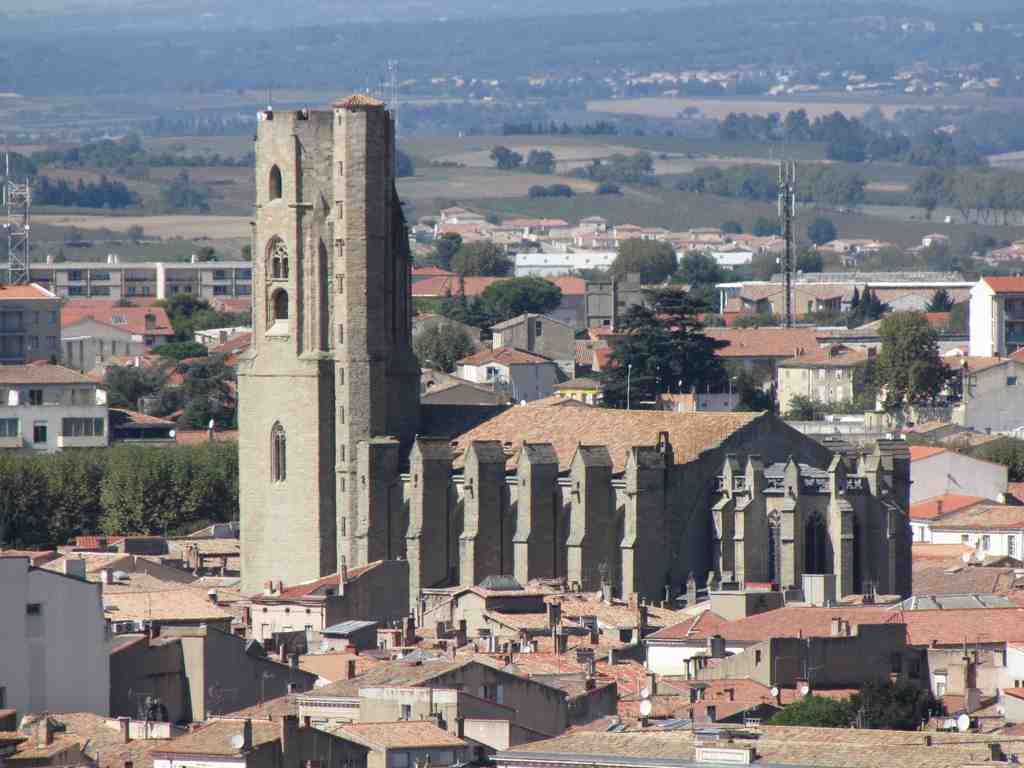
To spot the Church of Saint-Vincent, just look for the tall, square bell tower with its soft tan stone, rising high above the rooftops; it stands head and shoulders over the neighborhood, its sharply angled Gothic windows gazing out over the city.
Ah, here we are-standing in front of the mighty Church of Saint-Vincent! Let’s picture this place almost 800 years ago, when Carcassonne was two bustling neighborhoods packed around the famous fortress. There was once another Saint-Vincent church to the north, but back in 1240, it was swept away, quite literally knocked down during a wild attempt by Raimond II Trencavel to take back the city. The result? Not much left standing-just a need to rebuild.
Seven years later, King Saint Louis had an idea: let’s build a new district on the river’s left bank! If you listen closely, you can almost hear the rattling of carts and the distant clang of hammers as they laid out the chessboard-like streets. Two churches would stake their claim-Saint-Michel in the south, and, right here, Saint-Vincent in the north.
Now, the first attempt at the new Saint-Vincent? Let’s just say, if you sneezed too hard, it might’ve blown over! It was too small and made of barely-there materials. When the city finally got the royal thumbs up in 1308 to buy some actual land, the real church began to rise. But in true French fashion, they started from the wrong end-building the porch and nave first, leaving the choir for last. The whole thing took over 60 years!
This church has seen its share of drama. In the 1500s, the tower you see rising above you served as a lookout for approaching armies. And not just once-it was even battered by cannonballs during the religious wars! Fast forward to the French Revolution: Saint-Vincent traded prayers for fire and steel as it became a forge, with roaring furnaces glowing in the chapels and sparks flying everywhere. But when peace returned, the people begged for their church back, crowding in so stubbornly that officials had to break down the doors with axes-only to face a silent crowd who’d spent the night inside protesting.
Here’s a fun fact: for centuries, this was France’s widest Gothic nave, stretching over 20 meters across! Only two churches in all Europe ever got wider-pretty impressive, don’t you think? The church’s tower, meanwhile, soars 54 meters tall. If you feel like a workout, count all 232 steps to the top! This same tower played an odd part in making maps-scientists Cassini and his sons climbed up here to help measure France, and later, Pierre Méchain and Jean-Baptiste Delambre calculated the length of the meridian.
On the outside, the church is all flowing lines and impressive stonework. The west facade’s monumental portal, once decorated by four grand statues, still oozes drama. Peer up and imagine saints and apostles looking down, probably hoping you brought a croissant for your visit. The pattern of the church-a single, massive hall lined with dozens of chapels-was so effective they copied it for the city’s cathedral.
And let’s not forget the music! In 1737, the faithful splurged on a showstopping organ, crowned with golden angels and Saint Vincent himself. It’s now protected by law and recently restored, ready to shake the dust off the rafters. Inside the bell tower, you’ll also find a carillon-fifty-four bells in all, ranking among the loudest and most melodic in France. Early on, there were just seven, but locals decided that wasn’t nearly enough clang for their buck.
As you look up, remember: every stone here witnessed fierce battles, candlelit protests, hammering blacksmiths, and the laughter of generations. Just try not to imagine what 232 stairs would’ve done to the mailman!
Wondering about the ownership and management, organ or the bells? Feel free to discuss it further in the chat section below.


