
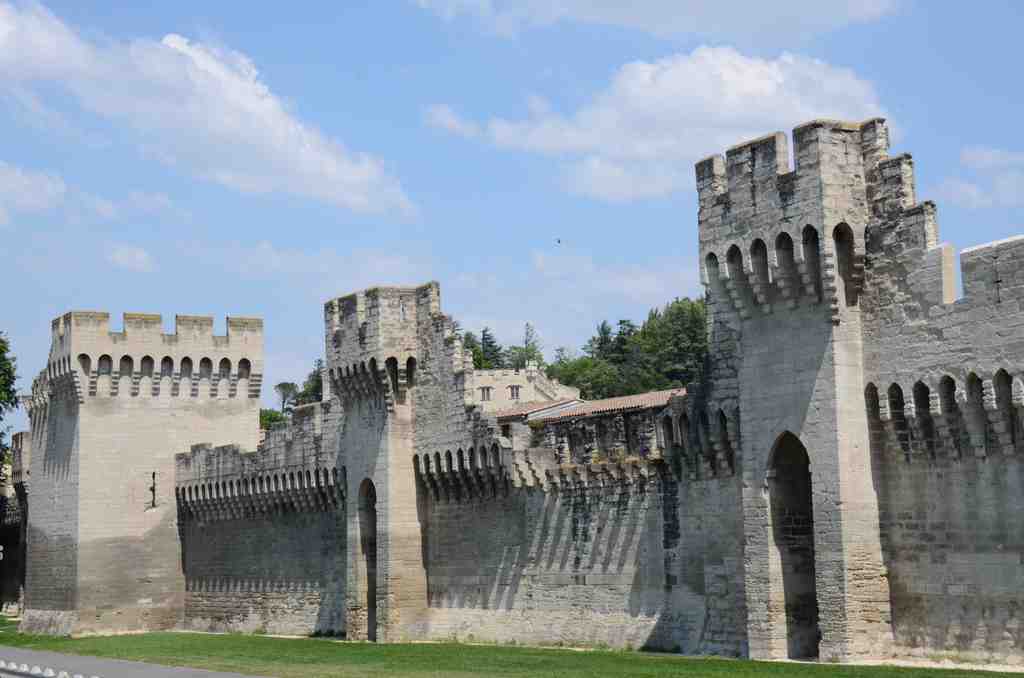
Right in front of you, you’ll see the sturdy, pale stone Walls of Avignon, stretching in a near-straight line with tall, square towers and deeply notched battlements-just look for the imposing medieval walls that zig-zag against the sky like the guards of an ancient fortress on watch.
Imagine standing here in the 14th century: the air thick with tension, the clang of builders’ hammers echoing as huge blocks of limestone are stacked to form these very walls. The townspeople bustle under the shadow of the towers, eager to feel safe inside their city while curious goats-yes, goats!-try to sneak through the maze of moats and gates for a nibble of someone’s laundry.
Before these defenses, Avignon had double walls and moats in the 1200s. But during the Albigensian Crusade, the city backed the wrong side and paid dearly-after a punishing three-month siege, Avignon was forced to pull down its old walls and fill in its moats. But a couple decades and some stubbornness later, the townsfolk rebuilt them. As you walk, behind some modern streets you still follow their ancient path, though aside from a single fragment, those early fortifications are whispers from beneath your feet.
The real drama began when the Popes moved to Avignon in 1309. Picture religious officials, artists, and merchants pouring into town, markets booming, and houses sprouting like mushrooms outside the old city walls. It didn’t take long before everyone realized these newcomers-especially the papal bigwigs-needed protecting from the bands of mischievous mercenaries roaming France in the chaos of the Hundred Years’ War. So, in 1357, the pope declared, “Let’s raise new walls!” (After collecting a little tax on wine and salt-cheers!) Twenty years-plus more taxes, papal loans, and lots of sweat-later, a truly mighty wall surrounded an area three times bigger than before. Twelve mighty gates, tall towers, and moats deep enough to make every frog in France jealous.
Some unlucky folks weren’t so lucky, though. If you tried to get through these gates when the drawbridges were up and the portcullis slammed down, you’d better have a good story-or at least a fresh loaf of bread. Each gate was heavily fortified for defense, but if your donkey’s singing kept the guards awake, maybe you got a wink and a pass!
Over the centuries, the walls evolved-a gate here, a tower collapse there, always adapting. By the time the Renaissance rolled around, cannons thundered to life, and new holes were made for them in the towers. Whenever change swept through France-like the French Wars of Religion-gates slammed shut, were walled up, or got reinforced, just in case some hungry army or angry neighbor came knocking.
Think of the rainstorms! The walls doubled as a flood barrier. In 1840, the Rhône river rose over eight meters, and the streets filled like bathtubs. Town leaders had to quickly slot in wooden planks and stuff gaps with straw and earth to keep out the water. Sometimes, not even that was enough-a section of the wall once collapsed during a massive flood, sending a rush of water through the streets, carrying more mud than a herd of wild pigs could ever dream of.
And yet, Avignon’s walls still stand-4.3 kilometers in all, ringed by ancient towers and stories. Once a symbol of papal power, fortress, flood defense, and, sometimes, a very effective toll booth for collecting taxes! Today, as you trace your hand over the cool, timeworn stones, you’re touching centuries of defiance, laughter, fear, and hope-proof that Avignon always rebuilt, even when the world outside was in chaos. And who knows, if you listen closely, you might just catch a goat bleating in the distance, still trying to sneak in.
Ready for the next chapter? Let’s continue our journey deeper into Avignon’s living history!
For a more comprehensive understanding of the early fortifications, 13th century double walls or the avignon papacy and the 14th century city walls, engage with me in the chat section below.




