
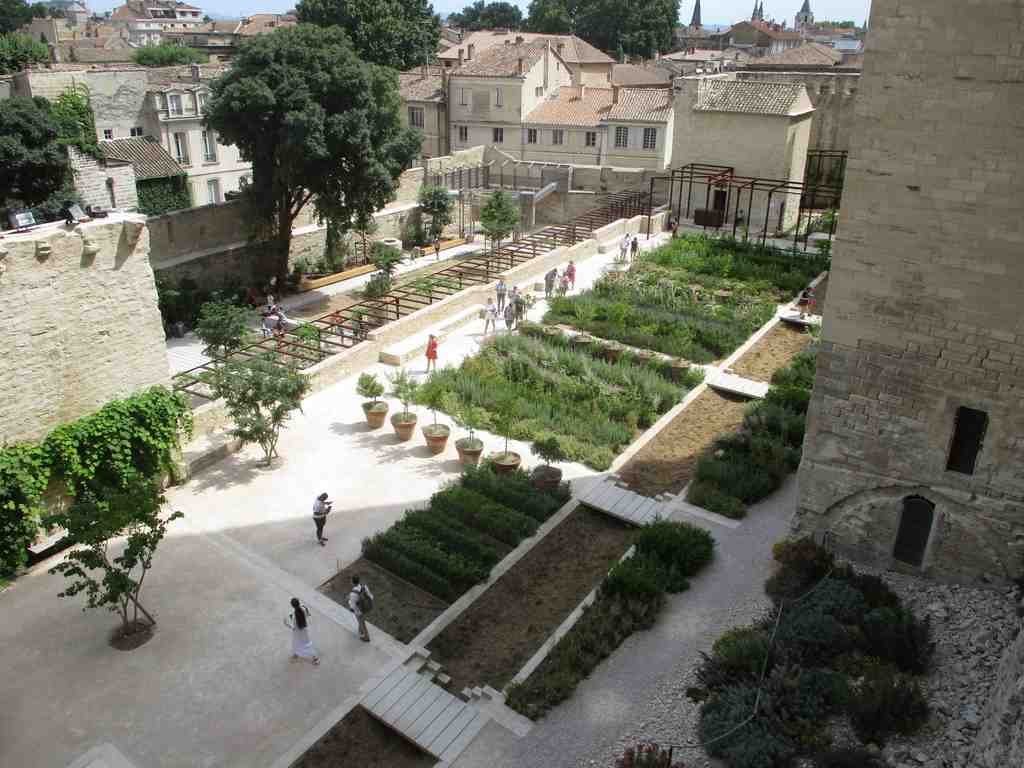
Directly in front of you, you’ll spot neat rows of green plants and trees spread out in geometric beds, all surrounded by weathered stone walls and shaded by a few large trees-just look for a peaceful, lush garden set against the backdrop of the imposing Palais des Papes.
Picture yourself standing right where popes once strolled, but don’t worry, you don’t have to wear a robe. The Gardens of the Palais des Papes have been a place of secrets, science, and even a bit of gardening gossip for over 700 years. Imagine the early 1300s: instead of tourists with cameras, this land was sprinkled with private gardens and orchards owned by powerful families. As Avignon transformed into the seat of the Papacy, the property beneath your feet was snatched up between 1316 and 1319-poof, instant holy expansion.
The first real papal garden took shape thanks to the blending of two humble orchards, right under what’s now the towering walls. Meanwhile, up to the north, under the brooding rock face of the Rocher des Doms, there was a “secret” utility garden where, yes, the popes kept not only fruit and vegetables, but a menagerie of animals too. So if you hear a mysterious rustling in the bushes, it’s probably just a bird-or maybe the ghost of one of Urban V’s peacocks!
As you walk past the tidy beds and pergolas, imagine the time of Pope Benedict XII in the 1330s and 1340s. He was a fan of garden makeovers, expanding the original plots to stretch right up to the palace walls, even installing a handy water supply system using both well and rainwater. And just to keep things dramatically medieval, there was a gigantic, clever cooling cistern nearby-part refrigerator for keeping the papal cheese fresh, part icehouse.
There were two main gardens enclosed by new ramparts during Benedict’s reign. To the south, there was a real showstopper: the Garden of the Griffon. Water splashed from a central fountain, which may have been dedicated to the papal favorite-manuscript-scribbling griffons or, perhaps, cheeky baboons! There’s a joke in there somewhere about papal monkeys and the grapes they couldn’t quite reach. In the north, another garden featured a wide meadow lined with benches made of greenery, all under trellises covered with vines. Picture the popes strolling along, crunching a fresh spinach leaf, or plucking some marjoram for the kitchen. And they certainly weren’t shy about their vegetables: borders of chard, parsley, and kale created a natural feast for both the eye-and the dinner table.
Fast forward a few decades, and Pope Urban V builds more gardens and even adds animal cages and a studio where he could relax and admire his work. You might say these were the original “VIP lounges” of Avignon, complete with fountains, shady spots, and even a noria-an ancient waterwheel for irrigation. Those popes really knew how to garden in style!
By the time the Renaissance swept through, the gardens had become elegant gathering spaces, with sanded terraces, geometrically perfect squares, and fountains at their hearts. A century later, even the force of an accidental explosion in the nearby fortress didn’t keep these gardens down; they just kept adapting-first as orchards, then as vegetable gardens for the papal deputies, then eventually as abandoned fields before finally being revived in the early 20th century.
Today, as you look out over paths and herbs, you’re wandering through three recreated distinct gardens. You’ll spot Mediterranean and Provençal plants as old as the papacy itself-grapevines, chard, rhubarb, onions, lavender, and even a citrus tree or two, all growing exactly as they were centuries ago. Pergolas and fountains are cleverly revived from old ruins, bees buzz by the palace hives, and ancient wells feed modern irrigation.
So next time you’re picking a sprig of rosemary or marveling at those neat garden beds, remember: these plants have outlasted popes, peacocks, and even exploding fortresses-making them possibly the most persistent vegetables in Europe.




