
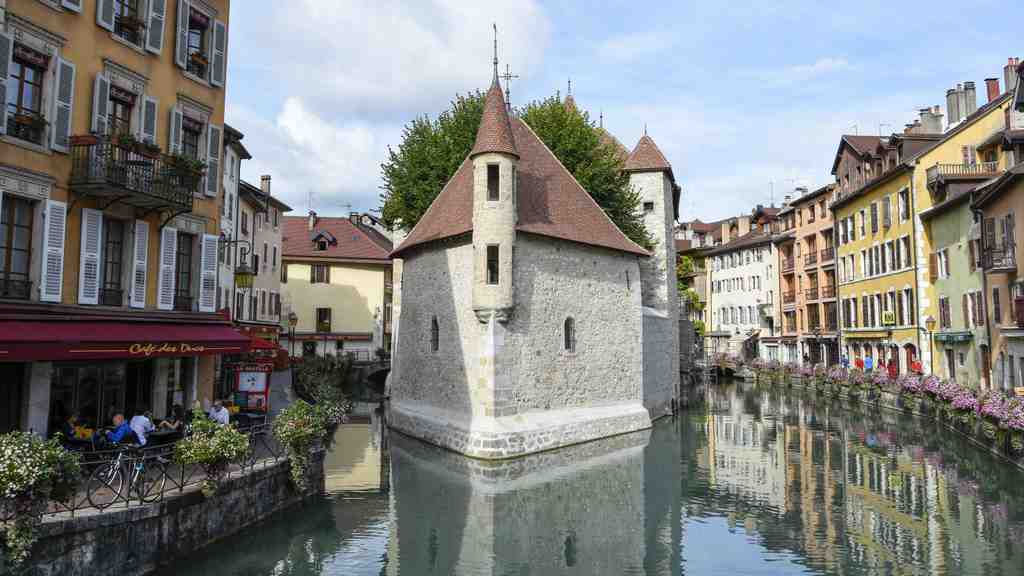
In front of you, the Isle Palace appears like a stone ship rising from the water, perched on a tiny island in the middle of the canal, with pointed red roofs and thick medieval walls-just look ahead where the Thiou splits the old town and you can’t miss its unique silhouette.
Now, let your imagination drift back almost 900 years. Picture the creak of a wooden bridge underfoot, as, in the twelfth century, local lords first built this stronghold to guard the only passage across the sparkling, icy water of the Thiou. The palace you see hugging its island once decided who could cross into Annecy, and who had to pay a toll-a place of power, its stone walls remembered every face that passed.
In those days, the palace belonged to the powerful Lords of the Isle, but it didn’t stay in one family for long. It passed to the Counts of Geneva, and later into the hands of the Monthouz family, who ran both the palace and its notorious prison cells. Imagine walking by at night, hearing murmurs or cries echoing from behind small, barred windows above the water, while the icy river below carried secrets out to the lake.
Annecy’s story was always changing, caught between powerful families and ambitious rulers. When Duke Janus of Savoy bought the palace, he gifted it to his wife, Hélène de Luxembourg-a wedding present of stone and moat. For a brief, shining time, it was transformed: imagine elegant parties lit by torchlight reflected in the water, music drifting into the alleys. But as quickly as luxury arrived, it faded. Soon the palace became a courtroom, a treasury, and, ever-present, a place of judgment and imprisonment.
Let your senses notice the thick, wedge-shaped walls. The oldest core, almost as wide as it is tall, is from the late twelfth or early thirteenth century. Back then, entrance was controlled by two heavy iron gates, one to the north, one to the south-look closely, and you can still see the rough scars in the stone where those ancient doors once hung. Walk around the edge, and you’ll find vaulted rooms where records and prisoners were kept. Overhead, the first floor’s grand hall was where the most important decisions in the region were handed down by stern-faced judges.
Every stone here has witnessed drama: duels between rival families, prisoners awaiting their fate, and outside in the plaza, official proclamations barked out to the crowds from the “banc du droit”. Imagine the tension as a judge’s hammer fell, sealing someone’s future, while fishermen listened with heads bowed or local merchants haggled for bread at the water’s edge.
During the Revolution and centuries that followed, the palace almost vanished. It was used as everything from a barracks to a warehouse, even an asylum for the elderly. More than once, people tried to knock it down-yet the cost of demolition was so high, the old palace was spared, surviving by a quirk of fate and a lack of funds.
It became a prison once again during the Second World War, its halls echoing with heavy footsteps and nervous whispers. But then, in the 20th century, the palace finally found its new calling. Thanks to its designation as a historic monument, it was saved from ruin, restored, and given back to the people of Annecy as a bridge to their past.
Today, if you step inside, you’ll find exhibitions on architecture and heritage, and the chill of the old cells that once held prisoners side by side with the sunlight streaming through the windows. Let yourself imagine the stories each room might tell if its stones could speak: secret romances, fierce family disputes, and endless negotiations between judges, jailers, and townsfolk-each one a note in the long history of Annecy’s most iconic building.
So as you stand here, listening to the river’s gentle rush, remember how many lives, dreams, and dramas unfolded on this very island-a living, shifting testament to the survival and spirit of Annecy.




