
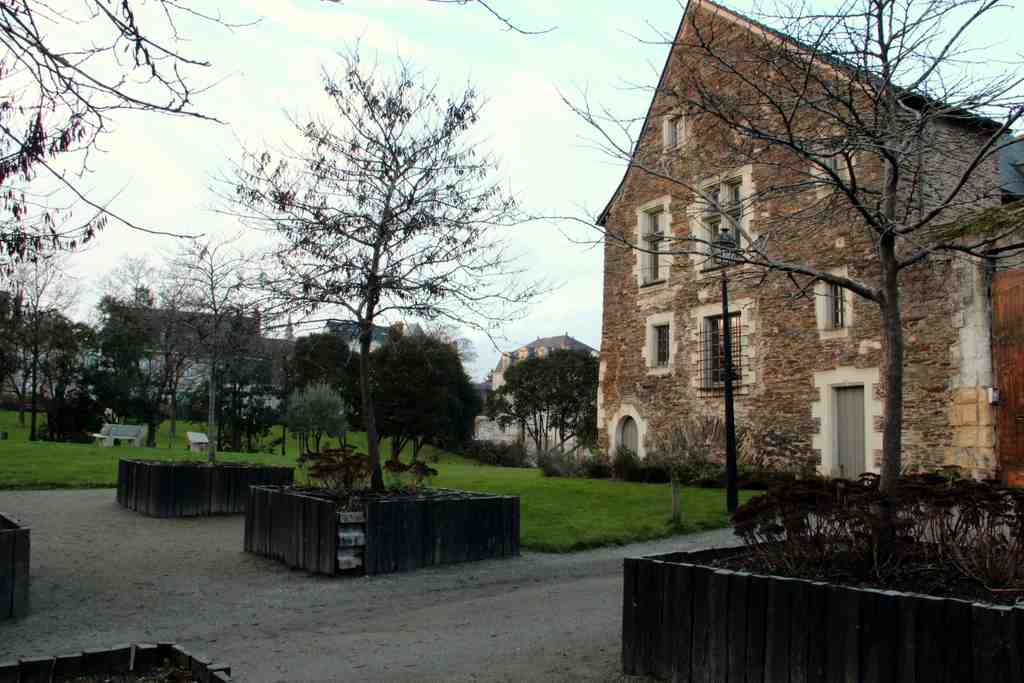
Look for the open square anchored by a tall, rough stone building with a sharply pitched roof and pale masonry framing its asymmetric windows.
Welcome to Place de la Paix, or Peace Square. Sounds quite tranquil, right? Well, the peace they were referring to when they named it in seventeen ninety-two was the eternal kind. For about six hundred years, this was the cemetery for the city's poor.
Back in the late twelfth century, around eleven ninety, a nobleman named Philippe de Ramefort donated this land to bury the destitute patients of the Saint-Jean hospital. Imagine a sprawling, uneven plot shaded by oak and walnut trees. It was filled with unmarked graves and a massive central cross. Oh, and one very strange tomb shaped like a table balanced on four pillars. Nobody ever figured out who was buried in that one.
By seventeen seventy-six, a royal edict banned burying people inside city walls. Probably a smart public health move. The graves were relocated, and between eighteen twenty and eighteen thirty, engineers moved massive amounts of earth to level the bumpy terrain into the flat urban square you see today.
The square is ringed by some impressive historic mansions. We actually walked right up rue de l'Hommeau earlier to get here, which forms the southern edge of this space. At the corner stands the Hotel Marcouault, bought in fifteen fifty-four by a university regent who bolted on a fancy Renaissance pavilion, complete with carved stone masks and fruit, just to show off his status. Later, in the eighteenth century, a royal musketeer named René-Olivier Du Guesclin inherited the property.
But the real engineering marvel is hidden underneath the nearby Hotel de Scépeaux. It conceals massive, twelfth-century vaulted stone basements, proving this patch of land was built up long before it ever became a graveyard.
Decades later in the twentieth century, the square became a breeding ground for political heavyweights. Number fourteen was home to Maurice Poperen, an anarcho-syndicalist, which is essentially a radical labor movement teacher. He and his wife, a lacemaker named Marie, raised two sons here. Growing up in that intense, activist household produced spectacular, if conflicting, results. The older brother, Jean, grew up to be a prominent minister for the Socialist Party. His little brother, Claude, took a different path, becoming a formidable leader for the C-G-T, the General Confederation of Labor union, and a top official in the Communist Party. Talk about interesting family dinners.
From medieval burials to revolutionary politics, this square has certainly seen its share of action. Take a breath in this deceptively quiet space. When you are ready, we can walk to our final stop.




