
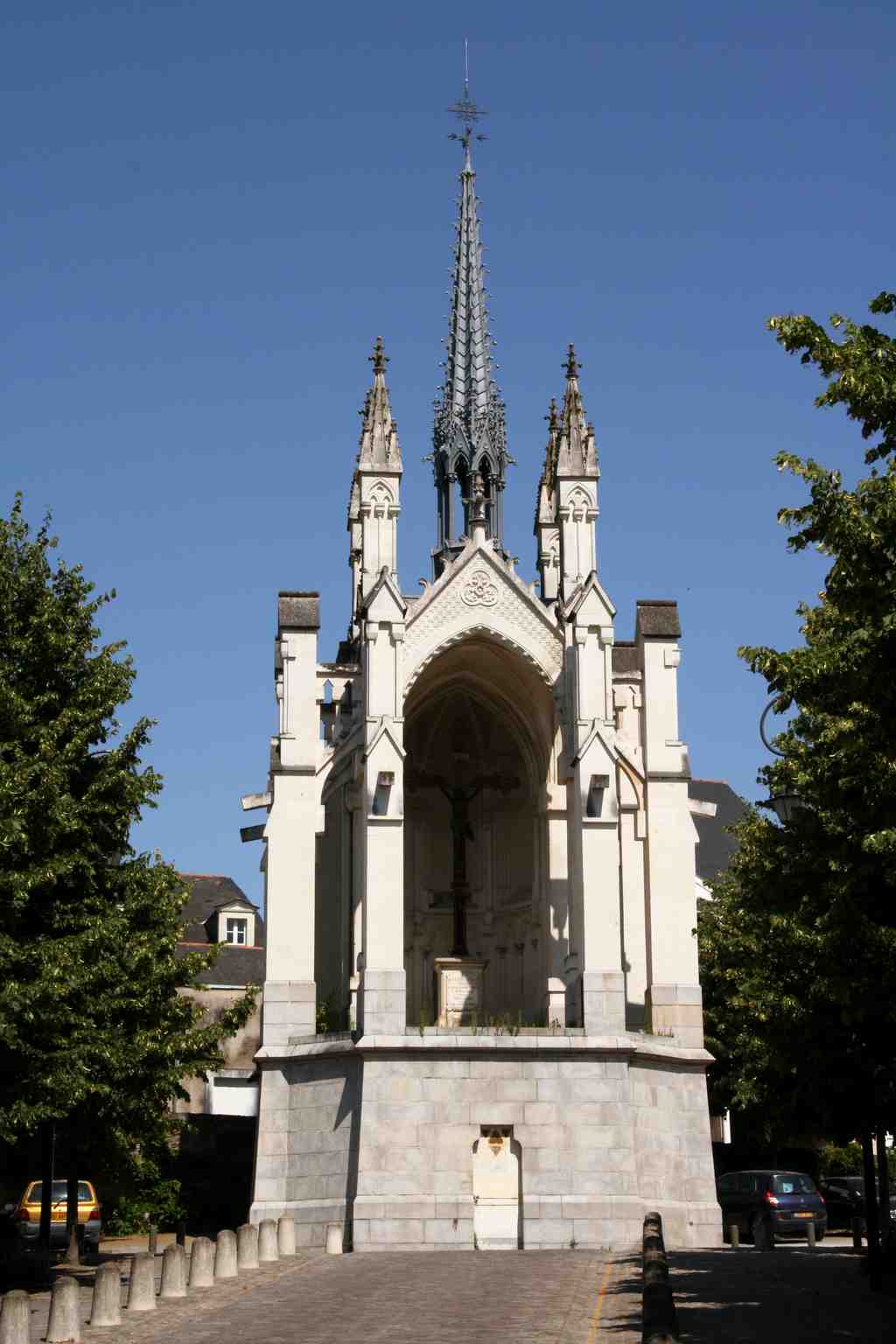
On your left, look for the tall pale stone monument shaped like an open-air archway, topped with a highly detailed metal spire and sheltering a large dark crucifix inside.
Originally, an octagonal structure stood here in the twelfth century, known cryptically as the tuba. It operated as a lantern of the dead, a hollow stone tower lit at night to honor the deceased in the surrounding cemetery. By the fourteenth century, it became the centerpiece of the Grand Sacre religious procession. Records suggest tens of thousands of people would flood the city just to see it, while the local abbess decorated the chapel bay with tapestries and white candles.
By the late eighteenth century, political upheaval swept the country, and the original chapel and cemetery were completely leveled. For decades in the nineteenth century, the parish solved this missing chapel problem by building a fragile, temporary wooden replica every single year. It cost them up to three thousand francs annually, which is tens of thousands of dollars today, for a stage set they had to constantly assemble and tear down. Finally, in eighteen seventy-four, Bishop Charles-Émile Freppel looked at this massive financial sinkhole and ordered a permanent masonry monument.
Architect René-Eugène Dusouchay took the commission, but he died in eighteen seventy-eight, leaving the project half-finished. The bishop had to hastily consecrate an active construction site. As someone who appreciates structural design, I have to point out that this building is literally incomplete. If you look at the supports, they seem strangely minimal. That is because the flying buttresses, the external stone arches meant to stabilize the upper walls, and the four central pillars from the blueprints were never actually built. They simply ran out of cash.
In eighteen ninety-one, to try and finish the look, they installed the massive cast-iron Christ on the cross that you see hanging inside the arch. It is a fascinating monument to both intense religious devotion and severe budget cuts.
Take a moment to examine the architecture here. When you are ready, we can move on to the next stop.




