
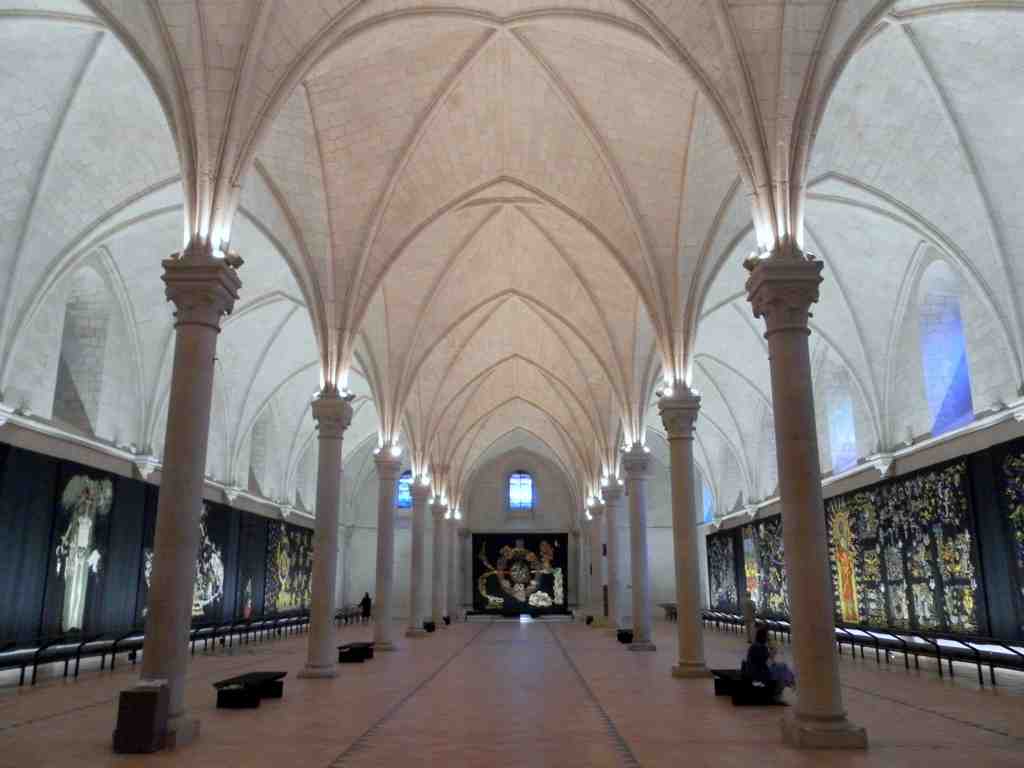
Though you are standing outside, the true marvel of the Jean-Lurçat Museum is the space awaiting you inside: a vast hall defined by pale stone ribbed vaults, slender cylindrical columns, and expansive walls designed to hold monumental artwork. You are looking at the former Saint-Jean Hospital.
In eleven seventy-five, Étienne de Marsay, the seneschal, or chief royal administrator of Anjou, founded this hospital at the request of King Henry the Second. The King needed a grand public gesture. Five years earlier, in eleven seventy, Henry’s knights had assassinated Thomas Becket, the Archbishop of Canterbury. This hospital was built as a very expensive act of royal expiation. Designed in an elegant architectural style known as Gothic of the West, it operated as an Hôtel-Dieu, a charitable hospital run by the Catholic Church, housing up to five hundred patients until it finally closed its doors in eighteen sixty-five.
Étienne funded this sanctuary of healing, but his own end was far less comfortable. After loyally defending Henry’s territories, the new king, Richard the Lionheart, threw Étienne in prison, stripped his wealth, and let him die in grim conditions in eleven ninety.
Inside this medieval ward, you will find a modern vision of the end of the world. In nineteen thirty-seven, the artist Jean Lurçat visited the nearby Château d'Angers and was mesmerized by the medieval Apocalypse Tapestry. Deeply shaken by the Cold War and the looming threat of the atomic bomb, Lurçat decided to weave his own version. He called it The Song of the World. The monumental tapestry cycle begins with the nuclear destruction of Hiroshima but evolves into a message of hope, ending with a piece called Champagne, bursting with woven bubbles and butterflies.
Lurçat died in nineteen sixty-six before finishing the epic cycle. Knowing his dream was to display his work near the medieval masterpiece that inspired him, his widow Simone sold the collection to the city. It was officially hung in the hospital's great hall on the sixteenth of May, nineteen sixty-eight.
Next door, in a former orphanage, the museum showcases modern fiber art, including the profound work of Thomas Gleb. Born Yehouda Chaïm Kalman to Jewish weavers in Poland, Gleb carried the unimaginable trauma of losing his entire family in the Lodz ghetto during the Second World War. He poured that grief into his art. His spiritual tapestries feature deep, vertical woven slits that mimic both divine revelation and profound scars. Gleb forged such a deep connection with this region that he moved to Angers, leaving a permanent legacy here after his death in nineteen ninety-one.
The museum also hosts major temporary exhibitions. In a spectacular crossover running until late twenty twenty-six, the museum temporarily replaced Lurçat's masterpiece with a colossal woven tribute to J-R-R Tolkien's The Lord of the Rings.
If you plan to explore the tapestries and the original seventeenth-century apothecary inside, complete with ceramic pharmacy jars, keep in mind the museum is open from ten in the morning to six in the evening, Tuesday through Sunday.
Absorb the scale of these masterworks. When you're ready, our next destination awaits.




