
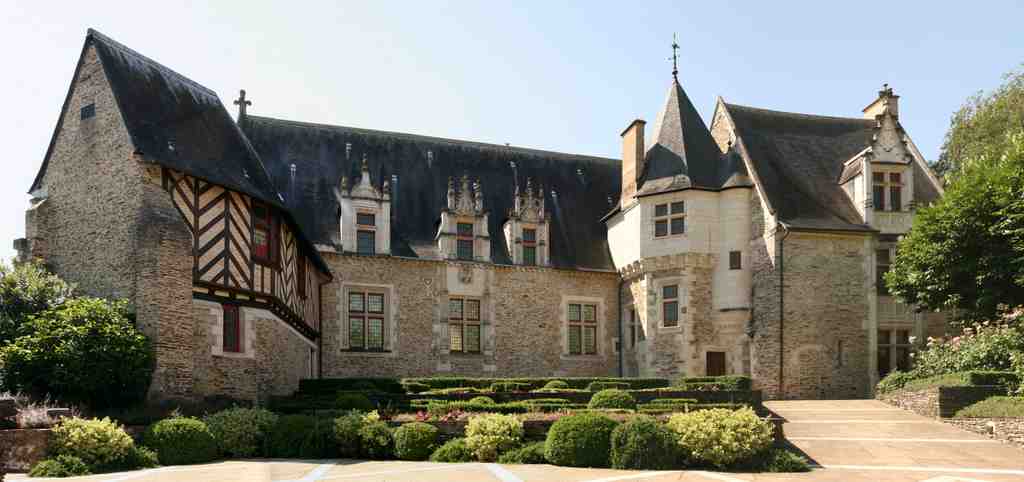
You will recognize the building on your right by its sturdy stone walls topped with steep slate roofs, the striking cylindrical stair tower capped with a pointed cone, and the section of patterned half-timbering on the left wing.
This is the Hotel des Penitentes. If these walls look like they have a bit of a split personality, that is because they do. Take a look at your screen to see the full layout of the surviving architecture.
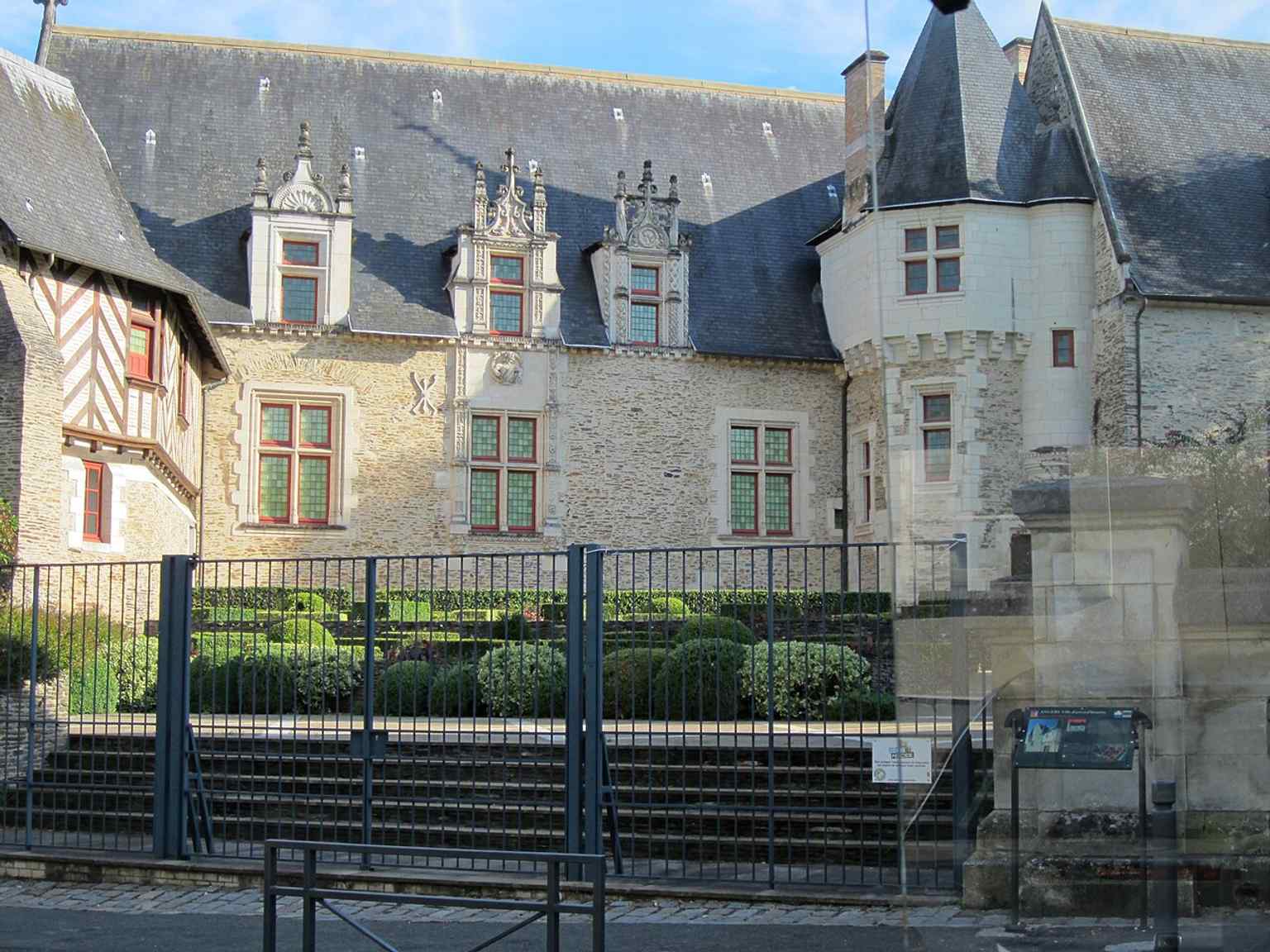
It was built in the late fifteenth century as a city refuge for the monks of the Saint-Nicolas abbey. Naturally, the monks almost never used it. Instead, it became a revolving door of unexpected tenants. A controversial abbot named Jean de Charnace died here in fifteen thirty-nine, and by sixteen forty-two, it was rented out to a famous local Baroque sculptor named Pierre Biardeau.
But the building's defining era began around sixteen forty. Caught up in the fervor of the Counter-Reformation, a priest named Claude Menard established a convent here for voluntary penitents, essentially women looking to leave a life of ill repute. It was not exactly a luxury retreat. Under the strict authority of the local bishop, Henri Arnauld, the women were subjected to a brutal regime of humility. Their uniform was a rough, grey serge dress shaped exactly like a sack, topped with a white wimple to hide their necks.
Things escalated in sixteen seventy-five. A new wing called the refuge was built to forcibly lock up public women on police orders for sanitary and moral reasons. So, you had devout volunteers and literal prisoners living under the same roof. By the early nineteenth century, it was a harsh holding pen for convicts, aging paupers, and the sick. In May of eighteen oh nine, it housed one particularly famous inmate. Her name was Renee Bordereau, known as the Angevin, a legendary female soldier who disguised herself as a man to fight in the royalist Vendean army during the Revolution.
The building itself has survived by the skin of its teeth. In eighteen sixty-four, urban planners plowed the new Descazeaux boulevard right through the complex, obliterating the prison wing and the chapel. Only this original manor house survived. Luckily, in nineteen forty-one, an art professor named Georges Chesneau painstakingly restored the surviving Renaissance stonework, even recreating a famous little sculpture of a penitent woman near the base of the western chimney.
Today, the story ends with a magnificent piece of irony, as this former house of correction and frugal, punishing meals was transformed in two thousand and eighteen into a culinary library holding over thirty-six thousand books on gastronomy. This strange stone structure has pulled off the ultimate architectural redemption.
Take a final look at this resilient facade. When you are ready, we will continue on.





