
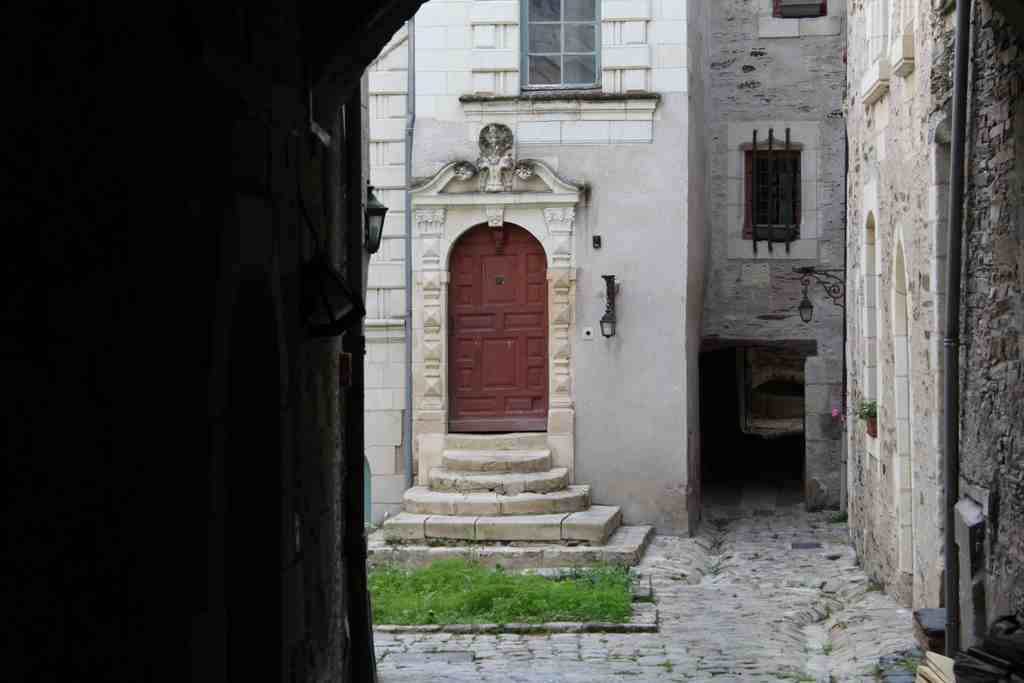
Look ahead to the courtyard and find the arched red wooden door set in an ornate stone frame, approached by a striking set of semi-circular stone steps. This is the Cour des Tourelles, an estate that has seen more than its fair share of real estate drama.
In fourteen twenty-six, a man of influence named Jean Hocquet lived here in what was already known as the Manor of the Tourelles. Hocquet needed a quick route to his private port on the river, so he simply punched an alleyway straight through this interior courtyard. This created a public thoroughfare that lasted for nearly two centuries. The property later passed to the Crespin family, a line of royal officers who built a private chapel to stamp their authority on the site.
Then came Pierre Gohier in the early seventeenth century. Gohier was a lawyer with a vision. He spent years patiently buying up every single adjacent parcel of land from the Crespin family. In sixteen hundred and seven, he achieved his dream of reunifying the entire grand estate. Naturally, he died the very next year. His heirs immediately chopped the property back into five separate lots and built a wall to seal off the courtyard, permanently ending the free public passage Hocquet had created.
The story took a sharp turn in seventeen twenty-three when the estate was bought by the Mont-de-Piété, an institutional pawnbroker designed to offer low-interest loans to the poor in exchange for their belongings. Known locally as Auntie's House, the grand aristocratic home became a clearinghouse for desperation. The eighteen ninety-three inventory lists the exact items people brought in just to survive. That year alone, clerks took in two thousand three hundred and twenty-three bundles of laundry, one hundred and forty-five duvets, eighteen umbrellas, and one rifle. The contrast between the grand stone architecture and the piles of pawned laundry was jarring.
In eighteen eighty-two, the administrators decided the building did not look medieval enough. They orchestrated a massive neo-gothic restoration, completely erasing authentic eighteenth-century architectural features just to fulfill a romanticized fantasy of the past. Sometimes architects cannot help themselves.
But the building had older secrets. During restorations in the nineteen nineties, archaeologists uncovered original twelfth and thirteenth-century foundations, including a painted window. They also found physical evidence of those old property disputes... a sixteenth-century interior door that had been aggressively bricked up to seal off the neighboring house during a bitter seventeenth-century feud.
The pawnbroker finally closed its doors in nineteen ninety-nine, and the complex returned to private hands. From a medieval manor to a pawn shop and back again, this courtyard holds centuries of local ambition and petty rivalries. Take a moment to appreciate the details here, and when you feel ready, we will make our way toward the Church of the Trinity of Angers.




