
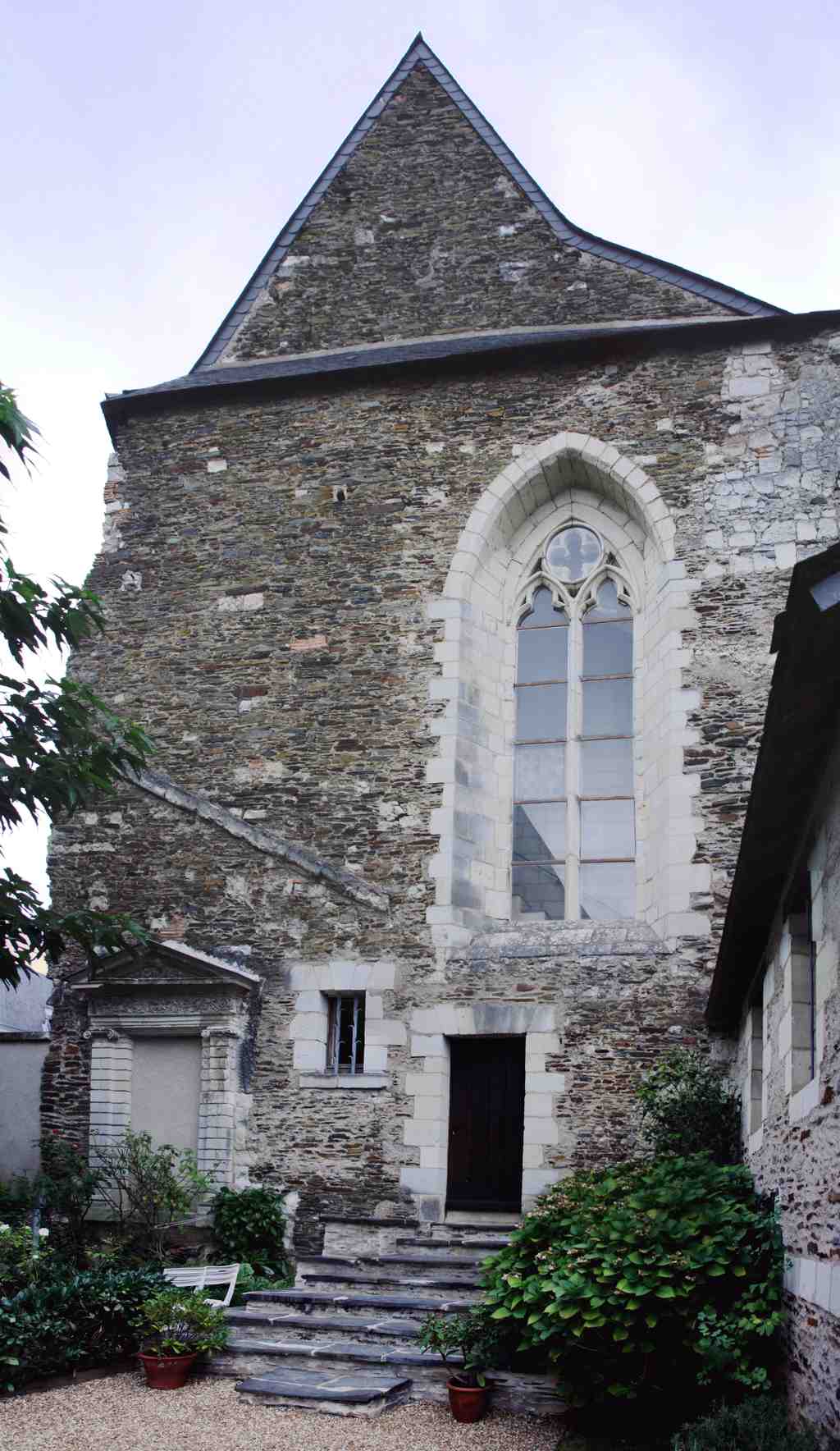
On your left, look for a building with rough, dark schist walls topped by a sharply pointed roof, featuring a tall, pale stone Gothic window right in the middle.
This is the Augustinian Convent, or rather, the fragments that survived centuries of architectural recycling. Back in twelve sixty-three, this land was given to a rather obscure medieval order known as the Sack Friars. They earned their name by walking around in itchy, completely unrefined sackcloth. The Pope, perhaps offended by their aggressive lack of fashion sense, dissolved the entire order just eleven years later in twelve seventy-four. The Augustinian monks moved in shortly after, taking the site from a humble camp to a sprawling religious complex. They built a massive church, a grand cloister, and the fourteen eighty Chapel of the Passion, which is the structure with that soaring window you see before you.
Life in a monastery is usually quiet. Usually. Enter Father Jacques Hommey. In the early eighteenth century, this resident theology scholar wrote a sprawling chronicle full of highly critical political commentary. The ambassador of the Republic of Venice caught wind of it and took extreme offense. The ambassador demanded severe punishment, and the French authorities actually caved to the diplomatic pressure. They exiled the elderly monk across the country to Bar-le-Duc. He was only permitted to return to this very convent just before he died on the twenty-fourth of October, seventeen thirteen.
The French Revolution arrived in the late eighteenth century and completely dismantled the property. In seventeen ninety-five, the main church was demolished, and the massive plot of land was carved up and sold off. Fast forward to eighteen seventy-one, and the site took a sharp turn from spiritual salvation to mass production. The Savaton-Hamard company bought these holy walls and transformed them into a bustling shoe factory. This is where the engineering gets clever. The architect, Julien Moirin, did not just bulldoze the site. He systematically dismantled the ruined sections and recycled the medieval schist stones to build his new factory walls. Inside, he installed heavy cast-iron columns and thick wooden floors to support the clattering workshops. For decades, the peaceful chants of monks were replaced by the heavy, rhythmic thud of leather-cutting machinery.
The shoe business eventually folded in nineteen hundred and five. Since then, these walls have housed an orphanage, a painting company, and even a trade school. Then, in two thousand and twelve, a developer decided to build a high-end residential complex on the grounds. Before they poured a single drop of concrete, archaeologists from I-N-R-A-P, the French National Institute of Preventive Archaeological Research, took over the site. Digging directly beneath the old factory floors, they uncovered original medieval funereal niches. It was a stark, quiet reminder of the sacred ground hiding beneath centuries of aggressive industry.
Today, the surviving architecture stands as an incredibly resilient patchwork of stone, seamlessly bridging the gap between medieval devotion and modern living. Appreciate this strange layering of history. Once you are set, our walk continues.




