
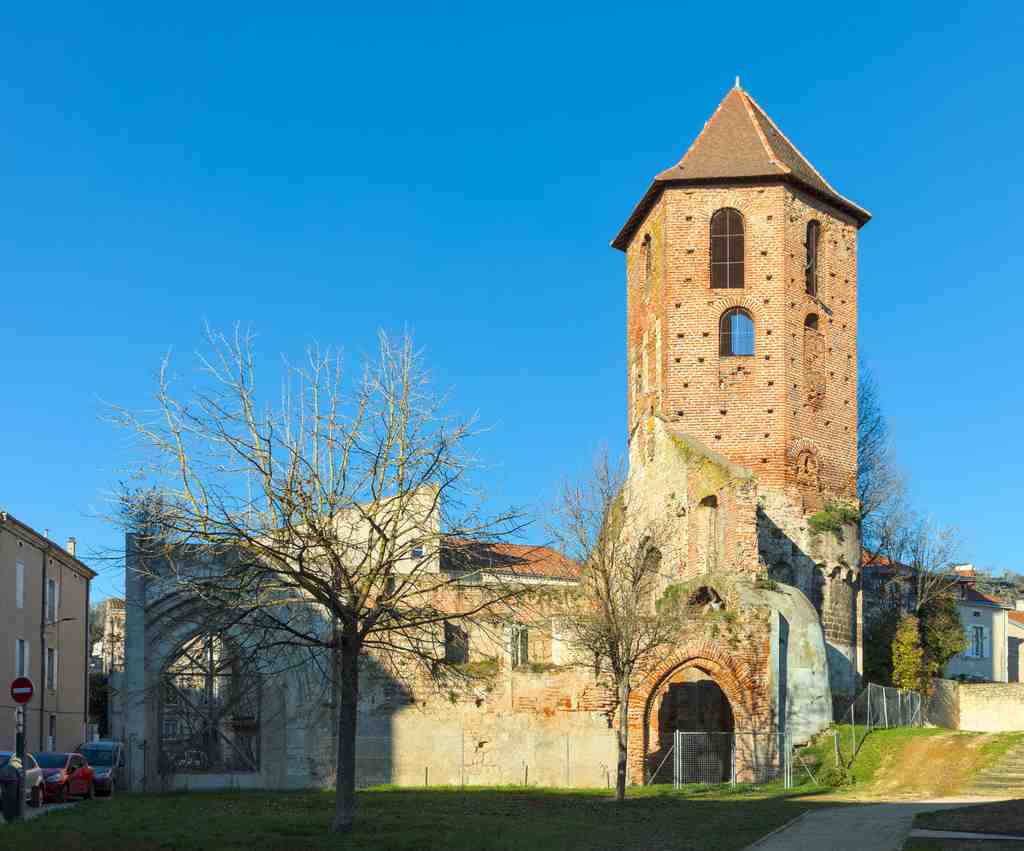
In front of you, you’ll spot the Old church of Saint-Hilaire d'Agen by its tall, weathered red-brick tower with pointed roof, rising out of the rough stone ruins surrounded by patches of grass and a few bare trees.
Let’s time-travel to the 11th century, right here on rue Georges-Thomas, where this church once stood proudly as a gem of early Romanesque design. At first, it was just a single nave ending in a modest, curved choir, decorated with old stone carvings-imagine the echoing chants and faint candlelight inside those thick walls. A simple stone bell wall once crowned the roof, calling the faithful to gather in this peaceful corner of Agen.
As we move into the 1200s, the church starts growing-probably because its congregation simply couldn’t fit! Builders added side aisles and two rounded mini-chapels, giving it some serious real estate upgrades. The once standalone nave now shared the space under one big roof, like a medieval open-plan living room. Somewhere along the way, a new hexagonal brick tower appeared, attached to the west side-tall and striking, a sign of Gothic ambition. Today, that tower is what catches your eye.
Fast forward a few centuries, and the story takes a twist. By the early 1800s, this old church was so cramped and crumbly it was almost falling down. The nearby former Cordeliers convent-once home to monks, then a police barracks, then, bizarrely, a voting hall, stable, and hayloft-became Saint-Hilaire’s parish instead. All it took was a petition signed by everyone from the mayor to the bishop-imagine that town meeting!
Then, disaster struck in the 1860s: city planners decided a new road would go right through the church. The west wall and the first six meters of the nave were demolished. What was left behind was used as a warehouse, and then, in 1913, a fire broke out, adding one more dramatic chapter to its life. At one point, the city even considered selling the tower-imagine putting that quirky fixer-upper on the market!
Yet, this ruin is more than just stone and brick; it’s a resting place for local nobles like Nicolas and Dominique de Bastard, whose family vault lies beneath what once was the altar.
By 1950, its crumbling elegance was finally recognized as a historic monument-a badge of honor for surviving centuries of ups and downs. So as you stand here, surrounded by sunlit ruins, you’re not just seeing an old shell. You’re standing at the crossroads of medieval devotion, local politics, noble legacies, urban ambition, and a surprising amount of drama-proof that even in ruins, stories endure.




