
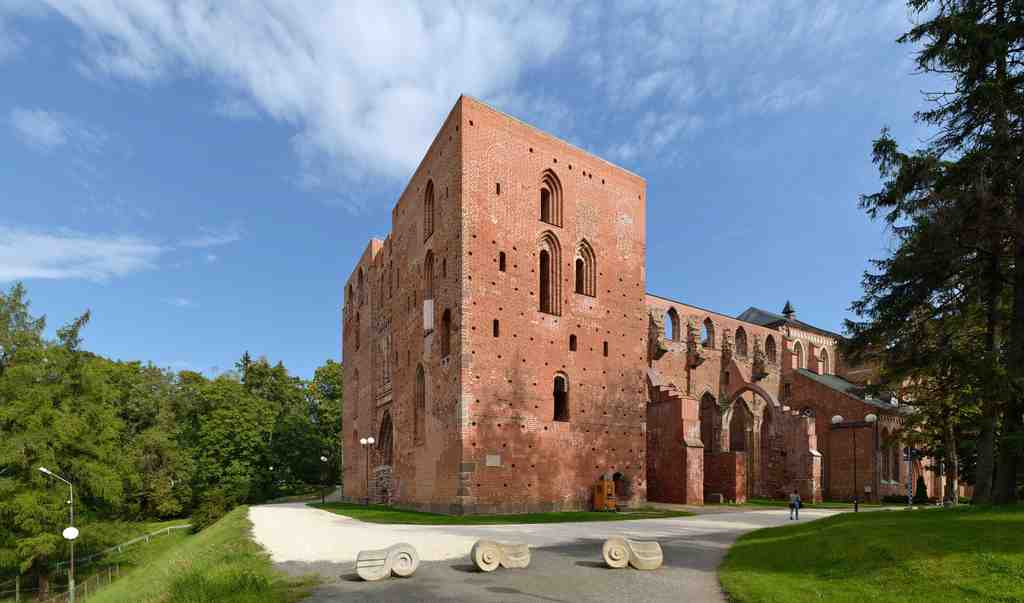
As you walk up the curving pathway to your left, look ahead and a little uphill-you’ll spot the enormous, red-brick ruins of the Tartu Cathedral towering above the green lawns, with its mighty, fortress-like walls and tall empty windows catching the light.
Take a deep breath and imagine yourself standing here nearly a thousand years ago, when this hill-called Toomemägi, or Cathedral Hill-was thick with ancient forests and crowned by a vast wooden stronghold. Back then, powerful pagan chieftains watched over the Emajõgi River from this very spot, their fortress standing as the heart of old Estonian power. But everything changed in 1224, when Christian invaders stormed the hilltop, tearing down the fortress, erasing centuries of stories, and marking the beginning of a new era.
Almost at once, the victors began to build-first a stone bishop’s castle, and then, slowly, the immense cathedral rising before you now. Imagine the clang and echo of medieval stonework filling the air as masons and craftsmen shaped red bricks for a new and mighty house of worship. The cathedral grew in stages from the late 1200s. People buried their loved ones here in graveyards that hugged the walls, while priests and bishops lived in houses just steps away. Its grand arches, soaring up in Brick Gothic style, were dedicated to Saints Peter and Paul, guardians of the city. By the time the 15th century ended, those twin towers on either side of the entrance rose so high, travelers swore they matched the great towers of Notre-Dame in Paris! But not for long.
Feel the chill in the air as the scene darkens-the mid-1500s bring the earthquake of Reformation. On a winter’s morning in January 1525, crowds charged in, smashing icons and shattering the cathedral’s forgotten peace. With the Bishop of Dorpat banished and religious wars raging across Livonia, the cathedral was left to rot. Fires, battles, and neglect allowed weeds to push up between the stones. Cornered by shifting armies-first Russians, then Poles, then Swedes-the proud towers crumbled. By the 1760s, instead of ringing with bells, they became platforms for cannons and lookout posts, the main entrances sealed by heavy walls, as Tartu had moved on and the cathedral slipped quietly into ruin.
But history’s tide turned again. In 1802, Tsar Alexander I founded a new university here, and a wave of serious, curious scholars swept into Tartu. Among the ruins, an ambitious German architect named Johann Wilhelm Krause built a three-story library inside the old walls. Imagine the footsteps of students and professors bouncing off ancient bricks as they climbed the same spiral stairs their medieval predecessors once ascended-ghostly echoes of parchment, ink, and debate in the air. The cathedral, in a strange twist of fate, became the intellectual heart of the renewed city, even as the outside was left a wild, windwhipped shell.
Throughout the 20th century and beyond, the building changed roles yet again. A water tower was placed where priests once chanted. The museum of the University of Tartu moved in, opening its doors with treasures from centuries of academic life-books, maps, and inventions displayed in the shadow of shattered arches. Offices, classrooms, even an art department have called these walls home, each one layering another chapter on top of ancient foundations.
Step back and notice the park around you. In the 1800s, Toomemägi was greened into a leafy haven, dotted with monuments-statues to poets, scientists, and visionaries. Pathways wind to the Angel Bridge, the Supreme Court, and even an anatomy theater. This hill, once alive with conflict and conquest, is now a place for walks, stories, and reflection. Yet, on crisp evenings, as the last sun glances off those enduring red towers, you might just hear the whispers of ancient priests, the songs of old Estonians, and the dreams of scholars echoing between the stones-reminding you that here, every era has left its voice.
If you're keen on discovering more about the decline of the cathedral, university or the toomemägi, head down to the chat section and engage with me.




