
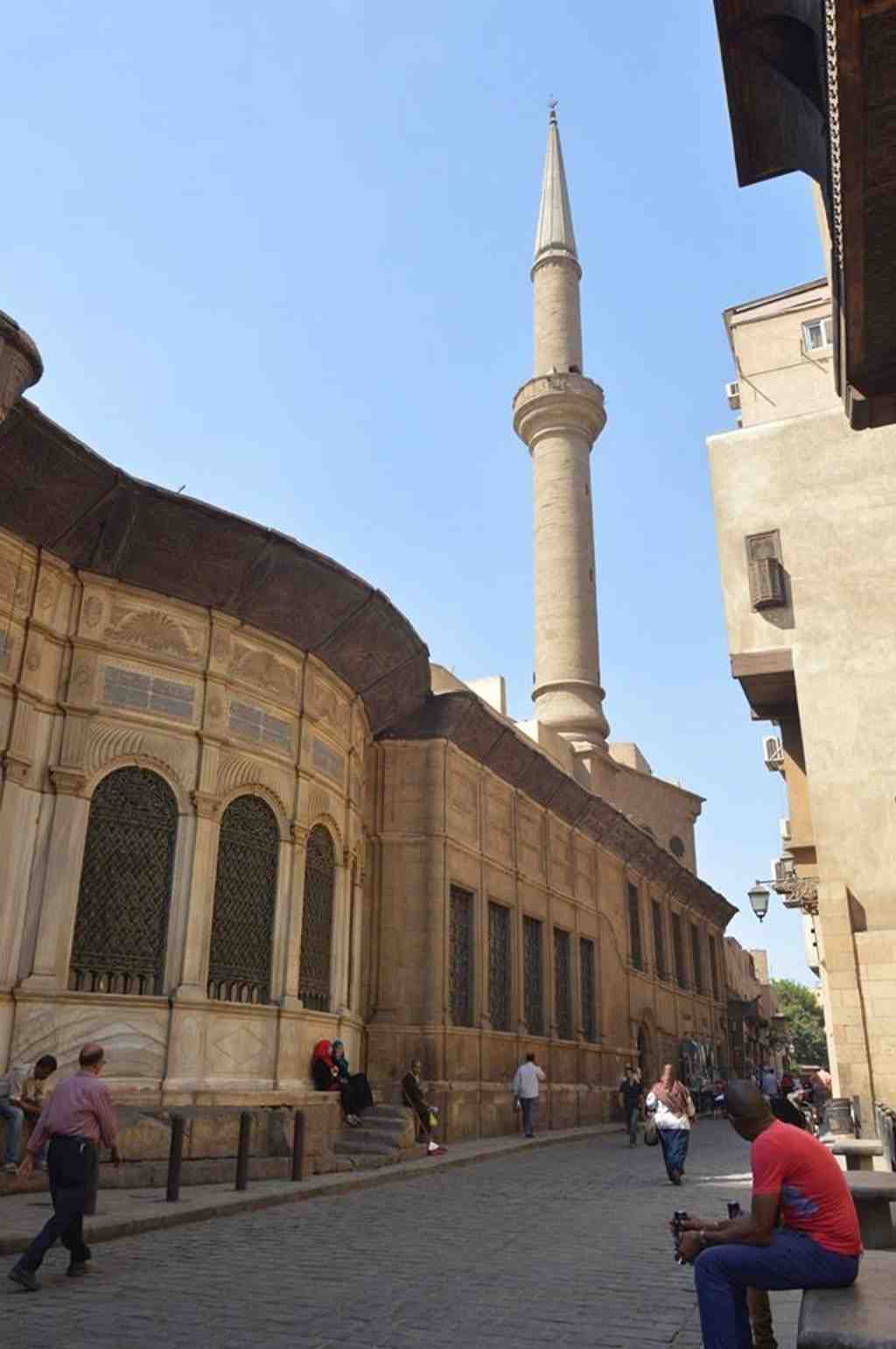
Look to your left for the striking long, curving marble facade decorated with tall arched windows and detailed carvings, and you’ll spot an elegant slender minaret rising confidently above-the unmistakable Mosque-Sabil of Sulayman Agha al-Silahdar.
Now, let’s spin back in time, just like the whirling dust on this ancient Cairo street. Imagine yourself in 1839, right as Sultan Suleiman Agha al-Silahdar decides to make a mark on the city. As you stand here, the noises of modern Cairo fade away, replaced by the clip-clop of horses, busy traders, and a trickle of water from that sabil-that’s the beautiful marble structure to your left, where fresh, cool water flows for every passerby, rich or poor. Finding a free drink back then? It was like winning the lottery, and all you had to do was walk by!
The building is a real show-off-built not just as a mosque, but as a sabil and a school, a kuttab, all at the starting point of Burjouan Alley, facing the bustling extension of Al-Nahasin Street. Its marble walls shine white in the sunlight, swirling with Baroque-inspired floral designs and bold Turkish calligraphy. And don’t miss the mashrabiya-intricate wooden screens that shielded mystery, gossip, and maybe an odd pigeon or two. The scent of history is thick here, and if you listen close enough, you might just hear secrets echoing from the days when Muhammad Ali Pasha ruled Egypt.
Inside, the rectangle of the mosque splits in two: step into the western side and you’ll find a sanctuary ringed by marble-pillared corridors beneath a vaulted ceiling, each small dome splashed with bright oil paintings of flowers and winding Qur’anic verses. Light pours in through long, oblong windows as it has for centuries, bathing the wooden ceilings and the marble mihrab-where prayers point to Mecca-in a soft, golden glow.
Of course, for thirsty travelers, the sabil was a lifesaver. But, Sulayman Agha wasn’t just looking to quench thirst-he wanted to help people get a little closer to heaven, too! The sabil’s water cooled in its marble basin, a charity on a busy street rather than a quiet back alley, so everyone from nobles to noodle-sellers could refresh themselves.
Above the door, there’s a tiny rounded balcony-just big enough for a well-placed pigeon or a bold announcer, perhaps summoning people to prayer. And if you glance up, you’ll spot that tall, elegant minaret soaring skyward like a finger pointing to the heavens.
Renovated in 2015 by one of Sulayman Agha’s own descendants, this stunning complex continues to shelter stories, prayers, and-if you’re lucky-the cool shade of Cairo’s centuries-old generosity. So take a moment to soak in the grandeur… but if you get thirsty, don’t expect the sabil to serve you-today’s menu is strictly historic!




