
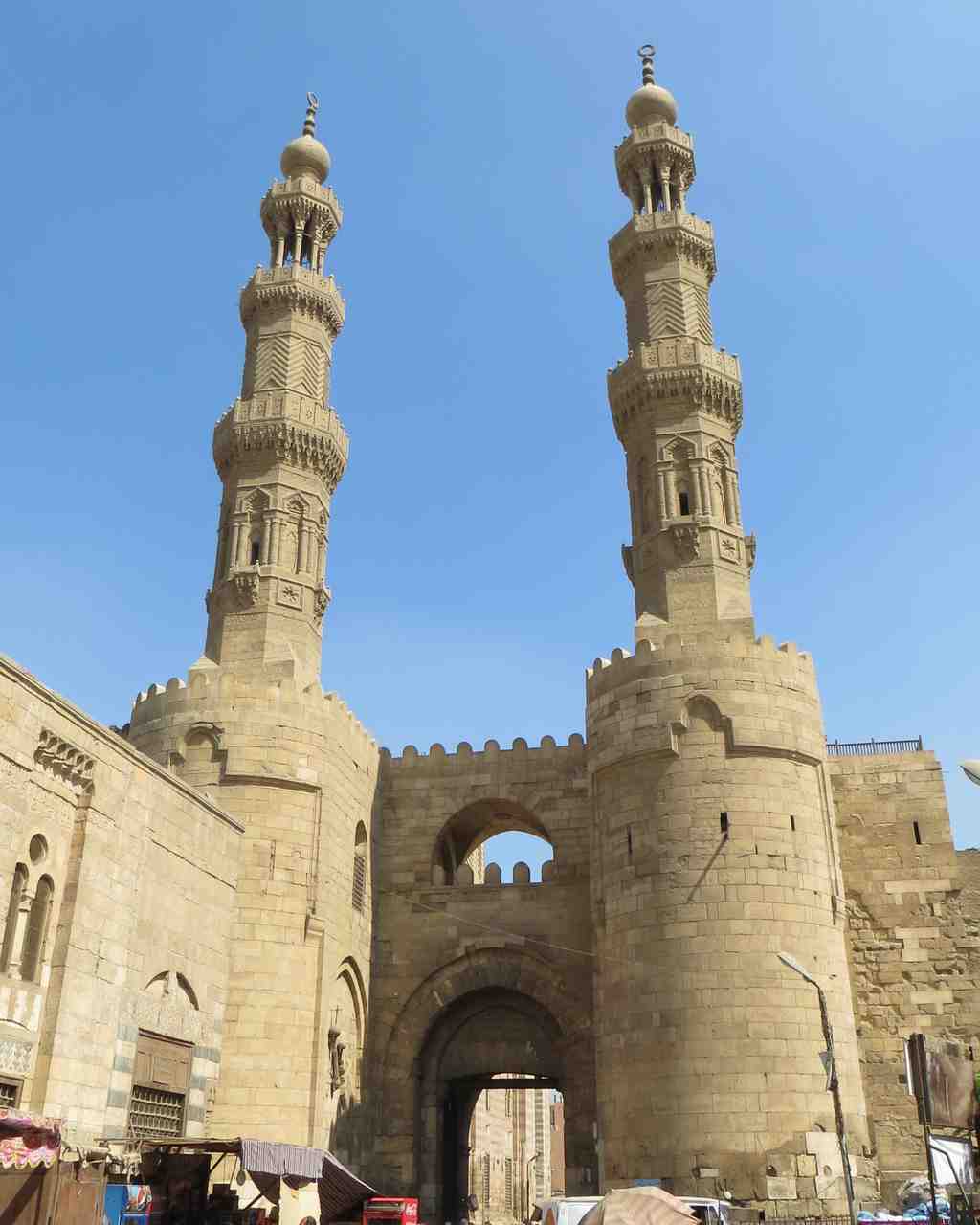
Directly ahead, you’ll spot two huge round stone towers linked by a mighty arched gateway, each tower topped with a slender minaret soaring high-Bab Zuwayla stands tall right in front of you.
Welcome to Bab Zuwayla, Cairo’s southern medieval gateway and a place where history has always had a dramatic flair! Picture the year 1092: the streets are dusty, the city’s new stone walls gleam in the sun, and the Fatimid vizier Badr al-Jamali strides through, overseeing construction as masons carve and fit the massive stones that still make up the gate today. But this wasn’t just any city entrance-it was built to defend the brand-new Fatimid stronghold!
Now, glance up at those fabulous twin minarets. They were actually added in the early 1400s, much later than the gateway itself, and belong to the adjacent Mosque of Sultan al-Muayyad. The mosque’s story is a wild one: Sultan al-Muayyad once sat imprisoned in a gloomy jail right beside this spot, vowing that if he ever got out and seized the throne, he’d swap prison walls for domes and prayer halls. Amazingly, he did! He demolished his old cell and built this glorious mosque. The very minarets you see resting on the round bastions of the gate were finished in 1419 and 1420, and if you look closely, you’ll find a small plaque naming the architect who put his heart into these stones.
But let’s rewind to the time of Fatimid Cairo’s birth, when streets bustled with North African soldiers from the Zuwayla tribe-the namesakes of this gate. “Bab” means “gate,” and “Zuwayla” echoes with stories of Berber warriors far from their desert home in Fezzan. As you imagine the commotion, you might also hear the drums and fanfares that once signaled the arrival of mighty Mamluk commanders.
Of course, Bab Zuwayla saw its share of drama. Enemy heads once decorated those battlements-perhaps not the neighborly welcome you’d expect! In 1260, when the Mongols demanded submission from Cairo, the Mamluk sultan Qutuz replied with a rather direct message: he executed their messengers and hung their heads right above this very gate. Those actions echoed through the city, spurring the Mamluks to victory at Ain Jalut.
You’ll notice the stone is worn and ancient, but if you could peel back layers of time, you’d find this place once striped in red and white, painted and plastered for special occasions like the opening of the Suez Canal. Above you, the gateway used to groan under the weight of gigantic wooden doors-each leaf weighing over three tons-closing off the city in times of threat.
Bab Zuwayla also shaped daily life. In the Ottoman era, drummers perched above, lining the platform to greet dignitaries with a thunderous beat, and once a year the sultans sat up there, watching the grand mahmal procession on its way to Mecca. The air buzzed with anticipation, dust swirling around the horses, the city holding its breath.
Yet not all tales here are of war and royalty; a hint of mystery lingers too. Locals once believed a saint named Mitwali al-Qutub protected those in need, and folks would hang bits of cloth or a lock of hair on the door, hoping for his blessing-call it Cairo’s own “wishing gate.” The tradition lingers, and if you look closely at the doors, you might spot faded marks of those ancient supplications.
This gateway is a true survivor. During the centuries, the street level has actually risen by 2 meters-so you’re standing higher than the original Fatimid visitors ever did! Inside, the ceiling is domed, carved with secretive blind arches and beautiful patterns, some inspired by far-off North Africa and even Byzantine legends.
And for decades, the city pressed in around it-markets, houses, hammams, even a palace just south of here. During restoration works at the turn of this century, archaeologists found a long-lost stone from a Pharaoh’s temple built right into the lower gateway. It’s as if Bab Zuwayla is holding onto all of Cairo’s ages at once!
So, as you stand here, imagine centuries of celebration, struggle, commerce, and hope swirling around you. Bab Zuwayla isn’t just a gate; it’s Cairo’s living time machine, surviving conquerors, crusaders, and curious travelers like you.
To expand your understanding of the name, construction and restorations or the historical uses, feel free to engage with me in the chat section below.




