
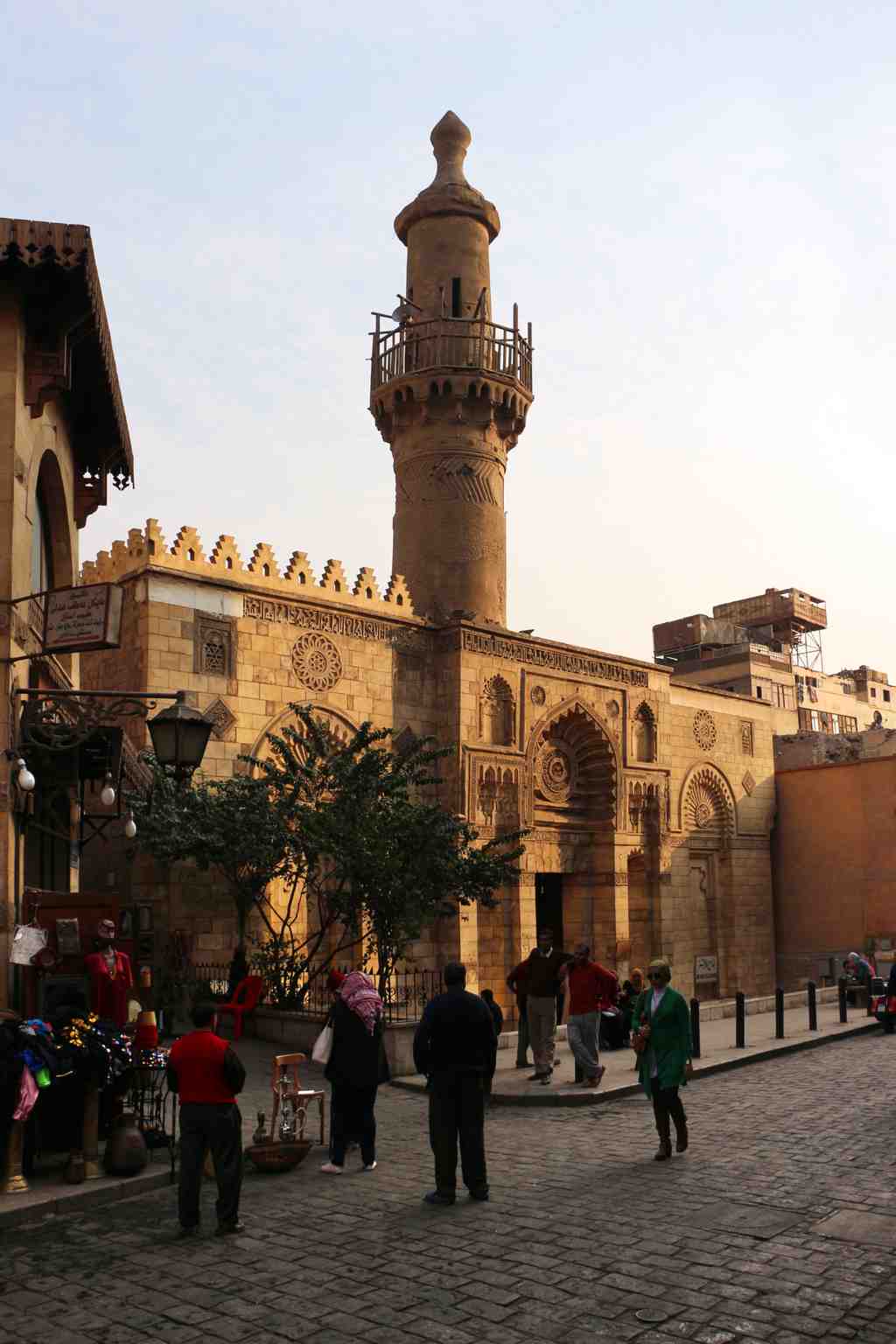
To spot the Aqmar Mosque, just look for the tall, cylindrical minaret and the dazzling stone façade with rows of beautifully carved arches and a huge shell-shaped niche right above the doorway, all set against the lively backdrop of al-Mu'izz Street.
Right here, at the heart of historic Cairo, you’re standing before the legendary Aqmar Mosque-whose name means “the moonlit mosque.” Imagine Cairo nearly a thousand years ago: bustling markets, the footsteps of people on cobblestone, and the aroma of spices swirling in the air. It’s 1125, and the city’s main avenue is alive with whispers of intrigue and power. Vizier al-Ma'mun al-Bata'ihi, a man who once struggled in poverty and learned building skills from humble jobs, decides to leave his mark on history-not just any mark, but a masterpiece of light and stone.
He picks this exact spot, once the ceremonial and palatial heart of Fatimid Cairo, to build the Aqmar Mosque-a beacon for the neighborhood and the mighty palace next door. You’ll notice that the façade in front of you isn’t just beautiful; it’s groundbreaking. For the first time in Cairo’s history, a mosque’s entrance has been carefully angled to line up perfectly with the street while the inside still faces Mecca. The architects had to change the thickness of the walls just to pull off this trick. Clever, isn’t it? If only assembling IKEA furniture were this inspiring.
Its exterior decoration is a riot of faceted textures, niches, and geometric patterns. Fatimid symbolism is everywhere you look-huge medallions inscribed with the names “Muhammad” and “Ali,” surrounded by Qur'anic verses meant to legitimize their rule and remind everyone, “Hey, we’re the real deal!” Above the doorway, the spectacular shell-shaped recess almost feels like a theatrical curtain ready to lift.
But listen closely, and you’ll hear not just the stories of power, but the drama that clings to these stones. Vizier al-Ma'mun, soon after completing this mosque, would be dragged away and executed-his brilliant creation left behind as his only voice. Yet even political storms couldn’t drown out Aqmar’s light. Over centuries, time took bites out of the mosque, its minaret collapsed, and the street rose up, burying the original row of shops that once paid the bills.
The Mamluk amir Yalbugha al-Salimi came along in the 1300s to save the mosque from ruin. He gave it a new minaret and, just for style, added shop stalls to the right of the entrance-imagine buying bread or trinkets right under these gorgeous carvings! Over time, parts of the mosque were restored, replaced, and, sometimes, lovingly criticized-like the 1990s restoration by the Dawoodi Bohras, who brought back parts of the façade but changed some historic details along the way. If you look at the front, the stone on the right is lighter and smoother than the original blocks on your left, like the world’s most ancient “before-and-after” renovation.
Now, pause for a moment and soak in all the details. To your left, there’s a special window grille: a six-pointed star with a lamp dangling in the middle. Scholars still argue about its meaning-some say it’s a symbolic prayer niche, while others claim it’s a nod to royal victory and power grabs, like an ancient version of showing off your team’s trophy.
Closer to the doorway, there are carved panels shaped like doors, alluding to a famous saying: “I am the city of knowledge and ‘Ali is its gate.” Or is it political? They could represent the gates to the caliph’s court, hinting at all the intrigue and ceremonial drama the Fatimid viziers lived through. And if you spot a rosette on the façade, it’s covering up a decorative medallion that was suspiciously removed-no one knows exactly why, but I like to imagine an ancient prankster or maybe just a ruler with a grudge.
Inside, there’s a tranquil courtyard, once surrounded by lively Kufic inscriptions, a place where the sun pours down and footsteps echo softly on cool stone. The original mihrab-the prayer niche-has been replaced a few times, from Fatimid to Mamluk to modern rebuilding. The roof above the aisles has changed too, going from an ancient flat ceiling to shallow brick domes during later restorations. Even the Mamluk minaret you see now is only partly original; the upper section fell in a storm and was replaced.
Every element on this mosque’s face-carved medallions, mysterious grilles, scalloped hoods-tells a story packed with meaning, design, and a little bit of Cairo’s playful mischief. So while you stand here, remember: you’re not just admiring stone. You’re peering into a glittering slice of Cairo’s soul, bright as moonlight, standing strong through centuries of change. And if you linger long enough, you might just catch the echoes of long-gone voices, laughing, debating, and living beneath the moonlit façade of Aqmar.




