
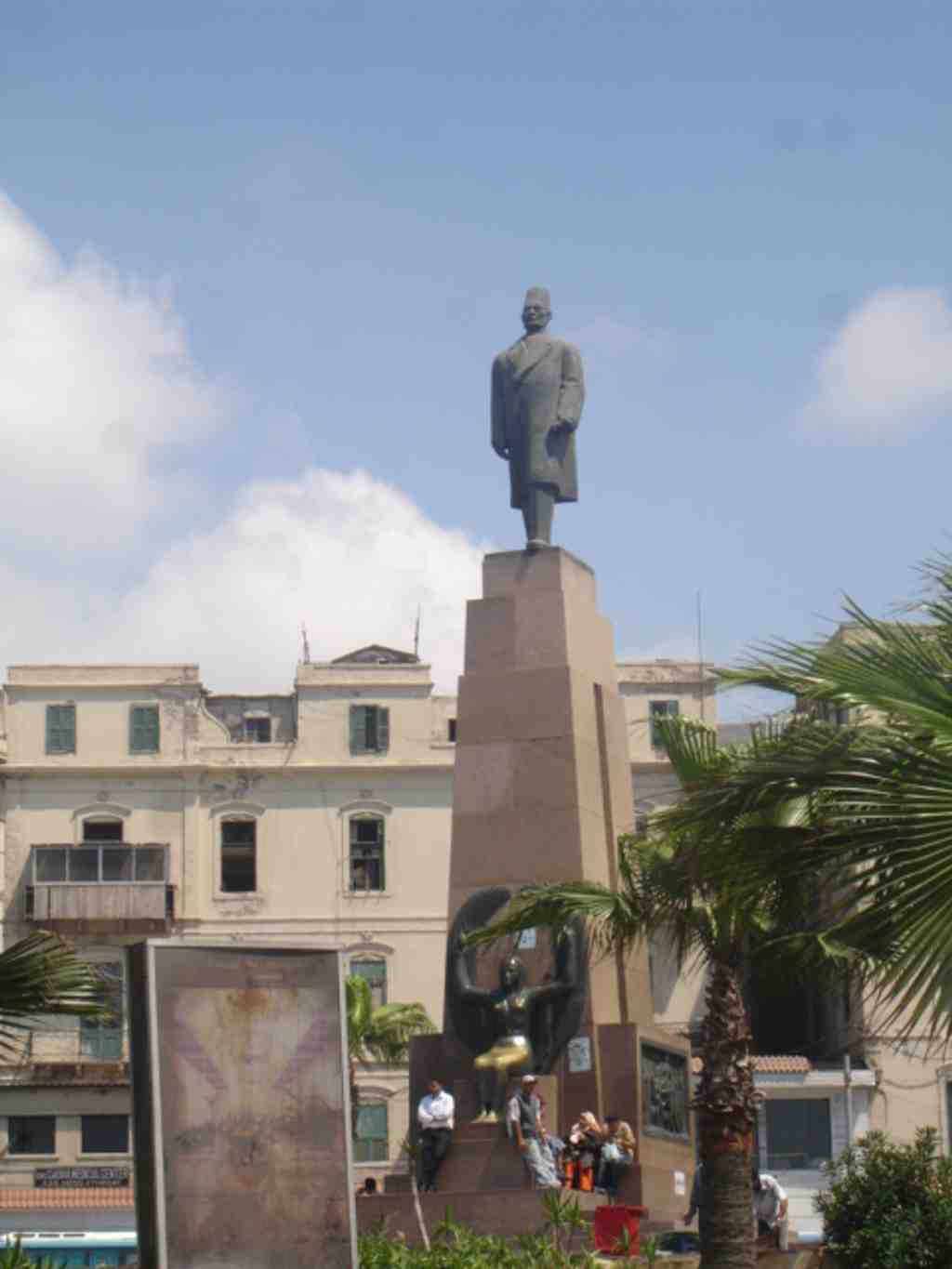
You’ll spot the Caesareum site right in front of you by the tall, stone pedestal topped with a striking statue of a man standing majestically above the crowds-just look for the upraised figure with palm trees swaying nearby and you’re in the right place.
Now, let’s peel back the layers of time! Imagine the ancient city buzzing around you, with the salty Mediterranean breeze swirling through marble columns and the shouts of traders from the distant harbor drifting through the air. Over two thousand years ago, this very ground was chosen by Queen Cleopatra herself, the legendary last pharaoh of Egypt. But Cleopatra wasn’t just here to organize grand parties-she had something far bigger in mind! She wanted to build a monument that would leave Rome’s jaws on the floor, a temple to honor either her great love Julius Caesar… or maybe Mark Antony. Love triangles and ancient politics, always a winning combination!
But here’s where history throws a twist: after Cleopatra and Mark Antony lost their final battle, the victorious Roman emperor Augustus silenced the memory of Antony and-like any good conqueror-dedicated the temple to himself instead. Talk about an awkward housewarming party, right?
As the centuries rolled on, the Caesareum transformed. In the fourth century, it became a Christian church and the power seat of Bishop Cyril, as Alexandria’s skyline began to bristle with church domes instead of obelisks. It also became infamous-right here, the brilliant mathematician and philosopher Hypatia met a tragic and mysterious end at the hands of a mob in 415 AD, a tale of knowledge clashing with fear that still echoes through Alexandria’s stones.
But if you’re looking for Cleopatra’s famous Needles, those ancient obelisks she moved here, you won’t find them-they migrated all the way to New York and London! Instead, today, the statue of Saad Zaghloul, a leader from the 20th century, stands tall where armies, lovers, and philosophers once moved through history. So look up, take a deep breath, and let the echoes of emperors, queens, and revolutionaries mingle in the Alexandrian air with you.




